Cartagena
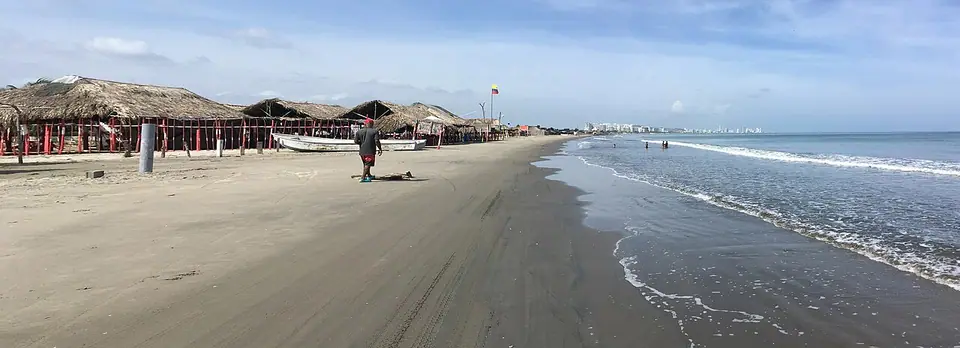
Cartagena pairs a UNESCO walled colonial city with fringe kite beaches to its north: La Boquilla is a working fishing-village strip of beach clubs and schools 15-25 minutes from downtown, Manzanillo del Mar is a quieter, windier, more obstacle-free beach about 20-30km further north.
It suits riders who want a real city plus kiting rather than a self-contained beach village, and who are fine with choppy, non-flat water and a daily commute between bed and launch; it does not suit anyone looking for a flat lagoon or an isolated kite-only base.
Spots and conditions
At La Boquilla. Other spots differ.

Straight-line distances, not roads.
Getting in
Getting in · all the detail
Car · Kite bag rules for your airline
Car
Transfers
Kite bag rules for your airline
Type the carrier you are flying: what it charges for a kite bag, and the year of the policy that says so.
Listed so far for Colombia:Avianca / LATAM (main carriers serving Cartagena/Barranquilla/Riohacha for Cabo de la Vela and Santa Verónica)
Every carrier, with limits and what riders report at the counter →
Cash, phone, health
Cash, phone, health · all the detail
Language · Seasons beyond wind · Health & safety
Health & safety
Before you book
Near-shore water at both spots is choppy, not flat/lagoon-style - this is a wave/chop destination, not a freestyle-flatwater one.
Weekends bring more crowding to La Boquilla than weekdays.
The kite beach and the residential village behind it are different environments; stick to the established beach-club zone.
Things to check before you go (4)
Is 'Cartagena' the name riders actually use for this area?
Specific food dishes/restaurants worth seeking out near La Boquilla beyond kite-school cafes.
Concrete 2026 price points for lodging/food/transfers.
Nightlife specifics in Getsemaní/Walled City relative to a kite trip schedule.
What riders say 8
Through the December-to-April season the wind shows up nearly every day; one long stay from January to late March counted only two days too light to ride.
Most riders agree · 4 ridersThe day starts dead. Nothing much moves before about 11am, it fills in slowly, and the strongest hours are the last ones before sunset.
Most riders agree · 3 ridersShow all 8 claims
The water is chop, not flat. The bay knocks the big swell down but leaves it bumpy, which is fine for freeride and bad news for anyone who came for slick-water freestyle or for waves.
Most riders agree · 3 ridersIt is cheap by Caribbean standards. Private tuition lands somewhere around 35-60 USD an hour, food and beds cost a fraction of what the Guajira spots charge, and beach kids will launch, land and rinse your gear for tips.
Most riders agree · 3 ridersThe public sand at La Boquilla has a hustling problem that is separate from the kiting. Invented beach charges, aggressive touts and at least one armed robbery on the beach turn up repeatedly; the school compounds are described as insulated from it.
Most agree · 4 ridersThe beach strip itself is not where the trip happens. Once the wind drops there is little to do out there and going out at night is discouraged, so the walled city has to carry the evenings.
Most agree · 3 ridersManzanillo blows harder and emptier than La Boquilla and has almost no obstacles, and the price is a longer drive out of town, one school and nothing much around it.
Most agree · 3 ridersHow busy it feels is genuinely disputed. Some describe an empty stretch with room to make mistakes; others describe a beach full of sunbathers that makes launching awkward. Manzanillo is the emptier of the two every time it comes up.
Disputed · 4 ridersMore on the area
Schools
6 schools · 3 IKO6
Pure Kitesurf Colombia
IKO
Doeslessons · rental · downwinders · foil · wing · accommodation
RidesManzanillo
SpeaksEnglish · German · Swiss German · Spanish
purekitesurf.com
En Colombia Kitesurf
Doeslessons · rental · storage · accommodation · camp · wingfoil
RidesLa Boquilla
SpeaksSpanish · English
encolombiakitesurf.com
Nativo Kite
Doeslessons · rental · accommodation · storage
RidesLa Boquilla
nativokite.com
Caribe Kitesurf
Doeslessons
RidesLa Boquilla
Nomad Kitesurf Colombia
IKO
Doeslessons
RidesLa Boquilla
Tata Kiteboarding (Kitesurf En Cartagena School)
IKO
Doeslessons · wing
RidesLa Boquilla
SpeaksSpanish · English · French
kitesurfencartagenatatakiboardingschool.com
Month by month
Peak February · 15 kn modelled
15 kn modelled monthly average
Strongest modelled monthly average among the spots here; the months riders and schools name are in blue. From a weather model, not from the beach.
Evenings and no-wind days
Vibe · Rider hangouts · Activities · +4 more
- Walled City colonial architecture and boutique shopping (UNESCO World Heritage since 1984)
- Getsemaní street art, music and international food scene
- sunset boat rides
- Beach-club bars along the La Boquilla kite strip
- kite-school on-site restaurants (e.g. Nativo Kite House)
History & trivia
- Cartagena's walled colonial city was founded in 1533 and its fortifications were designated a UNESCO World Heritage Site in 1984, built up as a Spanish silver-export port and slave-trade hub.
- La Boquilla is a historically Afro-Colombian fishing village that has grown a kite/tourism strip on its beachfront while remaining a working community behind it.
Itinerary idea
Scores
Room on the water 9.1 · Safety 8.1 · Beginner friendly 7.9
Scores out of 10, compared with other places.
Scores by trip type
FAQ
The short answers · 4 questions
The short answers
The essentials before the detail
When to come
Dec to Apr
Every spot here is in season then
Number = how many of the 2 spots are in season that month.
Windiest modelled month
February · 14.9 kn · La Boquilla
The month the wind model rates highest; the season above is when riders and schools go.
The month's average wind in February at La Boquilla, the strongest month any spot here models
A weather model's cell over this place, not a station on it. What it holds here is the month's average wind, month by month; it does not count how many days carry a three-hour window at 12 kt.
What it costs
Mid-range
Schools
6
Getting there
1 airport
Permits & rules
2 spots
With rules of their own for permits, zoning or the bathing season, on the spot cards
Where to ride
2 spots
Open Caribbean sandy beach with choppy water and small waves, choppy open water with shallow calm water near shore
Levels across the spots
beginner intermediate advanced
When is the best time to kite near Cartagena?
The main season runs December to April, with the strongest wind at Manzanillo reported in January, February and March.
Which spot should I choose?
La Boquilla is Cartagena's main kite spot, with a wide sandy beach and several schools; Manzanillo del Mar, further north, is quieter, more obstacle-free and generally windier.
Are there kite schools?
Yes, several schools operate at La Boquilla, and lessons are also taught at Manzanillo del Mar.
What is the wind like?
Northeast trade winds typically build from late morning and blow side-onshore through the afternoon.
Last updated: 4 September 2026
Colombia · Local favourite.
Sources (32)
- encolombiakitesurf.com
- kiteguide.com
- kiteguide.com
- kiteready.app
- kitesurftheworld.com
- thecartagena.guide
- booking.com
- hotels-cartagenacolombia.com
- aeropuertocartagena.com.co
- tuaeropuerto.com
- miviajeporcolombia.com
- cartagena.gov.co
- eltiempo.com
- tripadvisor.co
- lahaus.com
- purekitesurf.com
- moovitapp.com
- en.wikipedia.org
- kiteforum.com
- se.kiteforum.com
- kitejungle.com
- tomplanmytrip.com
- tripadvisor.com
- tripadvisor.com
- tripadvisor.com
- tripadvisor.com
- tripadvisor.com
- tripadvisor.com
- tripadvisor.com
- tripadvisor.com
- ikointl.com
- alternativetravelcartagena.com