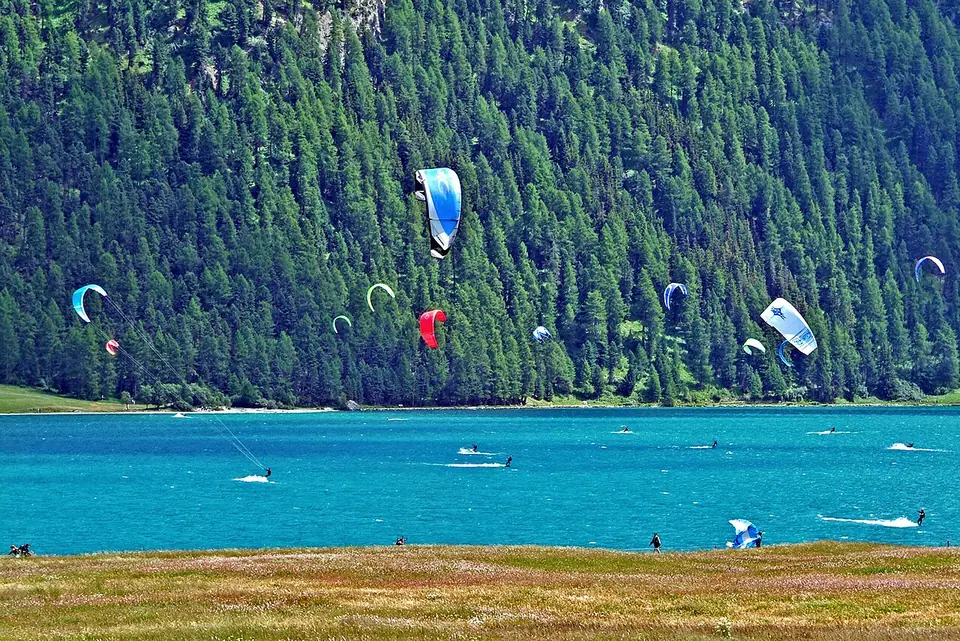
Lake Silvaplana (Surlej)
1Wind and kite size
Go bigger than you would for the same reading at sea level: the air at 1790 m is thin, so…
locals call it Malojawind
Direction
Direction to shore
Side-shore at the kite launch.
Dominant direction
S to SW, especially SW from the Maloja direction
Kite sizes
metres · typical quiver highlighted
The quiver, in words
Go bigger than you would for the same reading at sea level: the air at 1790 m is thin, so 20 kt on the meter still puts a 75-85 kg rider on 9-12 m, and a 10-15 m spread covers the season at that weight. Evening foil sessions get going on 5-8 kt.Indicative, from rider-facing guidance rather than any local measurement.
Character
Average strength
About 11-21 kt on a normal Maloja day (Beaufort 4-5), peaking near 22-27 kt (Beaufort 6) on the strongest ones. Across the season the range works out at about 7-27 kt (Beaufort 3-6), derived from Beaufort rather than measured on the water.
Typical strength
About 4-5 Bft on a normal Maloja day and 6 Bft on the strongest, which works out near 11-27 kt. Afternoon peaks of 20-25 kt between about 3 and 5 pm are the figure most often given; a lower 10-18 kt is also quoted for May to September. Foilers start at 5-8 kt in the evening. All of it is derived from Beaufort or from rider guides, not measured on the water.
Forecast
Live forecast
2Where to launch
The official Kitebeach run by Swiss Kitesurf at Sportzentrum Mulets.
three ways on to the water, and what each one asks of you
Launch
The official Kitebeach run by Swiss Kitesurf at Sportzentrum Mulets. Launching or landing anywhere outside that meadow needs landowner and municipal permissions you will not have.
With a school or a boat
1 school works here
On your own
Room to launch: A large grass meadow to rig on, and it gets tight on sunny weekends.
Somewhere else
No nearby spot listed
No other spot in the atlas sits within reach of this one.
3Rules and hazards
2026: follow the municipality's water-sports zones; use only official entries and exits…
Rules & access
1 min read
Water-sports zones
- follow the municipality's water-sports zones; use only official entries and exits;
- Lej Suot and Lej da Champfèr are completely closed to water-sports equipment;
- kitesurfing is also prohibited inside the buoy-marked windsurfing training zone;
- Kitebeach access requires the member fee or day pass to Swiss Kitesurf plus proof of VDWS level 4 or IKO level 3J and Swiss liability insurance that covers kitesurfing, with 2026 rates of CHF 15 for a day, CHF 50 a week, CHF 80 a month and CHF 100 for the season;
- Beach Marshall instructions must be followed;
- private teaching is prohibited and the kitesurf school zone is reserved for Swiss Kitesurf;
- launching or landing outside the Swiss Kitesurf meadow is forbidden without landowner and municipal permission;
- buoyancy aids are mandatory from 300 m offshore;
- boards must be marked with name and address;
- motorized water-sports devices are prohibited.
Access rules drift faster than anything else we hold — check locally, and propose an edit if this has changed.
4Schools and rescue
1 school rides here. 2026: lake rescue comes from Swiss Kitesurf and Windsurfing…
Rescue
Rescue — full text1 min read
1 school rides here
5If it is not working here
Nothing within 40 km. Corvatsch, the Freestyle Garden at Sportzentrum Mulets, and hiking in the…
Nothing else within 40 km. The wind here is the wind you get.
Corvatsch, the Freestyle Garden at Sportzentrum Mulets, and hiking in the Engadin. In winter the frozen lake takes snowkiting, cross-country skiing, walking trails and skating when the ice allows.
Riding essentials
Season
May–Oct
Best months
How windy
11-27 kt
Character: thermal
Room to launch
A large grass meadow to rig on, and it gets tight on sunny weekends.
rules and access below
Water
flat/chop
7–21 °C in summerAn alpine lake at about 1790 m
Hazards
7
Reported by riders
Level
Beginner to advanced
With a caveat: see Your level
Crowds
high crowds · busy Jun Jul Aug Sep
Schools
1
working here
From the airport
273 min
Zurich Airport (ZRH)
When it fills in
Rideable for twintips from about 1 pm on a normal day, and from around 11 am in July and August. It peaks roughly between 3 and 5 pm, then fades from 6 to 7 pm as the sun drops behind the mountains.
The spot
Silvaplana runs on the Malojawind, a thermal S/SW that comes up from the Maloja direction…
Season
Water and safety
Regulations
The water
Flat/chop. 5/4 mm wetsuit commonly recommended; cold alpine water even…
Type
flat/chop
Standing depth
false
Tides
false
Temperature
7–21 °C summer · 1 °C winter
Wetsuit
5/4 mm wetsuit commonly recommended; cold alpine water even in summer.
Conditions
Who it suits
All levels. Lessons cover beginners as well as advanced riders, but…
Your level
The scene
What riders come here for
Month by month
May–Oct. Modelled 7–9 kn across the year.
- Jan
- Feb
- Mar
- Apr
- May
- Jun
- Jul
- Aug
- Sep
- Oct
- Nov
- Dec
riding season given for this spot · no wind series here is reliable enough to name a season
- Jan2
- Feb2
- Mar6
- Apr2
- May, riders' month0
- Jun, riders' month2
- Jul, riders' month0
- Aug, riders' month5
- Sep, riders' month0
- Oct, riders' month3
- Nov7
- Dec6
windy days per month (3 h+ at 12 kn+)
Ringed months are the best ones according to riders and schools: May, Jun, Jul, Aug, Sep, Oct.
Our wind model misses this spot's wind
The model puts wind on only 7% of days, even in its best month, which does not match the season and the wind strength riders and schools report here. That is why the bars are hatched instead of coloured: go by the ringed months, the ones riders name.
Modelled from the operational forecast archive at 1.5–7 km (2023-2024), daylight hours only, not a ground station: it resolves thermal, lake and valley winds far better than coarse reanalysis but still tends to understate a strong local thermal.
Every figure, month by monthWindy days · Force 4+ · 12 kn or more · Knots · Wind from · Peaks at · Air · Readings
| Month | Windy days | Force 4+ | 12 kn or more | Knots | Wind from | Peaks at | Air | Readings |
|---|---|---|---|---|---|---|---|---|
| Jan | 2% | 15% | 10% | 7.5 kt | SW | 15:00 | -5.2 °C | 62 |
| Feb | 2% | 7% | 7% | 6.6 kt | NE | 15:00 | -3.2 °C | 57 |
| Mar | 6% | 21% | 15% | 8.3 kt | SW | 15:00 | -1.6 °C | 62 |
| Apr | 2% | 17% | 8% | 8.1 kt | SW | 15:00 | 0.2 °C | 60 |
| May | 0% | 2% | 0% | 7.1 kt | SSW | 15:00 | 5.9 °C | 62 |
| Jun | 2% | 17% | 8% | 8.7 kt | SW | 15:00 | 10.3 °C | 60 |
| Jul | 0% | 34% | 8% | 9.4 kt | SSW | 15:00 | 12.9 °C | 62 |
| Aug | 5% | 23% | 13% | 9.2 kt | SSW | 15:00 | 12.6 °C | 62 |
| Sep | 0% | 8% | 7% | 8.2 kt | SSW | 15:00 | 7.1 °C | 60 |
| Oct | 3% | 8% | 8% | 7.8 kt | SW | 14:00 | 5.4 °C | 62 |
| Nov | 7% | 18% | 12% | 7.8 kt | SW | 14:00 | -1.5 °C | 60 |
| Dec | 6% | 13% | 13% | 7.5 kt | NW | 12:00 | -4.4 °C | 62 |
About these figuresriders' months · 2023-2024
These are the best months according to riders and schools. The wind model reads lower here, so both are shown rather than averaged.
A windy day has at least three consecutive daylight hours at 12 knots or more. The typical daily max and the direction are columns of the table above, month by month. Highlighted months are the riding season given for this spot.
High-resolution weather model (modelled) · Open-Meteo historical forecast archive — best-match operational model (ICON-D2 / AROME / ICON-EU / GFS by region), not a ground station · 2023-2024
Rider tips
Sign in at the school before you rig: the day pass, the level proof and the zone plan all…7
- Sign in at the school before you rig: the day pass, the level proof and the zone plan all get checked.
- Rig for cold water and the thin air at 1790 m; the models tend to under-read the Maloja thermal.
- Treat northerly wind as a no-go unless the school or the Beach Marshall tells you otherwise.
- Wear a helmet in the shore zone; there are stones in it.
- Wrap your lines when you are off the water and keep the shore path clear for walkers and cyclists.
- At 20 kt on the meter, plan on 9-12 m at 75-85 kg. Altitude eats the power you would expect from that number at sea level.
- A day pass is CHF 15 in 2026 and the whole season is CHF 100, so a week of riding is worth pricing before you pay per day.
Getting there
Zurich Airport (ZRH) is the routing most people use; the Milan-area airports are closer on…
Airport
Zurich Airport (ZRH) is the routing most people use; the Milan-area airports are closer on the map but are not the practical public-transport option.
Route
Train to St. Moritz, then the bus to Silvaplana/Surlej. In summer and winter a free electric shuttle runs between Silvaplana and the Corvatsch cable car at Surlej when it is operating.
Transfer
273 min
Staying
Stay in Silvaplana, Surlej, Sils or St. Moritz; more than 1500 places are listed within reach of Silvaplana.
FAQ
When is the best time to kite at Lake Silvaplana?5
When is the best time to kite at Lake Silvaplana?
The usable thermal window runs roughly mid-May to mid-October, with the kite school season running end of May to beginning of October.
Is Lake Silvaplana suitable for beginners?
Yes with lessons, Swiss Kitesurf teaches beginners through advanced riders, but independent freeriders must hold a VDWS level 4 or IKO level 3J certificate plus insurance.
What is the wind like?
The Malojawind is a thermal S/SW wind that usually builds from late morning to early afternoon and is strongest in the afternoon, typically 4-5 Beaufort with peaks near 6.
Are there rules or permits required?
Yes, riders need Swiss Kitesurf membership or a day pass, proof of level and insurance, and must use only official entry and exit points within marked zones; buoyancy aids are mandatory from 300 m offshore.
What are the hazards?
The lake gets deep quickly from shore, water is cold even in summer, and north wind is considered dangerous and unsuitable for kitesurfing.
Photos
1

On this page
Lake Silvaplana (Surlej) has no other spot on this map within 40 km of it. straight-line distance
Grisons · Surlej, SW shore of Lake Silvaplana · Maloja. also known as Silvaplanersee, Lej da Silvaplauna, Lake Silvaplana
Last updated: August 2026
Sources (31)
- en.wikipedia.org
- de.wikipedia.org
- openstreetmap.org
- kitesailing.ch
- kitesailing.ch
- kitesailing.ch
- gemeinde-silvaplana.ch
- silvaplana.ch
- silvaplana.ch
- silvaplana.ch
- engadin.ch
- engadin.ch
- kitesailing.ch
- kitesurftheworld.com
- iksurfmag.com
- seatemperature.net
- alplakes.eawag.ch
- hydrodaten.admin.ch
- rome2rio.com
- en.wikipedia.org
- de.wikipedia.org
- weather.gov
- reddit.com
- reddit.com
- reddit.com
- reddit.com
- reddit.com
- oaseforum.de
- se.kiteforum.com
- reddit.com
- open-meteo.com
Map›Switzerland›Lake Silvaplana (Surlej)Switzerland