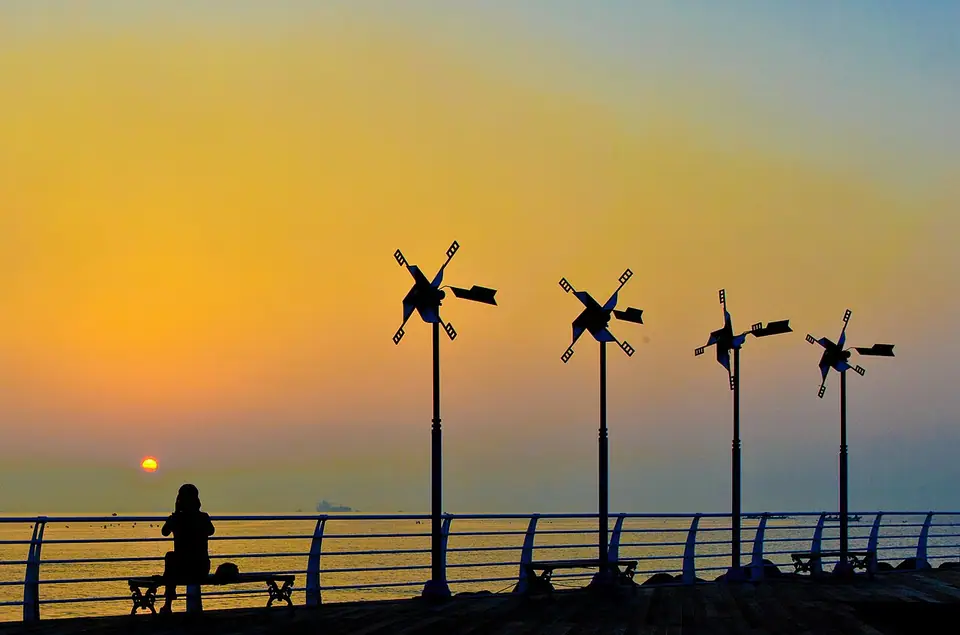
Jinha Beach
1Wind and kite size
For a 75-85 kg rider the working range sits large: 14-17 m on an ordinary northeast spring…
locals call it NE spring/fall wind
Direction
Direction to shore
The beach runs north-northeast to south-southwest with the sea to the east, so east is straight onshore. Northeast, which carries most of the autumn wind days, arrives cross-onshore and firms up towards the north end by Myeongseondo.Southwest, the summer direction, has an offshore component and pushes anything adrift out into open water. Northwest and west-northwest, the strongest winter pattern, are straight offshore.
Dominant direction
Northeast in spring and autumn - about a third of windy daytime hours in autumn - southwest and south-southwest through summer, and northwest to west-northwest in winter. Only the northeast band is usefully cross-onshore.
Kite sizes
metres · typical quiver highlighted
The quiver, in words
For a 75-85 kg rider the working range sits large: 14-17 m on an ordinary northeast spring or autumn day, 18-20 m or a foil when it is under 12 kt, and 9-12 m only when a winter front or a typhoon edge lifts it past 20 kt.
Character
Average strength
Monthly averages run roughly 7-11 kt, highest in winter and early spring and in December; the windy-day count behind that uses at least 4 Bft/12 kt.
Typical strength
8-20 kt on NE riding days; check forecasts for each session.
Forecast
Live forecast
2Where to launch
Sandy public beach in front of Jinha-ri: long open shoreline, a short walk from the car…
three ways on to the water, and what each one asks of you
Launch
Sandy public beach in front of Jinha-ri: long open shoreline, a short walk from the car, with restrooms and parking behind. Length is given as anywhere between 1 and 2 km.
With a school or a boat
1 school works here
On your own
Room to launch: huge
Somewhere else
1 spot nearby
3Rules and hazards
2026: Jinha Beach opened 26 June and closed 31 August, 67 days, with free showers…
Rules & access
1 min read
Access rules drift faster than anything else we hold — check locally, and propose an edit if this has changed.
4Schools and rescue
1 school rides here. The Jinha coast guard substation keeps a coastal rescue boat and is…
Rescue
1 school rides here
5If it is not working here
Songjeong Beach 26 km. Myeongseondo Island media-art night walk, Ganjeolgot…
Myeongseondo Island media-art night walk, Ganjeolgot Lighthouse/cape, Seosaengpo Japanese Fortress area, Jinha summer festivals, Ulsan city food/nightlife, and regional attractions such as Jangsaengpo Whale Museum and Taehwagang Bamboo Forest.
Backup spots Where riders go when the wind doesn't work here.
- Dadaepo Beach
- Dadepo Beach no page yet
- Chilpo Beach no page yet
- Pohang Beach no page yet
- Jeju-do spots no page yet
 The bigger pictureEverything about Ulju-gun, Ulsan
Riding essentials
Season
Mar, Apr, May, Sep, Oct, Nov, Dec
Best months
How windy
8-20 kt
Character: mixed
Room to launch
huge
rules and access below
Water
mixed
Open-sea chop and small wind-generated waves, flatter near Myeongseondo Island where the islet gives some shelter
Hazards
13
Reported by riders
Level
Intermediate to advanced
With a caveat: see Your level
Crowds
medium crowds · busy Jul Aug Jun
Schools
1
working here
From the airport
Ulsan Airport (USN)
Transfer times under Getting there
fall wind
08:00 · 09:00 · 10:00 · 12:00 · 16:00 · 17:00
A daily build rather than a steady breeze. Lightest from midnight to about 08:00, filling in from 09:00-10:00, best between 12:00 and 16:00, then falling away quickly after 17:00. Across a five-year average the mid-afternoon runs about 2.5-3 kt above dawn, which is most of the difference between a session and a swim on a marginal day. Winter fronts and typhoon-edge wind ignore the cycle and blow at any hour.
The marks are the clock times given for this spot, placed on a 24-hour day. The bar between the first and the last covers those hours; it is not a promise of wind.
The spot
Jinha is a real kite and windsurf beach on the southeast coast of South Korea, at Jinha-ri…
The water
Mixed. A wetsuit is recommended from October until late May, with…
Type
mixed
Standing depth
The public swimming beach is shallow and calm, with water reported to get gradually deeper; no kite-specific standing-depth limit is confirmed.
Tides
Riding is tide-independent.Myeongseondo, the islet in front of the beach, was once reachable only at low water; a bridge now opens it at any state of the tide, so expect walkers and sightseers on and around it whenever you ride the north end.Tide predictions are derived from the Ulsan station about 15 km north-northeast, so local timings can drift.
Temperature
Summer (°C) Ulsan August average about 26.2 °C, with 26.4 °C measured at the beach itself. A 2024 cold-water event reportedly dropped Jinha to about 13.1 °C in late July, so upwelling can be exceptional.
Winter (°C) Ulsan winter average about 14.4 °C, with February around 13 °C.
Wetsuit
A wetsuit is recommended from October until late May, with thick neoprene in winter; summer is shorts/shorty territory unless a cold-water event occurs.
Currents
Downwind drift is the known risk: in May 2026 a windsurfer whose rig failed in a 12-14 m/s southwesterly with a 1.5 m sea was carried out into open water before a rescue boat reached him, and an earlier case turned on fatigue alone. Southwest and the winter northwesterlies are the directions that take you away from the beach.
Conditions
Who it suits
Not for beginners. Intermediate and expert.
Your level
not for beginners here
The scene
What riders come here for
Month by month
Sep–Dec. Modelled 8–12 kn across the year.
- 12 ktJan
- 12 ktFeb
- 11 ktMar
- 10 ktApr
- 9 ktMay
- 8 ktJun
- 9 ktJul
- 9 ktAug
- 10 ktSep
- 10 ktOct
- 11 ktNov
- 12 ktDec
avg knots per month · season highlighted
Modelled monthly averages. Highlighted: the best months according to riders and schools (May, Oct, Mar, Dec, Apr, Sep, Nov).
Modelled from weather reanalysis on a 10–25 km grid (1980-2016), not a ground station: reliable for trade and synoptic winds, understates thermal sea breezes and valley winds.
Every figure, month by monthKnots · Wind from · Air
| Month | Knots | Wind from | Air |
|---|---|---|---|
| Jan | 12.2 kt | W | 1.7 °C |
| Feb | 11.6 kt | W | 3.9 °C |
| Mar | 10.8 kt | NE | 7.8 °C |
| Apr | 10.1 kt | NE | 13.3 °C |
| May | 9 kt | E | 17.8 °C |
| Jun | 8.3 kt | E | 21.7 °C |
| Jul | 8.9 kt | E | 25 °C |
| Aug | 9 kt | E | 25.6 °C |
| Sep | 9.6 kt | N | 21.1 °C |
| Oct | 9.6 kt | N | 16.1 °C |
| Nov | 10.6 kt | N | 10 °C |
| Dec | 11.8 kt | W | 3.9 °C |
How this is modelledmodelled · 1980-2016
A weather model's cell over this place, not a station on it. Good for comparing places, weaker for one beach.
A station this far away — often inland or at an airport — can understate accelerated local wind. The typical daily max and the direction are columns of the table above, month by month. Highlighted months are the riding season given for this spot.
Ulsan Airport (RKPU) (Weather Spark model) · weatherspark.com (MERRA-2 reanalysis) · 1980-2016
Rider tips
Come in May or October for the northeast, and come for the middle of the day: it peaks…6
- Come in May or October for the northeast, and come for the middle of the day: it peaks between midday and 16:00. September to November is when northeast turns up on about a third of the windy hours.
- Bring 14-20 m. Average wind is modest and most days you will be on the big kite.
- For NE, walk to the north end near Myeongseondo where it goes more sideshore, and expect sightseers on the islet whatever the tide is doing.
- Check the Coast Guard and Ulju-gun zoning before you launch in the official season; the 2026 Jinha restriction ran 2026-06-26 to 2026-08-31.
- Treat a summer southwesterly as an offshore day: ride with someone, carry a phone in a pouch, and remember 119 is the number that reaches the rescue boat.
- Pack a suit even in midsummer. A cold-water event dropped the sea to about 13.1 C here in late July.
Getting there
Ulsan Airport (USN) is the nearest domestic airport; Gimhae International Airport (PUS)…
Airport
Ulsan Airport (USN) is the nearest domestic airport; Gimhae International Airport (PUS) near Busan is the practical international gateway.
Route
By car from Ulsan or Busan on highways 7 and 31 - about 21.7 km and roughly 21 minutes from Ulsan, or via Onyang IC. By rail and bus from Ulsan KTX station, take bus 5004 or 1703 to Gongeoptap and change to 1715 for Jinha Beach; from Taehwagang station and the intercity bus terminal, 1715 runs direct. Namchang station plus a taxi also works.ParkingThe Myeongseondo car park at Jinha-ri 76-5 is free during the beach season and is the closest one to the north end; illegal parking is enforced.
Transfer
About 20-25 minutes by taxi/drive from central Ulsan; about 60-70 minutes by car from Gimhae Airport area depending on traffic.
Cost level
medium
Staying
Small beach hotels, motels and pensions around Jinha, with a wider hotel choice in Ulsan city. The beach itself has parking, restrooms and free entry. No kite-specific lodging.
FAQ
When is the best time to kite at Jinha Beach?4
When is the best time to kite at Jinha Beach?
Spring and fall bring the most reliable NE wind, with May and October giving the best sessions; summer is often light and winter can be cold and demanding.
Is Jinha Beach suitable for beginners?
No local kite school or supervised beginner area was confirmed, and the gusty wind and multi-use beach make it better suited to intermediate and advanced riders who can judge marginal conditions themselves.
What is the wind like at Jinha Beach?
The main NE wind blows cross-shore in spring and fall, typically 8-20 knots and gusty, so riders usually bring medium-to-large kites in the 14-20 m range.
Are there rules or restricted zones at Jinha Beach?
During the official beach season from June 26 to August 31, 2026, the Ulsan Coast Guard designated water-leisure prohibited zones at Jinha, with fines up to KRW 1,000,000 for violations, so riders should check the current zoning before launching.
Photos
1

On this page
Ulju-gun, Ulsan · Jinha. also known as Jinha Beach / Ulsan, 진하해수욕장, Jinha Haesuyokjang
Last updated: August 2026
Sources (44)
- kitejungle.com
- web.kite-and-windsurfing-guide.com
- kcg.go.kr
- yna.co.kr
- english.visitkorea.or.kr
- english.visitkorea.or.kr
- english.visitkorea.or.kr
- se.kiteforum.com
- windguru.cz
- windfinder.com
- windfinder.com
- windfinder.com
- windfinder.com
- windy.app
- windy.app
- seatemperature.info
- weather.go.kr
- fnnews.com
- ksaf.org
- investkorea.org
- yna.co.kr
- yna.co.kr
- surfholiculsan.co.kr
- surfholic.co.kr
- 01031121504.ussoft.kr
- rome2rio.com
- rome2rio.com
- taehwaairport.co.kr
- citybus.yohan1002.com
- mapcarta.com
- klook.com
- ulsanonline.com
- tripadvisor.co.kr
- unplug-kitesurf.com
- nominatim.openstreetmap.org
- blog.naver.com
- blog.naver.com
- blog.naver.com
- blog.naver.com
- blog.naver.com
- oleports.or.kr:6005
- archive-api.open-meteo.com
- openstreetmap.org
- weatherspark.com
Map›South Korea›Ulju-gun, Ulsan›Jinha BeachUlju-gun, Ulsan