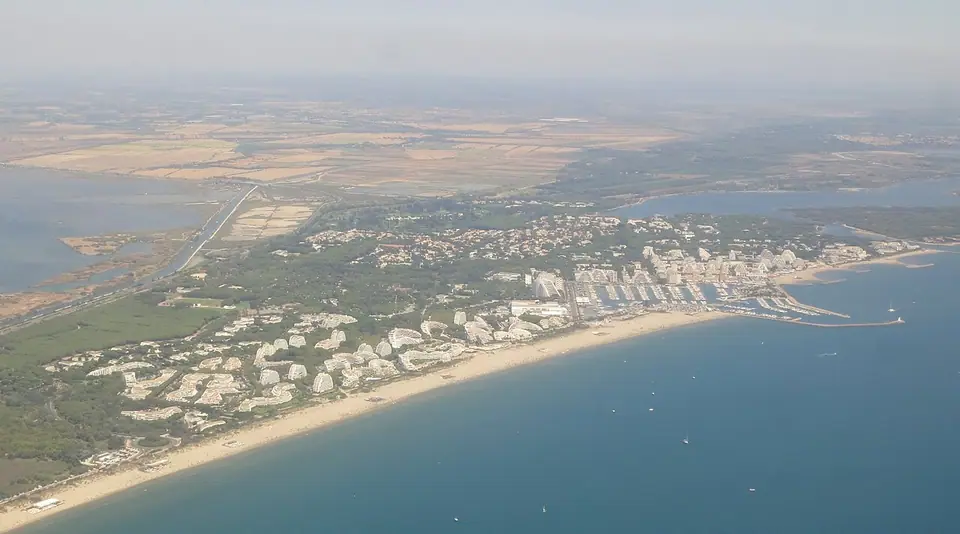
Le Petit Travers
1Wind and kite size
Indicative, derived from the published wind ranges rather than from any local quiver…
locals call it Marin; Thermique
Direction
Direction to shore
Onshore to side-onshore for SE and SW.
Dominant direction
SE and SW are the confirmed working directions. Anything from E through S to a west-sector sea breeze also gets ridden.
Kite sizes
metres · typical quiver highlighted
The quiver, in words
Indicative, derived from the published wind ranges rather than from any local quiver survey: a 75-85 kg rider is on 12-15 m for the 12-16 knot summer thermal, 17 m or a foil on the thinnest afternoons, and 7-9 m when a south-east Marin is at 25-30 knots or more.
Character
Thermal or synoptic
thermal and synoptic
Typical strength
Useful range 12-25 knots. The summer south-west thermal usually settles at 12-16 knots through the afternoon; a south-east Marin is the strong day and runs 25-30 knots and over.
Forecast
Live forecast
2Where to launch
Official kite zone at beach entrances 73 and 74 at Petit Travers: 200 m of linear sand for…
three ways on to the water, and what each one asks of you
Launch
Official kite zone at beach entrances 73 and 74 at Petit Travers: 200 m of linear sand for rigging and launching, 50 m buffer zones either side and a marked departure channel, certified by the French sailing federation.Sandy bottom, very shallow for the first 30 m.Around 500 free parking spaces along the lido road with a seasonal shuttle; the parking has a 2.20 m height barrier, sometimes left open in winter.
With a school or a boat
5 schools work here
On your own
Room to launch: medium but constrained by seasonal users and dune fencing
Somewhere else
6 spots nearby
3Rules and hazards
2021-2026: an official kite zone exists at beach entrances 73 and 74 with 200 m of beach…
Rules & access
1 min read
Access rules drift faster than anything else we hold — check locally, and propose an edit if this has changed.
4Schools and rescue
5 schools ride here. No kite-specific rescue and no safety boat.
Rescue
5 schools ride here
5If it is not working here
Grand Travers 3 km, Palavas-les-Flots 7 km. Montpellier city, Carnon/Palavas beaches, La Grande-Motte…
Montpellier city, Carnon/Palavas beaches, La Grande-Motte, cycling on the lido, Etang de l'Or nature areas, restaurants and wake/foil activities with local schools.
Backup spots Where riders go when the wind doesn't work here.
- La Grande-Motte Zone 60 no page yet
- Les Roquilles Carnon no page yet
- Villeneuve-les-Maguelone no page yet
- Etang de Thau / Pont Levis
 The bigger pictureEverything about La Grande Motte
Riding essentials
Season
Apr–Oct
Best months
How windy
12-25 knots
Character: mixed
Room to launch
medium but constrained by seasonal users and dune fencing
rules and access below
Water
sea
22.4 °C in summerOpen Mediterranean sand beach on the Mauguio-Carnon lido
Hazards
16
Reported by riders
Level
Intermediate to advanced
With a caveat: see Your level
Crowds
high crowds · busy Jun Jul Aug Sep
Schools
5
working here
From the airport
Montpellier Mediterranee Airport
Transfer times under Getting there
When it fills in
The south-west thermal strengthens through the middle of the afternoon and the zone fills up after work; no start or stop hour has been published for the beach.
The spot
Le Petit Travers is Montpellier's kite beach: the official zone at beach entrances 73 and…
Location and zone
Wind
Sessions
Parking
The water
Sea. Summer: shorty or light neoprene; spring/autumn: 3/2 or…
Type
sea
Standing depth
Very shallow over the first 30 m or so out from the sand, on a sandy bottom, then it deepens like any open beach. That shallow strip is where a south-east swell stands up into shorebreak.
Tides
Small Mediterranean tide range, generally not a primary session-planning factor; most Mediterranean tidal ranges run about 20-40 cm.
Temperature
22.4 °C summer · 11.9 °C winter
Modelled monthly average: 12–24 °C
Wetsuit
Summer: shorty or light neoprene; spring/autumn: 3/2 or shorty depending on wind; winter: full suit. Montpellier water temperature runs around 22–23 °C in August and around 12 °C in February, with 3/2/shorty commonly used through much of the shoulder season.
Currents
No persistent tidal current confirmed; there is a current along the beach when the spot works in southeast wind.
Conditions
Who it suits
Not for beginners. The official zone makes the site usable for competent…
Your level
not for beginners here
The scene
What riders come here for
Month by month
Apr–Oct. Modelled 11–14 kn across the year.
- Jan
- Feb
- Mar
- Apr
- May
- Jun
- Jul
- Aug
- Sep
- Oct
- Nov
- Dec
riding season given for this spot · no wind series here is reliable enough to name a season
- Jan32
- Feb26
- Mar40
- Apr, riders' month43
- May, riders' month26
- Jun, riders' month30
- Jul, riders' month29
- Aug, riders' month23
- Sep, riders' month37
- Oct, riders' month37
- Nov33
- Dec35
windy days per month (3 h+ at 12 kn+)
Ringed months are the best ones according to riders and schools: Apr, May, Jun, Jul, Aug, Sep, Oct.
Our wind model misses this spot's wind
The model puts wind on only 43% of days, even in its best month, which does not match the season and the wind strength riders and schools report here. That is why the bars are hatched instead of coloured: go by the ringed months, the ones riders name.
Modelled from the operational forecast archive at 1.5–7 km (2023-2024), daylight hours only, not a ground station: it resolves thermal, lake and valley winds far better than coarse reanalysis but still tends to understate a strong local thermal.
Every figure, month by monthWindy days · Force 4+ · 12 kn or more · Knots · Wind from · Peaks at · Air · Water · Readings
| Month | Windy days | Force 4+ | 12 kn or more | Knots | Wind from | Peaks at | Air | Water | Readings |
|---|---|---|---|---|---|---|---|---|---|
| Jan | 32% | 47% | 44% | 11.1 kt | N | 14:00 | 7.5 °C | 12.4 °C | 62 |
| Feb | 26% | 39% | 35% | 10.5 kt | NNE | 16:00 | 9.6 °C | 12.1 °C | 57 |
| Mar | 40% | 50% | 48% | 14 kt | WNW | 15:00 | 11.7 °C | 13.3 °C | 62 |
| Apr | 43% | 65% | 58% | 14.4 kt | WNW | 16:00 | 14.2 °C | 14.8 °C | 60 |
| May | 26% | 47% | 32% | 11.7 kt | S | 15:00 | 18.4 °C | 17.6 °C | 62 |
| Jun | 30% | 60% | 38% | 12.2 kt | SSW | 16:00 | 22.9 °C | 22.2 °C | 60 |
| Jul | 29% | 50% | 35% | 11.8 kt | SSW | 17:00 | 25.9 °C | 23.5 °C | 62 |
| Aug | 23% | 34% | 27% | 11.1 kt | SSW | 16:00 | 25.4 °C | 23.7 °C | 62 |
| Sep | 37% | 50% | 42% | 12 kt | SSW | 16:00 | 20.5 °C | 22.1 °C | 60 |
| Oct | 37% | 48% | 44% | 12.7 kt | SE | 14:00 | 18.3 °C | 20.2 °C | 62 |
| Nov | 33% | 55% | 48% | 12 kt | N | 12:00 | 12.5 °C | 16.8 °C | 60 |
| Dec | 35% | 47% | 42% | 11.1 kt | NNE | 14:00 | 8.7 °C | 13.2 °C | 62 |
About these figuresriders' months · 2023-2024
These are the best months according to riders and schools. The wind model reads lower here, so both are shown rather than averaged.
A windy day has at least three consecutive daylight hours at 12 knots or more. The typical daily max and the direction are columns of the table above, month by month. Highlighted months are the riding season given for this spot.
High-resolution weather model (modelled) · Open-Meteo historical forecast archive — best-match operational model (ICON-D2 / AROME / ICON-EU / GFS by region), not a ground station · 2023-2024
Rider tips
Stay inside the marked zone at entrances 73 and 74 and use the channel to get out; in…8
- Stay inside the marked zone at entrances 73 and 74 and use the channel to get out; in summer ride beyond the 300 m bathing band.
- Rig well back from the waterline and never leave lines stretched across the walkway; do not stand around with the kite at zenith on the sand.
- Expect people sitting in the kite zone from June to September despite the signage; ask them to move, politely first, then firmly.
- Skip Tramontane and Mistral days here: both are offshore and nobody rides them from this beach.
- Check the 2.20 m height barrier at the parking before you turn in with a van.
- In a southeast Marin expect shorebreak, messy waves and a current along the beach; not the day for a first solo session.
- The first 30 m are shallow sand, so a Marin swell breaks exactly where you are body-dragging back in.
- Lifeguard cover on the Carnon beaches runs 11:00 to 18:30 in the summer season only; an after-work session in April or October has nobody watching the water.
Getting there
Montpellier Mediterranee Airport
Airport
Montpellier Mediterranee Airport
Route
Take the D59 lido road to Carnon Petit Travers and park at beach entrance 74. About 15 minutes from Montpellier on the expressway; the Ride Academy base at Perols is close to the airport and the tram terminus.
Transfer
About 10-20 minutes from Montpellier Mediterranee Airport or central Montpellier depending on traffic and parking.
Cost level
medium
Staying
Beach-resort accommodation is available in Carnon, Palavas-les-Flots, La Grande-Motte and Montpellier; no spot-specific partner accommodation is listed.
FAQ
Is it suitable for beginners?4
Is it suitable for beginners?
No, onshore wind, chop, summer beach crowds and dune-protection posts make it better suited to intermediate and advanced riders.
What is the wind like?
Southeast and southwest Marin and thermal winds are the main working directions; Tramontane and Mistral are offshore here and not rideable.
Are there rules?
As of 2021-2026, an official FFVL-certified kite zone covers 200 m of beach at entrances 73 and 74 with a departure channel and 50 m buffer zones, open all year.
What are the main hazards?
Summer beach users inside the kite zone, wooden dune-protection posts near the line length, and chop or shorebreak in southeast wind.
On this page
Also near here
straight-line distance
Straight-line distances, not roads.
Metropolitan France · Hérault · Carnon-Plage / Mauguio. also known as Carnon Petit Travers, Zone 74, Accès 74, Acces 74, Le 74, Plage du Petit Travers
Last updated: August 2026
Sources (21)
- zoomkite.com
- mauguiocarnontourisme.com
- letskite.fr
- kiteculture.fr
- mauguio-carnon.com
- letskite.ch
- kitesurfmontpellier.com
- kitesurfmontpellier.com
- kiteloopers.com
- montpellierkitesurf.fr
- tiki-center.com
- l-effet-kiteschool.com
- bobkiteschool.fr
- seatemperature.info
- seatemperatures.net
- oceanadventure.surf
- firstclasssailing.com
- lets-kite.com
- mauguio-carnon.com
- windfinder.com
- open-meteo.com
Map›France›La Grande Motte›Le Petit TraversLa Grande Motte