1Wind and kite size
8-12 m for a 75-85 kg rider on a summer day here, down to 8 m once the nortada is over 20…
locals call it Nortada
Direction
Direction to shore
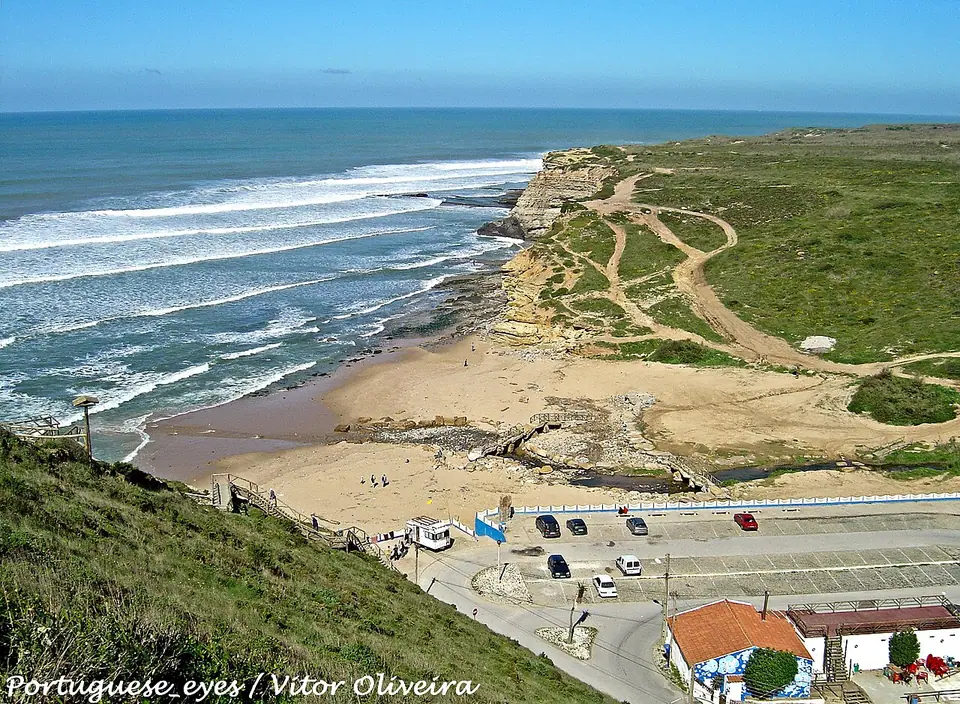
The beach faces roughly west-northwest, so east is straight offshore and the whole southeast-to-northeast band comes off the land. The summer nortada from north to northwest arrives side-shore to side-onshore; northeast is side-offshore and drops down the valley behind the beach in bursts. Derived from the orientation of the break, with no kite-specific measurement.
Kite sizes
metres · typical quiver highlighted
The quiver, in words
8-12 m for a 75-85 kg rider on a summer day here, down to 8 m once the nortada is over 20 knots. Regional numbers for Ericeira, not measured at Ribeira d'Ilhas.
Character
Typical strength
10-25 knots is the working range on this stretch of coast, most of it northerly and northeasterly in the summer months. Regional figure: nothing has been measured at this beach, and the nearest published station has no statistics.
Forecast
Live forecast
2Where to launch
A sandy pocket of about 120 m with rocks at each end.
three ways on to the water, and what each one asks of you
Launch
A sandy pocket of about 120 m with rocks at each end.
With a school or a boat
No school listed here
Nobody is listed as teaching or running a boat here.
On your own
Room to launch: small
Somewhere else
9 spots nearby
3Rules and hazards
No kite rule is known as of 2026-08-27, beyond the standing warnings: little space, rocks…
Rules & access
1 min read
Access rules drift faster than anything else we hold — check locally, and propose an edit if this has changed.
4Schools and rescue
Lifeguard surveillance during the bathing season and a first-aid post.
Rescue
5If it is not working here
Praia do Matadouro 2 km, Praia da Foz do Lizandro 5 km. Surf Ribeira d'Ilhas, walk the cliffs from the beach…
Surf Ribeira d'Ilhas, walk the cliffs from the beach, Ericeira old town and its seafood, Sintra for a day, Lisbon if the whole week is flat.
Backup spots Where riders go when the wind doesn't work here.
- Foz do Lizandro no page yet
- Coxos no page yet
- Algodio / Praia do Norte no page yet
 The bigger pictureEverything about Guincho
Riding essentials
Season
Mar–Sep
Best months
How windy
10-25 knots
Character: mixed
Room to launch
small
rules and access below
Water
ocean
20–22 °C in summer
Hazards
7
Reported by riders
Level
Advanced only
With a caveat: see Your level
Schools
none named here
From the airport
45 min
Humberto Delgado Airport (LIS)
When it fills in
afternoon, on the regional pattern
The spot
Ribeira das Ilhas sits north of Ericeira, a technical wave spot for experts and nobody else.
Technical expert spot
Beach facilities and wind
Alternative spots
The water
Ocean. 3/2 mm in summer if wind is up; 4/3 or 5/4 mm in winter.
Type
ocean
Standing depth
No depth has been measured. The sand pocket is narrow and the bottom outside it is rock and reef that carries enough water to surf at every stage of the tide, so do not plan on standing once you are past the shorebreak.
Tides
The wave works at all stages. For kiting the water is flatter from mid to low tide, and the current along these beaches runs hardest near high water. That tide-and-current pattern is regional for Ericeira rather than measured at this beach.
Temperature
20–22 °C summer · 14–16 °C winter
Modelled monthly average: 15–19 °C
Wetsuit
3/2 mm in summer if wind is up; 4/3 or 5/4 mm in winter.
Currents
Tricky current on the wave, reportedly, and the exposed beaches around Ericeira run strong current near high tide.
Conditions
Who it suits
Advanced only. Expert riders only: rocks, and almost no launch space.
Your level
not for beginners herenot for intermediates here
The scene
What riders come here for
Month by month
Mar–Sep. Modelled 13–14 kn across the year.
- Jan
- Feb
- Mar
- Apr
- May
- Jun
- Jul
- Aug
- Sep
- Oct
- Nov
- Dec
riding season given for this spot · no wind series here is reliable enough to name a season
- Jan68
- Feb62
- Mar, riders' month73
- Apr, riders' month78
- May, riders' month76
- Jun, riders' month76
- Jul, riders' month74
- Aug, riders' month80
- Sep, riders' month54
- Oct62
- Nov64
- Dec65
per cent of the month at force 4 or more
Ringed months are the best ones according to riders and schools: Mar, Apr, May, Jun, Jul, Aug, Sep.
Our wind model misses this spot's wind
The model puts wind on only 80% of days, even in its best month, which does not match the season and the wind strength riders and schools report here. That is why the bars are hatched instead of coloured: go by the ringed months, the ones riders name.
Modelled from weather reanalysis on a 10–25 km grid (2022-2024), not a ground station: reliable for trade and synoptic winds, understates thermal sea breezes and valley winds.
Every figure, month by monthForce 4+ · Knots · Wind from · Air · Water
| Month | Force 4+ | Knots | Wind from | Air | Water |
|---|---|---|---|---|---|
| Jan | 68% | 13.3 kt | E | 12.1 °C | 15.6 °C |
| Feb | 62% | 13.3 kt | ENE | 12.6 °C | 15.2 °C |
| Mar | 73% | 14.2 kt | W | 13.4 °C | 15.1 °C |
| Apr | 78% | 13.7 kt | N | 15 °C | 16.2 °C |
| May | 76% | 14.1 kt | N | 16.9 °C | 16.4 °C |
| Jun | 76% | 13.7 kt | N | 18.5 °C | 18.2 °C |
| Jul | 74% | 13.1 kt | N | 19.8 °C | 18.1 °C |
| Aug | 80% | 13.7 kt | N | 20 °C | 17.2 °C |
| Sep | 54% | 12.6 kt | N | 19.3 °C | 17.6 °C |
| Oct | 62% | 13.4 kt | N | 18.5 °C | 19.2 °C |
| Nov | 64% | 12.7 kt | ESE | 15.7 °C | 18.1 °C |
| Dec | 65% | 13.1 kt | E | 13.1 °C | 16.5 °C |
About these figuresriders' months · 2022-2024
These are the best months according to riders and schools. The wind model reads lower here, so both are shown rather than averaged.
The typical daily max and the direction are columns of the table above, month by month. Highlighted months are the riding season given for this spot.
ERA5 reanalysis grid point (modelled) · Open-Meteo historical weather API — ECMWF ERA5/ERA5-Land reanalysis, not a ground station · 2022-2024
Rider tips
Talk to someone who rides it before you rig; the sand is tiny and the rocks sit at both…6
- Talk to someone who rides it before you rig; the sand is tiny and the rocks sit at both ends.
- Stay off the surf peaks. It is a pointbreak, so the whole wave belongs to the lineup.
- Bring a full suit even in August: 3/2 mm in summer, 4/3 or 5/4 mm in winter.
- Take the regional Nortada numbers as background, not a promise for this launch.
- East and northeast blow off the land and down the valley behind the beach: gusty, side-offshore, and nothing between you and the Atlantic.
- Mid to low tide is the flatter water; near high water the current is at its strongest along this coast.
Getting there
Lisbon Humberto Delgado Airport (LIS)
Airport
Lisbon Humberto Delgado Airport (LIS)
Route
Access by car from Lisbon on the A8, exiting to Mafra on the N116, then following signs to Ericeira and north toward Ribamar.
Transfer
45 min
Staying
Ericeira has hostels, surf camps, Airbnb-style rentals and boutique hotels; restaurant/bar services are available at Ribeira de Ilhas.
FAQ
Is this spot suitable for beginners?4
Is this spot suitable for beginners?
No, it is rated for expert riders only because of the rocks on both sides and the limited roughly 120 m launch space.
When is the best time to kite?
The kitesurf season is listed as March to September, with the regional summer Nortada as the main wind pattern.
What hazards are there?
Rocks, a rock-and-reef bottom, tricky currents, a crowded surf lineup and gusty wind near the cliffs and valleys are all reported.
How consistent is the wind?
No spot-specific kite wind data is published; regional Ericeira guidance says summer northerly wind is rideable but can be gusty near cliffs.
Photos
1

On this page
Also near here
straight-line distance
Straight-line distances, not roads.
Lisbon · Mafra / Ericeira. also known as Ribeira d'Ilhas, Praia da Ribeira de Ilhas
Last updated: August 2026