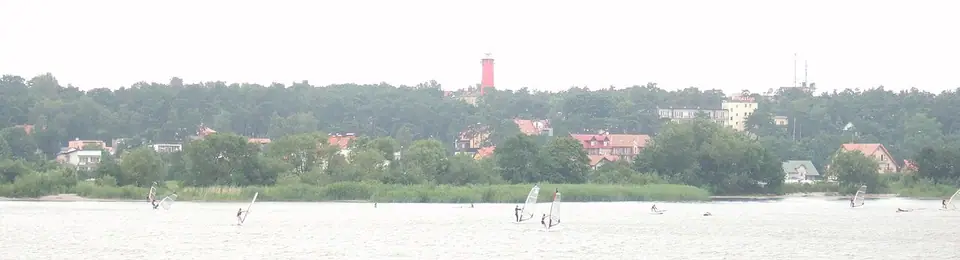
Krynica Morska
1Wind and kite size
May-September wind is generally reliable at 10-25 kt; monthly average wind ranges roughly…
Direction
Direction to shore
Cross-shore on the lagoon's north shore in the dominant westerlies. On the Vistula Lagoon, any direction outside the southerly-to-easterly quadrant counts as comfortable riding wind; southerlies come onshore here and northerlies offshore.
Dominant direction
West for most of the year: predominant from May 28 to October 19 and from November 27 to April 15, north from April 15 to May 28, and south from October 19 to November 27.
Character
synoptic
Average strength
Approx. 9 kt in May, 9.4 kt in June, 9.5 kt in July, 10.0 kt in August, 11.3 kt in September, 12.6 kt in October, 13.3 kt in November, 13.7 kt in December, 14.1 kt in January, 13.0 kt in February and 11.7 kt in March, converted from mph values.
Typical strength
May-September wind is generally reliable at 10-25 kt; monthly average wind ranges roughly 9-14 kt, with stronger averages in autumn/winter than late spring/summer.
Forecast
Live forecast
2Where to launch
The usual launch is the lagoon-side watersports base by the yacht club/port at the end of…
three ways on to the water, and what each one asks of you
Launch
The usual launch is the lagoon-side watersports base by the yacht club/port at the end of ul. Bojerowców: a sandy beach with parking and space to rig. The town also has long Baltic beaches, but no formal kite launch zone is known there.
With a school or a boat
2 schools work here
On your own
Room to launch: ok
Somewhere else
1 spot nearby
3Rules and hazards
2026: official sea bathing areas with monitored water quality are designated in Krynica…
Rules & access
1 min read
Access rules drift faster than anything else we hold — check locally, and propose an edit if this has changed.
4Schools and rescue
2 schools ride here. ActiveZone's Krynica Morska base keeps constant cover on the water…
Rescue
2 schools ride here
5If it is not working here
Kąty Rybackie 14 km. Krynica Morska Lighthouse, Wielbłądzi Garb/Camel's Hump…
Krynica Morska Lighthouse, Wielbłądzi Garb/Camel's Hump viewpoint, Vistula Spit cycling/forest routes, wide Baltic beaches, fishing/port walks, boat trip to Frombork, Elbląg or Malbork day trips.
Backup spots Where riders go when the wind doesn't work here.
- Piaski / Nowa Karczma no page yet
- Kadyny no page yet
- Suchacz no page yet
- Tolkmicko no page yet
- Sopot Sailing Club no page yet
- Hel Peninsula / Chałupy
 The bigger pictureEverything about Mierzeja Wiślana (Vistula Spit)
Part of Mierzeja Wiślana (Vistula Spit) →
Riding essentials
Season
May–Sep
Best months
How windy
10-25 kt
Character: synoptic
Room to launch
ok
rules and access below
Water
mixed
Krynica Morska has sea and lagoon, and waves that run from none to chop
Hazards
7
Reported by riders
Level
Beginner to advanced
With a caveat: see Your level
Crowds
medium crowds · busy July August
Schools
2
working here
From the airport
Gdańsk Lech Wałęsa Airport (GDN)
Transfer times under Getting there
When it fills in
No onset time is published for this spot.
The spot
Krynica Morska sits on the Vistula Spit with water on both sides: the shallow Vistula…
The water
Mixed. A wetsuit for most sessions.
Type
mixed
Standing depth
The Vistula Lagoon is shallow, about 2.5 m on average with plenty of shoals at 1-1.5 m. The small bay used for riding at Krynica runs about 1.5 m, with deeper water only in places close to the shore, so treat it as chest-to-shoulder rather than true standing depth. Beginner lessons start where students can stand, and lessons for the youngest children stay inside 1.2 m.
Tides
Baltic tide is negligible here; on the Vistula Lagoon, NNE-NE wind can raise the Polish-side water level by about 0.7-0.9 m.
Temperature
Summer (°C) Baltic-side figures disagree: August about 18 °C in one set, 19.7 °C average with a 20.5 °C peak average in another.
Winter (°C) Baltic-side winter water is very cold: February about 3 °C in one set, 2.2 °C average with a 1.9 °C minimum in another.
Modelled monthly average: 2–22 °C
Wetsuit
A wetsuit for most sessions. The schools count one as part of the kit, and the Baltic stays cold even in season.
Conditions
Who it suits
All levels. The lagoon side teaches in standing-depth water and suits…
Your level
The scene
What riders come here for
Month by month
May–Sep. Modelled 10–16 kn across the year.
- Jan
- Feb
- Mar
- Apr
- May
- Jun
- Jul
- Aug
- Sep
- Oct
- Nov
- Dec
riding season given for this spot · no wind series here is reliable enough to name a season
- Jan63
- Feb44
- Mar34
- Apr33
- May, riders' month13
- Jun, riders' month33
- Jul, riders' month23
- Aug, riders' month29
- Sep, riders' month25
- Oct56
- Nov60
- Dec65
windy days per month (3 h+ at 12 kn+)
Ringed months are the best ones according to riders and schools: May, Jun, Jul, Aug, Sep.
Our wind model misses this spot's wind
The model puts wind on only 65% of days, even in its best month, which does not match the season and the wind strength riders and schools report here. That is why the bars are hatched instead of coloured: go by the ringed months, the ones riders name.
Modelled from the operational forecast archive at 1.5–7 km (2023-2024), daylight hours only, not a ground station: it resolves thermal, lake and valley winds far better than coarse reanalysis but still tends to understate a strong local thermal.
Every figure, month by monthWindy days · Force 4+ · 12 kn or more · Knots · Wind from · Peaks at · Air · Water · Readings
| Month | Windy days | Force 4+ | 12 kn or more | Knots | Wind from | Peaks at | Air | Water | Readings |
|---|---|---|---|---|---|---|---|---|---|
| Jan | 63% | 84% | 71% | 15.5 kt | SW | 12:00 | 1.5 °C | 1.9 °C | 62 |
| Feb | 44% | 61% | 54% | 13.9 kt | W | 12:00 | 3.1 °C | 3 °C | 57 |
| Mar | 34% | 50% | 40% | 11.6 kt | SSW | 09:00 | 4.4 °C | 4.4 °C | 62 |
| Apr | 33% | 50% | 42% | 11.3 kt | NNE | 12:00 | 7.9 °C | 8.2 °C | 60 |
| May | 13% | 27% | 21% | 9.6 kt | NNE | 15:00 | 13.6 °C | 14.4 °C | 62 |
| Jun | 33% | 43% | 38% | 10.9 kt | NNE | 16:00 | 17.8 °C | 19.7 °C | 60 |
| Jul | 23% | 44% | 39% | 11.2 kt | SW | 12:00 | 18.8 °C | 21.9 °C | 62 |
| Aug | 29% | 40% | 37% | 10.6 kt | SW | 12:00 | 20.2 °C | 21.9 °C | 62 |
| Sep | 25% | 35% | 32% | 10.8 kt | SW | 10:00 | 16.5 °C | 20.1 °C | 60 |
| Oct | 56% | 69% | 66% | 14.4 kt | SW | 10:00 | 11 °C | 13.7 °C | 62 |
| Nov | 60% | 80% | 73% | 14.7 kt | SW | 10:00 | 4.6 °C | 8.3 °C | 60 |
| Dec | 65% | 77% | 71% | 15.4 kt | SSW | 13:00 | 2 °C | 4.3 °C | 62 |
About these figuresriders' months · 2023-2024
These are the best months according to riders and schools. The wind model reads lower here, so both are shown rather than averaged.
A windy day has at least three consecutive daylight hours at 12 knots or more. The typical daily max and the direction are columns of the table above, month by month. Highlighted months are the riding season given for this spot.
High-resolution weather model (modelled) · Open-Meteo historical forecast archive — best-match operational model (ICON-D2 / AROME / ICON-EU / GFS by region), not a ground station · 2023-2024
Rider tips
Read both the Krynica Morska and the Zalew Wiślany forecasts; the sea beach and the lagoon…7
- Read both the Krynica Morska and the Zalew Wiślany forecasts; the sea beach and the lagoon behave differently in the same weather.
- On a first visit, start with a school or base on the lagoon side rather than self-launching from the busy Baltic bathing beach.
- Ask locally where the fishing nets are set before you commit to a long tack across the lagoon.
- Bring a full wetsuit even in summer: August is the warmest month and average water is still only around 18-20 C.
- In north-sector wind, work out whether the lagoon launch turns offshore or gusty before you rig; the more-experienced-rider warning bites hardest on the sea side.
- Ask locally where the fishing nets are set, then read the markers on the water: two flags on the outer poles and one at the centre, or a diamond whose red face is the side the lines are on.
- Wind from the southerly-to-easterly quadrant is the one to think twice about on the lagoon; everything else is normally workable.
Getting there
Gdańsk Lech Wałęsa Airport (GDN)
Airport
Gdańsk Lech Wałęsa Airport (GDN)
Route
Drive from Gdańsk/GDN via the S7/DW501 route to the Vistula Spit; public transport is possible by bus with seasonal limitations, and there are lagoon cruises/ferries such as Krynica Morska-Frombork in season.
Transfer
About 75-90 minutes from GDN by private transfer, around 88-95 km; bus journeys can be much longer and seasonal.
Cost level
medium
Staying
Large summer-resort stock: hotels, guesthouses, apartments, camping/cottages and port/lagoon-side lodging are listed by local and booking sources; July-August is the peak demand period.
FAQ
When is the best time to kitesurf at Krynica Morska?4
When is the best time to kitesurf at Krynica Morska?
The practical Polish kite season runs May to September, though average wind is actually stronger in the colder autumn and winter months.
Is Krynica Morska suitable for beginners?
The lagoon-side base near the port is described as good for beginners with shallow, standing-depth water, while the open Gulf of Gdańsk side is better suited to more experienced riders.
What is the wind like at Krynica Morska?
West is the predominant direction for most of the year, with typical reliable wind of 10-25 knots May to September and stronger average speeds in autumn and winter.
What hazards should riders know about at Krynica Morska?
Fishing nets marked by poles and flags can be set in unexpected places on the lagoon, and NNE-NE wind can raise the lagoon's Polish-side water level by about 0.7-0.9 m.
Photos
1

On this page
Pomeranian Voivodeship · Mierzeja Wiślana (Vistula Spit) · Nowy Dwór Gdański County. also known as Zalew Wiślany (Krynica Morska), Vistula Lagoon Krynica Morska
Last updated: August 2026
Sources (32)
- pomorskie.travel
- pl.wikipedia.org
- windsurfing.pl
- krynica-morska.com
- e-windsurfing.pl
- soulriders.pl
- mierzeja.pl
- windsurfing.pl
- pomorskie.travel
- kitejungle.com
- kitejungle.com
- windguru.cz
- windguru.cz
- windfinder.com
- windfinder.com
- weatherspark.com
- pl.climate-data.org
- bip.krynicamorska.tv
- sk.gis.gov.pl
- hellomierzeja.pl
- hellomierzeja.pl
- krynicamorska.com
- krynicamorska.pl
- krynicamorska.pl
- pomorskie.travel
- mrshuttle.com
- taxiairportgdansk.com
- zegluga.pl
- findingpoland.com
- mapy.com
- mapa.targeo.pl
- open-meteo.com