Map › Guides › Advanced Riding › How to stop plateauing
The Kitesurfing Compendium · Advanced Riding
How to stop plateauing
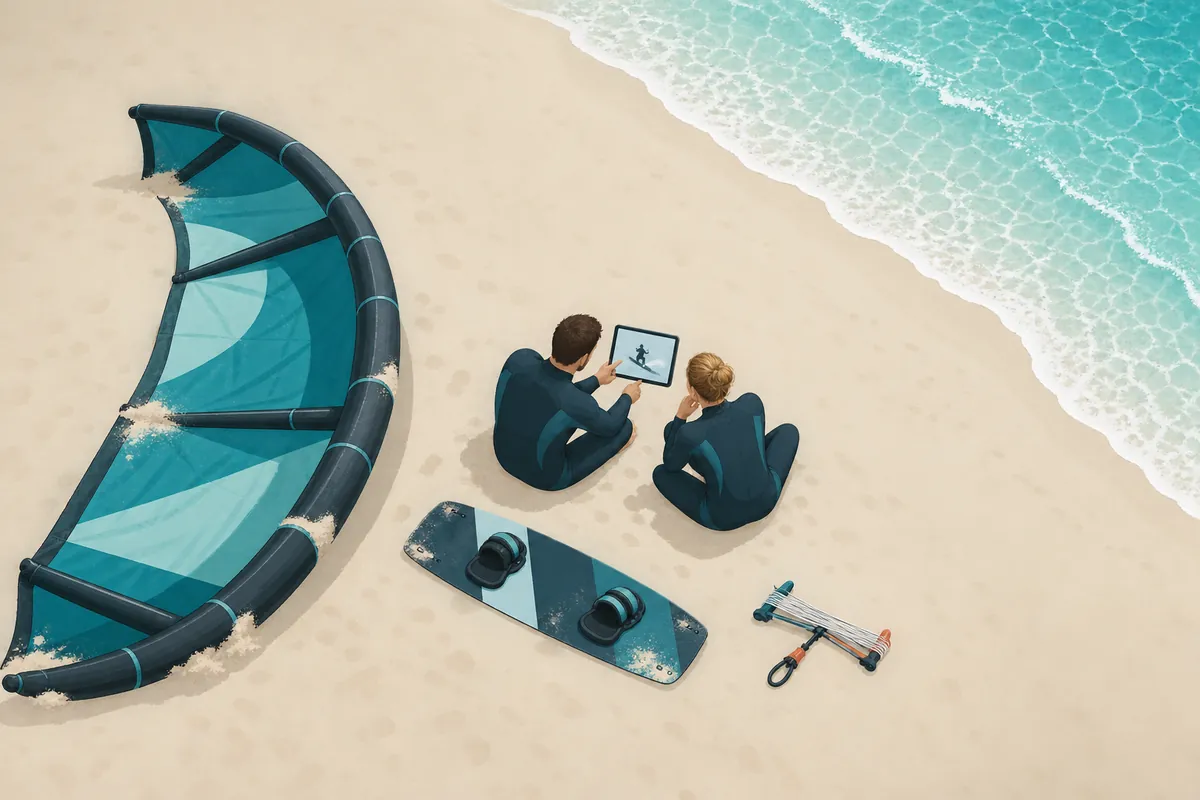
The difference between a rider stuck on jumps and back rolls forever and one who keeps advancing is rarely talent. It is process.
Research the trick like a student. Before a session, watch several different tutorials of the same trick, because every coach points at something different. Watch each one more than once with a single focus per pass: the kite, then the bar, then the body and board, then the timing that links them. Seeing the same movement from several angles is what plants the markers your subconscious reaches for in mid-air.
Visualise deliberately. Before and between attempts, run the whole film: the approach, the send or pop, the body position at the apex, the landing, and the feeling of landing it. Sports psychology applies to kiting the way it applies to anything else. Your body performs what it has rehearsed and believes.
Structure the session. Arrive with two or three target tricks matched to the day's conditions. Light wind means transitions, toeside and unhooked pop; strong wind means boosting and loops.
Attempt new tricks early, while you are fresh, because fatigue is when technique collapses and injuries happen. Commit fully to each attempt: a half-hearted kiteloop is more dangerous than a committed one. When hesitation strikes, use a trigger. Count 3-2-1 and go.
Film and review. A GoPro on a line mount, a helmet or a short pole, shooting 60 fps, or 120 fps for slow-motion analysis, with a horizon-locking lens such as the Max Lens Mod on a Hero 9 or later, turns every session into coaching footage.
Review the same attempt against the tutorial. The gap between what you think you did and what the camera shows is where the fix lives. Video-coaching platforms such as Progression and the North Academy app exist for that loop.
Typical plateaus and their cures
| Plateau | Usual cause | Cure |
|---|---|---|
| "I can ride but can't jump" | Timing or edge: sending the kite while flat, or sheeting in before the edge is loaded | Exaggerate the J-hook carve; practise sent jumps in marginal power, where mistakes are cheap |
| "My jumps stopped getting higher" | Riding too underpowered and sending too slowly | Size up or wait for wind, sharpen the send, hold the edge one beat longer |
| "Stuck at back rolls" | Fear of the front roll's blind phase | Trampoline and land rehearsal, grab mid-rotation to slow the spin, and remember that the head leads the rotation |
| "Unhooked terrifies me" | Usually a trim problem wearing the costume of a courage problem | Re-trim so the kite sits sweet at fixed bar, park it lower, start with straight unhooked pops before any trick |
| General staleness | Same spot, same wind, same three moves | Change the constraint: ride a directional for a month, chase a light-wind foil skill, book a wave or flat-water trip, ride with better riders |
The other way out of a plateau is other people. 479 schools in the atlas run camps, 264 run downwinders and 45 list freestyle coaching, and the school list on each destination page says which is which. A coached week on flat water moves most riders further than a whole season of solo sessions at the home spot.
More from Advanced Riding
The other articles in this chapterThe Fundamentals · Learning the Sport · The Gear · Buying Gear & Keeping It Alive · Tech & Innovation · Wind, Weather & Water · Safety & Risk · When Things Go Wrong · Rules & Etiquette · Advanced Riding · Spots of the World · Practical Tricks & Life Hacks · The Video Library · Field Notes & Extras