All 14 chapters
In this chapter
Each of these has its own pageKitesurfing safety comes down to two questions you answer before you launch: what the wind is doing, and what is downwind of you. Per hour on the water the injury rate is low, but beginners get hurt around sixty times more often than professionals, and the fatal accidents repeat a short list of scenarios. This chapter is that list, plus the quick-release sequence, the self rescue and the pre-flight check. Read it twice.
How dangerous is kitesurfing?
Measured per hour on the water, not very. Studies put the overall injury rate at 5 to 10.5 injuries per 1,000 hours of riding, and about 16.6 per 1,000 hours in competition.
The average hides the part worth knowing: a large retrospective survey found beginners taking around 65 injuries per 1,000 hours against 1.1 for professionals, a sixty-fold gap that has nothing to do with nerve and everything to do with what you know.
The rare severe accident is also a different animal from a twisted ankle. A rider lofted by a squall into a sea wall. A rider drifting out to sea behind a kite that will not relaunch. Those two sentences cover most of the deaths in the sport.
The percentages below come from a worldwide analysis of kiteboarding fatalities between 2000 and mid-2006. That is a twenty-year-old dataset, collected before the push-away quick release became the standard fitting, and whether the proportions still hold in 2026 is unconfirmed. Read them as the shape of the problem, not as this season's numbers.
Getting lofted or dragged on land
The deadliest hazard in kitesurfing is not drowning. It is being lifted ("lofted") or dragged while still on or near land.
The fatality analysis found riders were lofted in 67% of fatal accidents, and that launching (23%) and landing (31%) together accounted for more than half of all deaths: the two minutes when you are standing on hard ground with a powered kite in the air. Insufficient buffer from hard objects was a factor in 65% of cases.
The physics are unforgiving. A 12 m kite in a 35-knot gust can generate several hundred kilograms of pull, and if it is parked at zenith when the gust arrives, that force points straight up. You become a passenger. Riders have been lifted 10–20 m and carried over car parks and roads.
The rules follow straight from the accident data:
- Minimise ground time. Launch, walk to the water, get in. Land, kill the kite, pack up. The beach is not where you stand and chat with a kite in the air.
- Never park the kite at zenith on land. Keep it low, at the edge of the wind window, no higher than about 3–6 m whenever you are within 100 m of the shore or of anything solid.
- Keep two line lengths of downwind buffer. On the 22–24 m lines most bars ship with that is 44–48 m, and make it 100 m when what lies downwind is a wall, a road, a power line or a car park.
- Do not launch near vertical obstacles. Cliffs, buildings and tree lines make rotors and updrafts that loft kites and deliver violent gusts.
Where local rules are strict, this is the moment they target. At De Panne you launch and land only inside the yellow-coned zone at the high-water line, never where a falling kite would come down on the public (2026). The spot page lists the launch corridor and the flag rules.
Which wind directions are safe to kitesurf in?
Side-shore and side-onshore are the working directions. Offshore wind kills quietly; dead-onshore pins you against the beach with no run-off room, and the fatality analysis found onshore wind direction was a factor in 58% of deaths.
Can you kitesurf in offshore wind?
Offshore wind blows from the land out to sea. Close in, the water looks flat and inviting because the land is blocking the waves, and every metre you drift is a metre further from help. Kite down and no relaunch, wind dies, a line snaps: you are heading for the horizon. No offshore wind without organised boat rescue on the water.
Two things get mistaken for the exception. The first is the enclosed lagoon. At Ilha do Guajiru the trade comes in side-onshore over the sandstrip, so a drift carries you across flat water instead of out through an opening; at Dakhla the lagoon wind runs cross-shore, N to NE. That is geography doing the work, not offshore riding.
The second is a spot with a real safety operation: at Icaraí de Amontada one bay-tip centre runs a lifeguard team, safety boats, rescue cars and radio, and that cover belongs to its own clients rather than to the beach. Most spot pages carry a rescue line for this reason. At Tatajuba it reads no lifeguard, no rescue boat, no jet-ski, nearest medical care in Camocim.
The related trap is offshore-gusty wind: air that has crossed land arrives turbulent, with lulls that drop a kite out of the sky and gusts that overpower you seconds later.
Storms and squalls
In the same fatality analysis, squalls or violent weather were a factor in 52% of deaths and gusty wind in 67%. Seasonally, autumn (42%) and spring (27%), the seasons of fast-moving fronts and unstable air, took the large majority, against 17% in summer and 14% in winter.
A squall line can double or triple the wind speed in under a minute and swing its direction 90–180°. A rider happy on a 12 m kite in 18 knots is helpless when 40 arrives. The defence is all anticipation:
- Read the gust figures, not the average. A forecast of 18 knots gusting 30 is a red flag: a spread wider than about 8–10 knots means turbulent air.
- Read the sky. A dark line of cloud upwind, a sudden drop in temperature or an odd calm means land now, not in ten minutes.
- Never launch with cumulonimbus or thunderstorms in the area. Lightning and 22–24 m of wet line is a hazard of its own.
- If it catches you out, ride in early and land; in the worst case, quick-release on the water and self-rescue.
Some places put a number on the judgement call, and the spot page carries it. At De Panne the 2026 regulation lets you go to sea only between sunrise and sunset, only with no red flag flying, and only below 7 Beaufort, 13.9 m/s, about 27 knots.
Along the same coast at Nieuwpoort - Oostduinkerke that ceiling was dropped for 2026 and the call is yours again. The Greek national rules allow riding above Beaufort 6 only with a lifeguard and a motor boat present.
Kitesurfing injuries: impact, collisions, lines, cold and marine life
Shore break and shallow-water impact
Waves dumping onto a steep beach break boards, dislocate shoulders and drive riders head-first into the sand. Most impact injuries come from something duller: crashing at speed in waist-deep water. The commonest kitesurfing injuries in clinical studies are cuts and abrasions (23%), rib injuries (12%), knee ligament injuries (6%), foot and ankle fractures and ligament injuries (about 5% each) and concussion (5%).
Other water users, and other kiters
Collisions are a real share of injuries, and kite lines make them worse: two kites tangling can loop both into power that nobody controls. Give at least 50 m of clear space downwind before you jump, 30 m upwind.
Keep well clear of swimmers, because kiters give way to every other water user, and never assume the rider on the other tack knows the right-of-way rules or will honour them.
Stay out of marked bathing zones, which in many countries is law rather than etiquette. The awkward part is that the number moves: on the Gold Coast three versions of the exclusion circulate and disagree, from 60 m either side of the flags to 200 m offshore before you cross flagged water (2026). Take the widest and read the spot page before you rig.
Lines under tension
Kite lines are Dyneema 1–2 mm thick with a breaking strain of 200–300 kg or more. Under load they behave like a cheese wire, and the medical literature documents deep lacerations, tendon damage and finger amputations.
Four rules cover it: never grab a line under tension; never step over or stand inside your lines or anyone else's; control a kite in wind by the leading edge, never the bridles; and when you help someone launch or land, hold the kite, not the lines.
Cold water and hypothermia
Cold is a slow emergency that takes your judgement first and your hands second, the two things a crisis needs. Below about 35 °C core temperature come confusion, fumbling fingers and lost coordination. A self-rescue that takes 45 minutes in 12 °C water is a survival situation in board shorts and a routine chore in proper neoprene. By water temperature (see the full wetsuit-thickness chart for the finer bands):
| Water temperature | Recommended exposure protection |
|---|---|
| Above ~22 °C | Boardshorts or a shorty |
| 17–21 °C | 3/2 mm fullsuit |
| 12–16 °C | 4/3 or 5/4 mm fullsuit with boots |
| Below 12 °C | 5/4–6 mm suit (or drysuit) plus 5 mm boots, gloves and a hood |
In winter, shorten the session, stay closer to shore, and never ride alone.
Marine life
Statistically the least of your worries, and still worth a paragraph. Jellyfish stings and standing on a weever fish or a sea urchin cause more incidents than anything with teeth.
The stingray shuffle, sliding your feet along the bottom instead of stepping down, prevents most ray strikes in warm shallow water; the Gold Coast spot notes ask for exactly that on the flats beside the sandbanks. Shark incidents involving kitesurfers are vanishingly rare, and the moving board and kite appear to deter rather than attract. Ask the school what lives at the spot.
How the quick release and safety leash work
Modern kite hardware gives you three escape levels, each shedding more power than the last. Every kiter should run through them by reflex, eyes closed, with cold hands. Beginner
- Sheet out: let go of the bar. Counter-intuitive and life-saving. The instinct in panic is to pull the bar in, which powers up the kite. Letting go, or pushing the bar away, flattens the angle of attack and dumps most of the power. In the majority of frightening moments, releasing the bar is the whole solution. Drill it until the instinct reverses: panic = hands open.
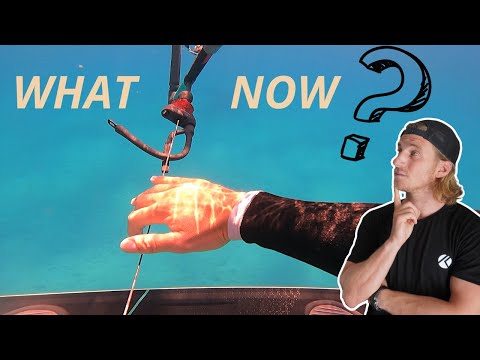
- Fire the quick release on the chicken loop. If sheeting out is not enough, because the kite is looping out of control or dragging you toward an obstacle, fire the quick release. On modern bars it is a push-away collar directly above the loop; it opens the loop and detaches the kite from your harness. The kite stays connected only by the safety leash, which runs to a single front line: it "flags out", presents its edge to the wind and loses effectively all of its power.
- Release the safety leash: the last resort. If even the flagged kite is dragging you into danger, usually a tangle that stops the flag-out or a "death loop" where a wrapped line keeps the kite powered, release the leash and let the whole kite go. You lose a €1,500 kite and bar (2026 prices) and keep your life. This is why IKO teaches attaching the leash to the front of the harness, where both hands can reach it, never behind the back for beginners.
Watch · 2

Should you use a board leash when kitesurfing?
On a twin-tip, no. Tying the board to your ankle or harness looks logical and it is one of the most dangerous things a kitesurfer can do.
When you crash, the kite drags you while the board anchors in the water; the leash stores elastic energy and then slingshots a 2–3 kg board with sharp fins at your head. The documented toll includes facial trauma, skull fractures, brain injury and deaths. Schools and training organisations ban them and manufacturers advise against them.
The complication is that a few places require one, so a flat "never" is wrong. A board leash is mandatory at the Magawish station in Hurghada (2026), and the Greek national regulation lists one as compulsory kit alongside the helmet, harness hook, line-cutting knife and buoyancy vest.
Belgian ordinances attack it from the other end: at De Panne and on the Bruges coast a helmet is compulsory for anyone riding with a board leash (2026). So if a rule or a school demands one, wear a helmet with it and use a coiled reel leash, not a straight line to your ankle. Otherwise the answer stays no. The spot page carries the local requirement with its year.
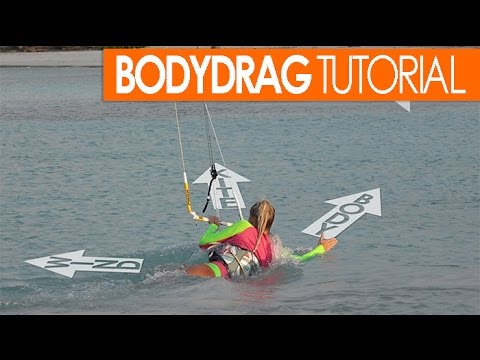
The skill that replaces it is the upwind body drag. Beginner A dropped board drifts downwind more slowly than you do, so you have to drag upwind to reach it.
- Park the kite at about 45°. Hold it at roughly 10 or 2 o'clock and sheet in only enough for a gentle, constant pull.
- Turn your body into a keel. Lie on your side with your leading arm extended slightly upwind and your body rigid, so you track across the wind rather than downwind.
- Tack in short legs. Work upwind in legs of about 7–8 m, turning through the wind between them, keeping the board in sight over your shoulder.
- Bear off and collect. Once the board sits downwind of your track, bear away, drift onto it and take hold.
Every certified course requires this before you are signed off to ride alone. It is not a lesson box to tick; it is your board-retrieval system.
Watch · 3


How to do a kitesurfing self rescue
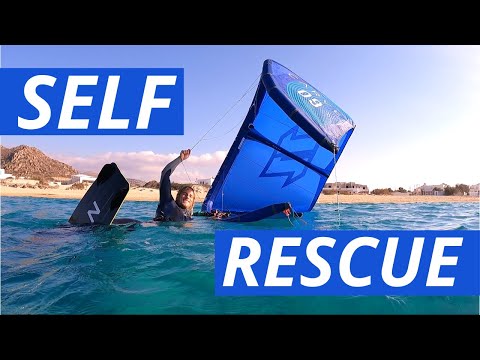
The last skill in the chain: kite down, no relaunch, wind or distance against you. Beginner The self-rescue turns the downed kite into a sail and a raft that carries you home.
- Fire the quick release. Every self-rescue starts here. Riders have drowned trying to swim while still powered up to a half-flying kite. Let it flag out completely on the safety line.
- Climb the safety line. Go hand-over-hand up the safety line only, winding the lines onto the bar as you go so nothing is left loose in the water around you.
- Reach and flip the kite. Get to the leading edge, flip the kite into its resting position and hold on.
- Rig the kite as a sail. Grab the outboard wingtip lines and angle the inflated kite so it catches the wind, sail and raft at once.
- Sail downwind to shore. Steer it to the nearest safe landing, resting on the inflated leading edge when you need to.
Watch · 3


Pre-flight check: what to inspect before every session
Borrow the discipline of aviation: the same checklist every session, in the same order, before the kite leaves the ground. Five minutes.
- Kite. Inflate to the correct pressure and listen for leaks; scan the canopy and leading edge for tears, pinholes, worn stitching. A small tear becomes a mid-session canopy explosion.
- Bridles. Run each bridle from the leading edge to its connection point; check the pulleys run free and no line is wrapped around a wingtip.
- Lines. Unwind and walk the lines, feeling for knots and fraying. Never fly a kite with a knot in a line: it can cut the breaking strength by roughly half. Confirm the four or five lines are equal in length and the connections match, left and red to left and red, nothing crossed.
- Connections. Pigtails and lark's-head knots seated properly, colours matching, no worn pigtails.
- Safety systems. Fire the chicken-loop quick release and reassemble it; check the leash release; confirm the safety line runs free of sand and salt and the bar slides on it without sticking.
- Yourself and the environment. Harness closed, helmet and impact vest on, cutting knife in the spreader-bar slot, and check it is actually in there. Confirm the wind direction, the gust forecast, the tide, what is downwind of you, and who your buddy is.
The golden rules of kitesurfing safety
- Never kite alone. A buddy on the beach who knows your plan is the difference between a story and a statistic. If nobody is around, tell someone ashore your plan and your expected return, and carry a phone in a waterproof pouch.
- Never ride in offshore wind without organised rescue. No exceptions for "just staying close".
- Never ride in squally or thermally unstable weather. Half of all fatalities involved squalls. If the sky looks wrong, it is wrong.
- Respect the distances. Two line lengths, 45–100 m, from anything hard downwind on land; 50 m clear downwind before any jump; a wide berth for swimmers and every other water user.
- Keep the kite low near land. Never at zenith on the beach.
- Know your limits and your gear's limits. Overpowered is not exciting, it is the pre-condition for every lofting accident. When in doubt, take the smaller kite.
- No board leash on a twin-tip. Learn the upwind body drag instead, and where a local rule makes a leash compulsory, wear a helmet with it.
- Take lessons. The 65-versus-1.1 injuries-per-1,000-hours gap is the strongest argument in this book for professional instruction. Of the 1,606 schools in the atlas, 549 list IKO certification and 136 VDWS; the school pages show which.
Do you need kitesurfing insurance?
The risk you are most likely to underestimate is the one you pose to other people. A loose kite cartwheeling down a crowded beach injures bystanders and wrecks property, and you are personally liable. At a growing number of spots, cover is an entry condition.
On the Gold Coast the 2026 local policy asks for public liability cover through a national or international kiteboarding membership, with the tag on your harness; that is a house rule, not state law.
On the Bruges coast it is the ordinance: annual proof of insurance on the harness, the numbered club lycra and proof of kite competence (2026). At Miami, the Crandon Beach pennant requires IKO or PASA level 3 or above plus proof of insurance.
The cover itself is cheap. The German association VDWS sells its SafetyTool membership at €39 a year (2026), with €3,000,000 of third-party cover (2026) for injury and property damage, valid worldwide; it is the de-facto card at many European spots.
The International Kiteboarding Association and the national federations run comparable schemes, and specialist sports insurers add personal-accident and equipment cover. Two things to check before you buy: that kitesurfing is named explicitly, since many household liability policies exclude air sports and traction kites, and that the policy follows you abroad.
What the accident data adds up to
The average fatality in the 2000–2006 analysis was a 39-year-old experienced rider (range 18–61), not a clueless novice. He died near land (54% during launch or landing), lofted (67%), in gusty (67%) or squally (52%) conditions, in autumn or spring (69%), with insufficient buffer from hard objects (65%). Almost nothing there is equipment failure or bad luck. It is experienced people launching in marginal weather, close to hard things.
Which is why the decisions that keep you alive are made on the beach, before the kite leaves the ground: the forecast, the spot, the gear check, the kite size, and walking away when it looks wrong. Everything after that is execution.
Questions riders ask
How dangerous is kitesurfing?
Studies put the overall injury rate at 5 to 10.5 injuries per 1,000 hours on the water. The risk sits at the start: beginners take around 65 per 1,000 hours against 1.1 for professionals, and lessons are what move you along that curve.
What do you do when the kite drags you toward something hard?
Three levels, in order. Let go of the bar, which solves most of it. If that is not enough, fire the chicken-loop quick release and let the kite flag out. If a tangle stops the flag-out, release the leash.
Can you kitesurf in offshore wind?
Not without organised boat rescue on the water. Enclosed lagoons are not the exception people take them for: at Ilha do Guajiru and Dakhla the wind is side-onshore or cross-shore, so a drift crosses flat water. The spot page gives the direction relative to shore and the rescue cover.
Should you use a board leash?
Not on a twin-tip: the board comes back at your head on the elastic recoil, and the upwind body drag replaces it. Where a local rule requires one, wear a helmet with it and use a coiled reel leash.
How do you do a kitesurfing self rescue?
Fire the quick release, climb the safety line hand-over-hand while winding the lines onto the bar, flip the kite at the leading edge, then grab the outboard wingtip lines and use it as a sail and raft to reach shore downwind. Practise it in light wind, shallow water, small kite.
Do you need kitesurfing insurance?
Third-party liability is the one that matters, and some spots check it: the Bruges coast ordinance wants annual proof on your harness, and the Crandon Beach pennant wants proof plus level-3 certification. VDWS SafetyTool runs €39 a year (2026) with €3,000,000 of cover (2026).
Chapter 08 · Part III · Wind, Water & Risk