Map › Guides › Safety & Risk › Should you use a board leash when kitesurfing?
The Kitesurfing Compendium · Safety & Risk
Should you use a board leash when kitesurfing?
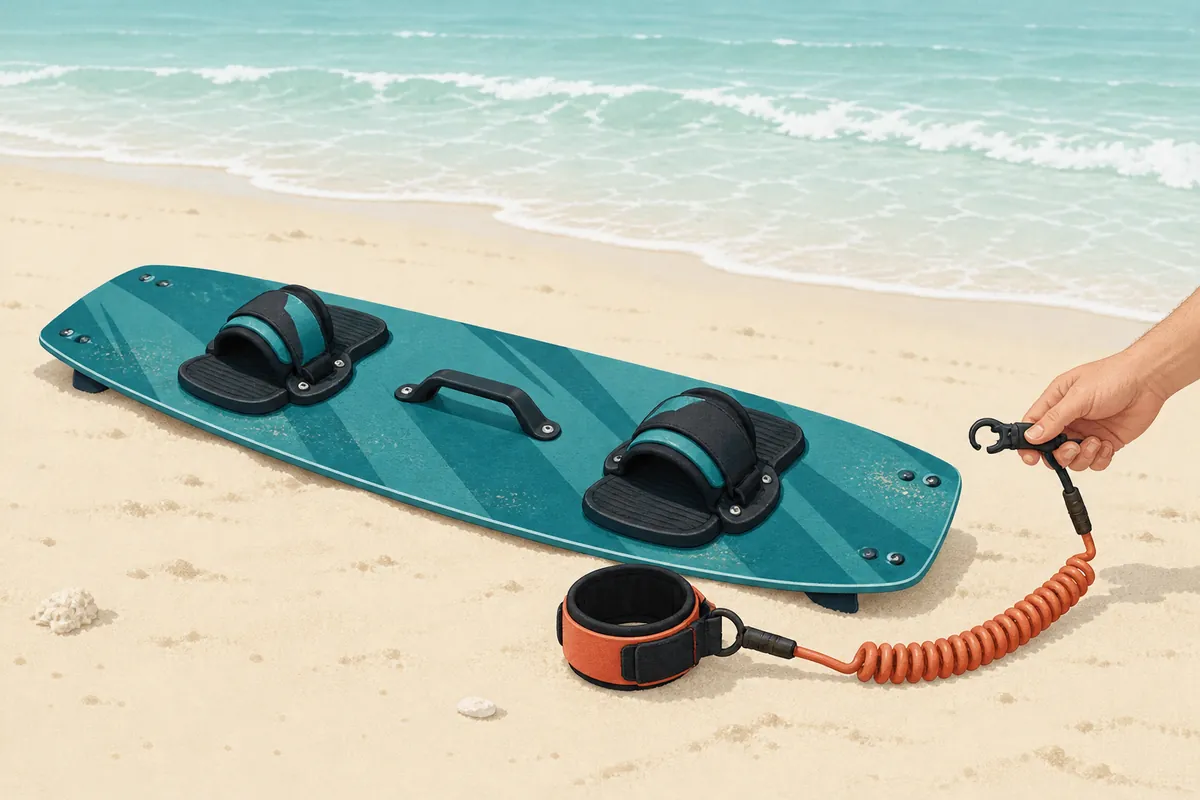
On a twin-tip, no. Tying the board to your ankle or harness looks logical and it is one of the most dangerous things a kitesurfer can do.
When you crash, the kite drags you while the board anchors in the water; the leash stores elastic energy and then slingshots a 2–3 kg board with sharp fins at your head. The documented toll includes facial trauma, skull fractures, brain injury and deaths. Schools and training organisations ban them and manufacturers advise against them.
The complication is that a few places require one, so a flat "never" is wrong. A board leash is mandatory at the Magawish station in Hurghada (2026), and the Greek national regulation lists one as compulsory kit alongside the helmet, harness hook, line-cutting knife and buoyancy vest.
Belgian ordinances attack it from the other end: at De Panne and on the Bruges coast a helmet is compulsory for anyone riding with a board leash (2026). So if a rule or a school demands one, wear a helmet with it and use a coiled reel leash, not a straight line to your ankle. Otherwise the answer stays no. The spot page carries the local requirement with its year.
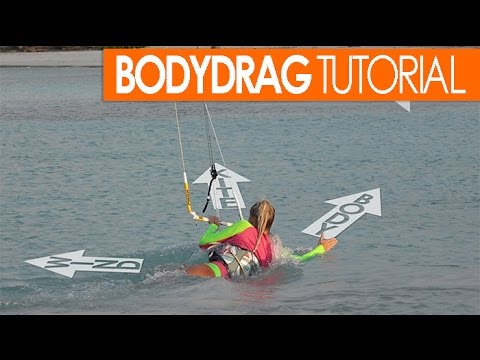
The skill that replaces it is the upwind body drag. Beginner A dropped board drifts downwind more slowly than you do, so you have to drag upwind to reach it.
- Park the kite at about 45°. Hold it at roughly 10 or 2 o'clock and sheet in only enough for a gentle, constant pull.
- Turn your body into a keel. Lie on your side with your leading arm extended slightly upwind and your body rigid, so you track across the wind rather than downwind.
- Tack in short legs. Work upwind in legs of about 7–8 m, turning through the wind between them, keeping the board in sight over your shoulder.
- Bear off and collect. Once the board sits downwind of your track, bear away, drift onto it and take hold.
Every certified course requires this before you are signed off to ride alone. It is not a lesson box to tick; it is your board-retrieval system.
Watch · 3


FAQ
How dangerous is kitesurfing?
Studies put the overall injury rate at 5 to 10.5 injuries per 1,000 hours on the water. The risk sits at the start: beginners take around 65 per 1,000 hours against 1.1 for professionals.
Should you use a board leash?
Not on a twin-tip. The board comes back at your head on the elastic recoil. Where a local rule requires one, wear a helmet with it and use a coiled reel leash.
More from Safety & Risk
The other articles in this chapter- Which wind directions are safe to kitesurf in?
- Kitesurfing injuries: impact, collisions, lines, cold and marine life
- Should you use a board leash when kitesurfing?
The Fundamentals · Learning the Sport · The Gear · Buying Gear & Keeping It Alive · Tech & Innovation · Wind, Weather & Water · Safety & Risk · When Things Go Wrong · Rules & Etiquette · Advanced Riding · Spots of the World · Practical Tricks & Life Hacks · The Video Library · Field Notes & Extras