Map › Guides › Rules & Etiquette › Kitesurfing right of way rules
The Kitesurfing Compendium · Rules & Etiquette
Kitesurfing right of way rules
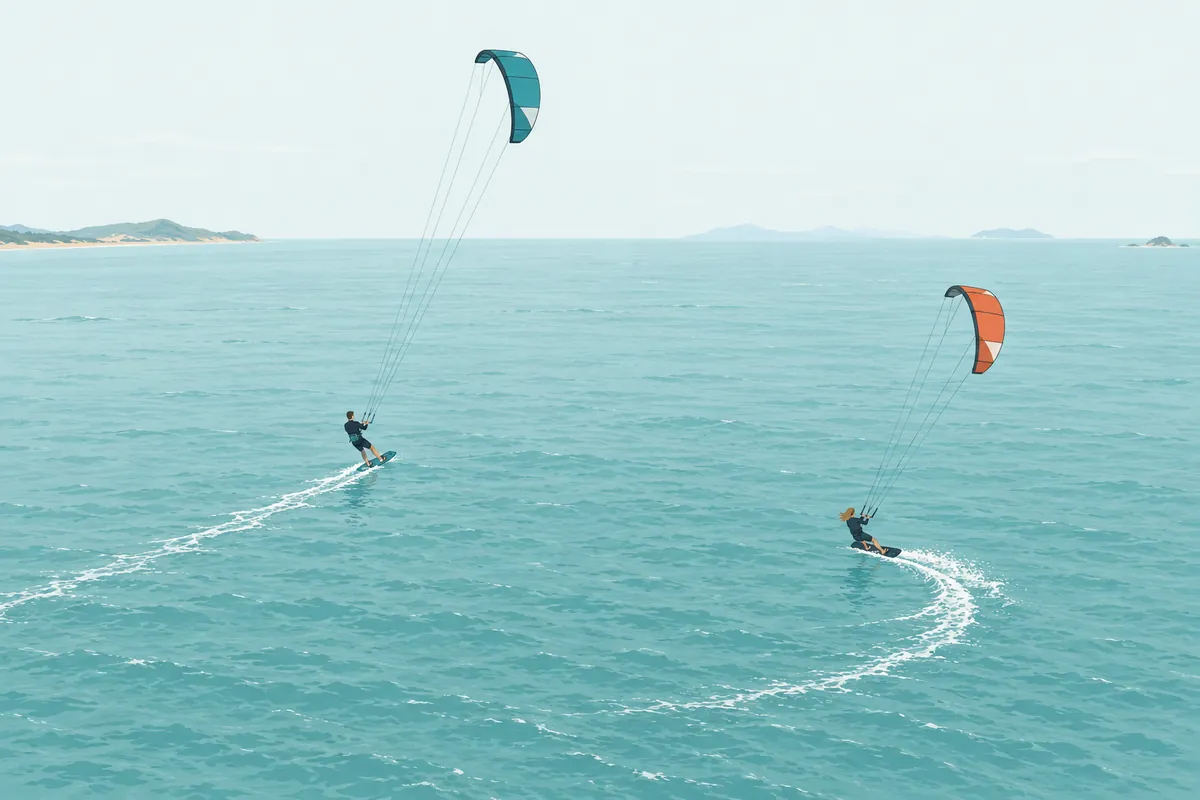
Beginner Three rules cover almost every kiter-versus-kiter encounter on open water. They come straight from sailing, and they work because they are binary: one glance tells you who holds course and who yields.
Rule 1: starboard tack has priority
When two kiters converge on opposite tacks, the rider on starboard tack, right hand and right shoulder leading, wind coming over the right side, has right of way and holds course and speed. The rider on port tack (left hand forward) yields, by bearing off downwind or tacking away. The memory aid is four words: right hand forward, right of way.
The stand-on rider's job matters as much. Hold a predictable, constant course so the yielding rider can plan around you; erratic last-second dodging by the priority rider causes as many near-misses as failure to yield.
Rule 2: passing, with the upwind kite high and the downwind kite low
When two kiters pass close on opposite tacks, or one overtakes the other, the kites must not tangle, so the sky is split:
- The upwind rider flies the kite high, towards 12 o'clock.
- The downwind rider flies the kite low, towards the water, roughly 10–20 degrees off the surface.
Signal early. Raise or lower the kite well before you cross, so the other rider can read your intention from 50 m out. Two kites and up to four lines of 22–24 m crossing in a two-metre gap is how mid-water tangles happen, and a tangle of loaded lines can multiply kite power and cut through line, and through skin.
Rule 3: same tack, the upwind rider gives way
When two riders travel in the same direction, the rider upwind yields to the rider downwind. The logic is visibility and room: the upwind rider can see the downwind rider, whose view is often blocked by their own kite, and the upwind rider has more space to manoeuvre.
Overtaking on the same tack, pass downwind of the slower rider with your kite low. Never barge through the narrow gap upwind of them, which also robs their wind; the wind-shadow numbers are further down.
| Situation | Who holds course | Who yields, and how |
|---|---|---|
| Opposite tacks, converging | Starboard tack (right hand forward) | Port tack bears off downwind or tacks away |
| Passing close / crossing | Both hold course | Upwind rider takes the kite high; downwind rider takes it low |
| Same tack, same direction | Downwind rider | Upwind rider yields; overtake downwind with the kite low |
| One rider jumping | Everyone else | The jumper forfeits all priority the moment they leave the water |
| Beach: one launching, one landing | Rider entering the water | Incoming rider waits, or takes another tack out |
| In surf | Rider on the wave (first to catch it) | Everyone not on the wave; no dropping in, no snaking |
FAQ
Who has right of way in kitesurfing?
On opposite tacks, the rider on starboard tack, right hand forward. On the same tack, the downwind rider. At the shoreline, the rider going out. In surf, whoever caught the wave first. A rider in the air has no priority at all.
Does the upwind or the downwind rider put the kite up?
Upwind rider high, towards 12 o'clock. Downwind rider low, roughly 10-20 degrees off the water. Move the kite early enough that the other rider can read it from 50 m out.
Do kitesurfers have right of way over swimmers?
No. Yield to everyone who is not on a kite. Keep about 50 m, two line-lengths, from swimmers, divers and paddlers; your lines are invisible to them.
How do I find the local rules before I arrive?
Read the spot page: 1,314 of the 1,504 spots in the atlas carry a dated rules-and-access note, plus the launch, the crowd level and the schools nearby. Then watch the beach for ten minutes and ask a local.
More from Rules & Etiquette
The other articles in this chapter- Kitesurfing right of way rules
- Where to rig, launch and park your kite
- Kitesurfing hand signals for launching and landing
The Fundamentals · Learning the Sport · The Gear · Buying Gear & Keeping It Alive · Tech & Innovation · Wind, Weather & Water · Safety & Risk · When Things Go Wrong · Rules & Etiquette · Advanced Riding · Spots of the World · Practical Tricks & Life Hacks · The Video Library · Field Notes & Extras