All 14 chapters

In this chapter
Each of these has its own pageThe best free kitesurfing tutorials on YouTube, sorted by channel and then skill by skill: trainer kite, body drag, waterstart, riding upwind, first jumps, kiteloops, self rescue, wave riding and foiling. Video will not teach you kite control in real wind, which is what lessons are for. From the waterstart onward it is the cheapest coaching you will ever get. Every tutorial named here plays on this page.
Can you learn kitesurfing from YouTube?
Partly. You can learn the theory, the order of the moves and most of your own mistakes from video. You cannot learn to fly a powered kite in real wind that way, and that is the stage that puts people in hospital. Watch the tutorials, pay for lessons through the early powered sessions, then lean on video for the long stretch afterwards, when nobody is coaching you anyway.
The money is the reason this chapter exists. A beginner course of 6 to 10 hours costs €300–500 in Europe (2026) and $700–1,100 in the United States (2026).
When it ends you are alone with the years between a first waterstart and a first kiteloop: riding upwind, jumping, looping, waves, foil. Every one of those skills now has several tutorials shot by working instructors or by competitors, and they cost nothing.
The teaching pedigree is real, not marketing. Of the 1,606 schools in the atlas, 790 state a certification: 549 teach to IKO, 136 to VDWS and 9 to BKSA. Several channels below belong to those schools, and their videos are the lesson plan they run on the beach. Each school page says which body its instructors are certified under.
Three habits get the most out of the library. Watch the relevant tutorial before your lesson, so you are not paying an instructor to explain the wind window. Watch it again the same evening, when you can finally recognise your own mistake in the common-mistakes segment.
And from the waterstart on, treat one channel as your curriculum rather than grazing across twenty, because the channels below disagree about small things and a beginner cannot tell which disagreement matters.
The best kitesurfing YouTube channels
Dozens of channels post kitesurfing footage. About ten of them teach. These are the ones worth subscribing to, and what each is good at.
Kitesurf College
This is the textbook of the sport, now branded Wingfoil, Kitefoil & Kitesurf College since it expanded into foiling and winging. The style is deliberately unglamorous: calm narration, clear on-water footage, and its signature clean animations showing exactly what the bar and the kite are doing at each moment.
Nearly every video runs the same way, technique broken into numbered steps, then a common-mistakes section, which is where the learning actually happens.
Its beginner twintip series is a nine-episode playlist that runs from trainer kites and setup, through safety and self-rescue, to launching and riding: an IKO-style curriculum in video form. Individual tutorials cover the trainer kite, body dragging in all three directions, the waterstart, riding upwind (an original 2016 version and a 2024 extended edition), transitions and jumping.
Best for absolute beginners through early intermediates who want systematic instruction with no hype, and the first stop for twintip riders curious about foil. Kitesurf College on YouTube. Beginner Intermediate
Duotone Kiteboarding Academy
Duotone came out of North Kiteboarding in 2018 and is run from Oberhaching in Germany; the atlas holds 18 Duotone-branded centres and partner schools, from Torbole to Kalpitiya. Its Academy series is short, well shot and demonstrated by professional athletes, most of the beginner videos by Jeremie Tronet, a French pro based on Union Island in the Grenadines who runs his own channel too.
The Academy is organised by discipline and level, with a beginner playlist covering kite preparation, bodydrag, waterstart, first rides and downloop jibes, plus parallel series for freestyle, big air, wave riding and foil.
Its real advantage is the companion app described at the end of this chapter, which arranges more than 250 trick lessons into a progression tree. The videos are brand-produced, so expect Duotone gear in every frame; the technique is gear-agnostic. Best for riders who want a structured progression by discipline and short, dense videos. Duotone Kiteboarding on YouTube.
MACkite and Ride with Blake
MACkite Boardsports runs one of the busiest kiteboarding channels in North America out of two West Michigan lake towns, a lesson site at Pere Marquette Park in Muskegon and a shop in Grand Haven, both on Lake Michigan.
Its instructional core is Ride with Blake, in which team rider Blake Olsen covers beginner and intermediate skills: waterstarts, beach starts, riding upwind, transitions, first front rolls, in a chatty style that feels like a mate coaching you from the beach. His waterstart video breaks the move into five steps and is the friendliest of the four in this chapter.
MACkite also posts a large volume of gear reviews, which makes it the channel to watch while you are buying your first kite.
For reference, its own rates are $199 for a 90-minute beginner lesson (2026) and $299 for a three-hour one (2026), and a complete new setup, a 9–12 m kite, a 135–140 cm twintip, a bar, a harness and a pump, runs $1,800–2,200 in 2026. Best for North American riders, gear research, and learners who take coaching better informally than from a curriculum.
Progression Sports
Progression sold instructional DVDs before YouTube existed and it shows: the videos are the most methodically structured in the sport, built on slow-motion analysis and precise body-position breakdowns.
The free material on YouTube is strongest on surfboard and wave riding, and it feeds the paid Progression Player platform and app, which holds full collections for every level plus wave and foil. Best for intermediate riders ready to pay for depth, for anyone starting waves, and for riders who want coaching-grade analysis instead of vlogs. Intermediate
Steven Akkersdijk and the SA Masterclass
Akkersdijk is Dutch, coaches for a living and rides out of Big Bay in Cape Town. He was a Red Bull King of the Air podium finisher in 2014 and a finalist several times since, and his channel is the best advanced-technique resource on YouTube.
The SA Masterclass series breaks tricks into exercise ladders: the three-part Road to Kiteloops starts with the downloop jibe, so you are comfortable looping the kite low before you ever loop it in the air, then works up through small loop transition jumps to full loops and megaloops.
His most-watched videos are about unglamorous things, line length and kite trim. Best for intermediate and advanced riders chasing bigger jumps and kiteloops, and for anyone who wants to know why a technique works rather than only how. Steven Akkersdijk on YouTube. Advanced
Sam Light
Sam Light is a British pro who rides the south coast of England around Hurst Castle, and his channel mixes high-level riding with useful how-tos. His jumping tutorial is one of the most-referenced first-jump videos in the sport: send, pop, redirect, land tail-first, in a handful of key points. Best for intermediate riders working on jumps and downloops, and on slider and park riding. Sam Light on YouTube. Intermediate
The Kitesurf Centre
The Kitesurf Centre has taught at Camber Sands since 2007, on the kite beach at Jury's Gap and at Greatstone ten minutes away, and it is one of only nine schools in the atlas certified by the BKSA. Its videos mirror the lesson plans: how to fly a trainer kite, how to launch and land, and the safety procedures including the emergency pack-down.
This is what a British instructor says to you on the beach, filmed. Useful before a first lesson anywhere. Camber Sands itself wants about 12 knots for a beginner and 18 for an experienced rider, and the spot page lists that range along with the schools on the beach. Beginner
REAL Watersports
REAL has been teaching on the 40-mile barrier island of Cape Hatteras / Outer Banks, North Carolina since 2001 and has put more than 50,000 students through its kite and surf programmes. Its Introduction to Kiteboarding series is six sequential lessons starting with how to fly a trainer kite, and there is a long how-to playlist behind it covering kitesurfing as well as surf and SUP.
The order it teaches in, trainer kite, then body drag, then board, is the standard American method and the same one its Zero to Hero camp runs on the water. Best for anyone booking a camp-style learning trip, and for structured study before you go. Beginner
Epic Gust
Run from a school in Domaso, at the windy northern end of Lake Como, where the Breva thermal fills in most summer afternoons at 15–18 knots. Epic Gust pairs long-form tutorials with written guides, and its waterstart video claims to be the last waterstart tutorial you will need.
It earns that with the edge cases nobody else covers: light-wind starts, overpowered starts, what to do when the board is gone. Best for learners stuck on one skill who want a 15 to 20 minute walkthrough instead of a four-minute overview.
Tribe Watersports
A Kenyan school on Galu Beach in Diani, 30 km south of Mombasa, teaching under both IKO and BKSA. The channel is worth following for one video: a self-rescue and deep-water pack-down filmed in real open water rather than in a pool.
Galu Beach runs 15–22 knots on the Kaskazi and 18–25 on the Kuzi, so the demonstration is done in wind you would actually be rescuing yourself in. It is the skill most riders neglect until the day they need it.
Also worth knowing
- Jeremie Tronet (JT Pro Center). The Grenadines-based pro behind many Duotone Academy videos runs his own channel of tutorials and tropical freestyle footage.
- Univers Kite. A big French-language channel that aggregates footage and gear tests. More inspiration than curriculum.
- KiteBud. The Perth school, on Pinnaroo Point in the Fremantle Doctor sea breeze, sells online courses including an 11-minute deep-water self-rescue module filmed in real conditions. Beginner lessons there run A$369–A$1,779 (2026).
| Channel | Style | Best for |
|---|---|---|
| Kitesurf College | Systematic, animated, no hype | Complete beginner to intermediate curriculum; foiling |
| Duotone Academy | Short, polished, pro-demonstrated | Structured progression by discipline; the companion app |
| MACkite / Ride with Blake | Informal shop coach | North American learners; gear research |
| Progression Sports | Coaching-grade slow motion | Wave riding; paid deep courses |
| Steven Akkersdijk | Exercise-ladder masterclasses | Kiteloops, big air, technique theory |
| Sam Light | Concise pro key points | First jumps; freeride tricks |
| The Kitesurf Centre | School lesson plans on video | Pre-lesson prep; BKSA safety procedures |
| REAL Watersports | Sequential six-part course | US-style structured intro |
| Epic Gust | Long-form troubleshooting | Getting unstuck on one skill |
| Tribe Watersports | Real open-water demonstration | Self rescue and safety |
Two playlists work as complete courses on their own. Start with one of these if you want a single path rather than a pile of individual videos.
Watch · complete curricula · 2
How to fly a trainer kite
Beginner Everything in kitesurfing sits downstream of kite control, and kite control is learned on land with a small trainer kite before you touch a full-size wing. A 2–3.5 m trainer, $100–300 in 2026, flown in 10–15 knots teaches the wind window, figure-eights through the power zone and one-handed flying, which is exactly what your first paid hour would otherwise go on.
Kitesurf College, The Kitesurf Centre and REAL Watersports each cover the same ground in different accents. Watch one before your first lesson, then fly the thing until steering is unconscious.
Watch · 3


How to body drag and get your board back
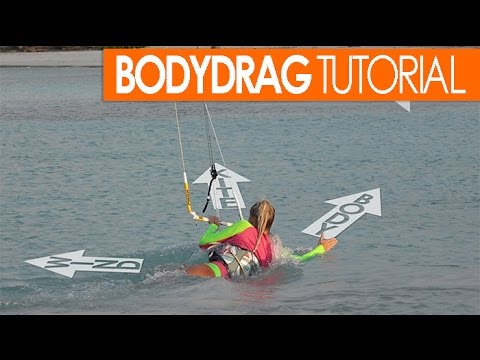
Beginner Body dragging is being pulled through the water by the kite with no board, and it is where you learn to fly while the rest of you is busy staying afloat.
The Kitesurf College tutorial covers upwind, crosswind and downwind dragging plus steering direction in one video; the Duotone version adds a pro demonstration of the same thing. Upwind dragging is the one that matters: it is how you get a lost board back, and every rider loses a board.
Watch · 2

How to waterstart on a kiteboard
Beginner The waterstart, diving the kite to pull yourself onto the board and away, is the milestone that turns a student into a kitesurfer, and it has the deepest bench of tutorials of any skill in the sport.
The four below complement each other rather than repeat: Kitesurf College for the mechanics and the animated bar timing, the MACkite five-step breakdown for a friendly walkthrough, Duotone for what good form looks like when a pro does it (feet in, body close to the board, dive the kite), and Epic Gust for the long session when you are stuck, including light wind, too much power and board-loss recovery.
Watch · 4


How to ride upwind
Beginner Intermediate Riding upwind ends the walk of shame back along the beach, and it is where self-taught progress usually stalls. Kitesurf College has covered it twice. The 2016 original is still a good treatment of the edging body position; the 2024 extended edition adds preparation and speed control.
Start with the newer one and use the old one as revision. Both hammer the same three points: hips forward and edged against the kite, speed held under control rather than maximised, and the kite flown lower than your instinct wants it.
Watch · 2

How to jump and how to learn kiteloops
Intermediate Two tutorials cover first jumps between them. Kitesurf College starts with small hops and medium jumps, with its animated bar-and-kite timing and the usual common-mistakes section. Sam Light adds a pro's key points on the send-pop-redirect sequence and on landing softly: redirect the kite before you touch down, land tail-first with the knees bent.
Advanced Once jumps are comfortable, the three-part Road to Kiteloops from Steven Akkersdijk is the best free progression toward the most committing move in the sport. Its value is the order.
Part one keeps you on the water doing downloop jibes, so you learn to loop the kite low, where a mistimed loop is a splash instead of a slingshot. Part two ladders up through small loop transition jumps to real kiteloops. Part three is timing, gear and megaloop theory.
Watch · 5


How to do a kitesurfing self rescue
Beginner The self rescue is releasing the kite's power, securing the lines and using the deflated kite as a sail or a raft to get yourself home. It is the skill riders skip until the afternoon they are a kilometre offshore with a broken line.
The Tribe Watersports demonstration stands out because it is filmed in open water off Galu Beach rather than in flat conditions staged for the camera. The second video walks the sequence step by step: fire the safety release, half-hitch the safety line, wrap all four lines, then sail in or pack down completely.
Watch · 2

Kite wave riding and foiling tutorials
Intermediate Once you ride upwind on a twintip without thinking about it, two branches open up. Each has one clear set of free tutorials.
Waves. Start with Progression. The riding-waves introduction covers catching and riding a first wave with a kite, and the strapless foot-positions video is the reference for where to stand on a surfboard when you ride, carve or turn. Learn jibes and carving on flat water first, then take the backside line on small waves before you go near anything with punch in it.
Foil. The Kitesurf College foil tutorial is the most complete single-video foil progression anywhere. It stages the learning curve into separate drills, bodydrag with the foil board, taxiing on the surface, deliberate short flights, then sustained flights, so you never take a fall you have not already taken a smaller version of.
Pair it with the Duotone foil-handling video, which covers the awkward and hazardous business of carrying a hydrofoil and body-dragging out with one.
Watch · 4



In what order should you watch these videos?
Mapped to the normal learning progression. Each stage's videos are in the grids above.
- Kite control on land. Trainer kite tutorials from Kitesurf College, The Kitesurf Centre and REAL Watersports. A 2–3.5 m trainer in 10–15 knots teaches the wind window and figure-eights before you touch a full-size kite.
- Body drag. The Kitesurf College all-directions tutorial plus the Duotone beginner version. Get the upwind drag right, kite at 11 or 1 o'clock, tacking 7–8 m each side, because it is your board-recovery tool.
- Waterstart. Kitesurf College for mechanics, MACkite for the five steps, Duotone for form, Epic Gust when you are stuck. Aim for 15–20 knots and waist-deep flat water.
- Riding upwind. The 2024 extended edition from Kitesurf College: edging body position, speed control, kite height.
- First jumps. Kitesurf College for the small-hop progression, Sam Light for send timing and for redirecting the kite to land rear foot first with the knees bent.
- Kiteloops and big air. Road to Kiteloops, all three parts, in order, downloop jibes through megaloop theory.
- Self rescue. The Tribe Watersports pack-down, then practise it on land and in shallow water before you need it offshore.
- Wave riding. The two Progression videos. Jibes and carving on flat water first, then small waves.
- Foiling. The staged Kitesurf College progression plus the Duotone handling video, on a short mast, in a helmet and impact vest.
Kitesurfing apps, forums, podcasts and paid coaching
Apps
The Duotone Kiteboarding Academy app is the standout and is free on iOS and Android (2026): more than 250 trick lessons across six disciplines, over 100 fitness routines built with the Porsche Formula E training team, a progression tree that proposes your next trick, and in-app comments where coaches, Aaron Hadlow and Lasse Walker among them, answer technique questions. The Progression app delivers the same company's paid courses offline.
For progress you can measure, the WOO and Surfr sensors log jump height and airtime; the WOO record stood at 40.0 m in December 2025, King of the Air-level jumps clear 20 m, and a good amateur jump is 5–10 m. For wind, most riders live in Windy, Windguru or Windfinder, and in the United States iKitesurf adds a dense network of live wind stations.
Forums and communities
Kiteforum is the long-running general forum, and still the place for gear archaeology, spot threads and blunt equipment opinions. The r/Kiteboarding subreddit is the most active Q&A space and the kindest to beginner questions. Seabreeze covers Australia, iKitesurf's regional boards the United States, Kiteboarder.co.uk the United Kingdom.
In practice the local Facebook and WhatsApp groups for a beach are where you find launch partners and same-day wind calls, and the spot page lists the schools that usually know who is going out.
Podcasts
On The Air, hosted by Lewis Crathern, a two-time King of the Air finalist who also commentates the event, mixes interviews with riders and practical coaching threads. Kitesurf Academy by LakeUnited is more directly about learning and progression. Both are drive-to-the-beach listening rather than instruction.
Online coaching and structured courses
Progression is the most established paid platform, with full course collections and video-analysis coaching. Tantrum Kitesurf pairs a technique blog with coaching holidays. KiteBud in Perth sells focused online modules, including the deep-water self rescue. Steven Akkersdijk coaches big air privately.
If you would rather spend the money on the water, a private hour with an instructor at your own spot, €60–90 in Europe (2026) or $90–160 in the United States (2026), beats any of them for a single stubborn problem, and the school pages list who teaches where.
Questions riders ask
Can you learn to kitesurf from YouTube?
Not the powered stages. Kite control, launching, the first waterstarts: those need an instructor next to you, because a 9–12 m kite in 18 knots hurts people who guess. Everything after that, upwind, jumps, loops, waves, foil, is learned mostly from video by most riders.
What is the best kitesurfing YouTube channel for beginners?
Kitesurf College. Its nine-episode twintip series runs the full beginner curriculum in order, and its common-mistakes sections are what you actually need after a lesson.
What should I watch before my first lesson?
One trainer kite tutorial and one self-rescue video. The trainer video saves you paying an instructor to explain the wind window; the self-rescue video means the safety briefing is revision rather than news.
Are there free video tutorials for the waterstart?
Four good ones, all embedded above: Kitesurf College for the mechanics, MACkite for a five-step walkthrough, Duotone for pro form, Epic Gust for a long troubleshooting session in light wind, too much power and board loss.
How do I learn kiteloops without hurting myself?
In the order of the three-part Road to Kiteloops: downloop jibes on the water first, then small loop transition jumps, then loops in the air, with plenty of downwind room and no audience to impress.
Is the Duotone Academy app free?
Yes, on iOS and Android in 2026, with more than 250 trick lessons and a progression tree. The Progression app is the paid alternative and holds that company's full course library offline.
Chapter 14 · Part V · The Kitesurfer's Life