All 14 chapters
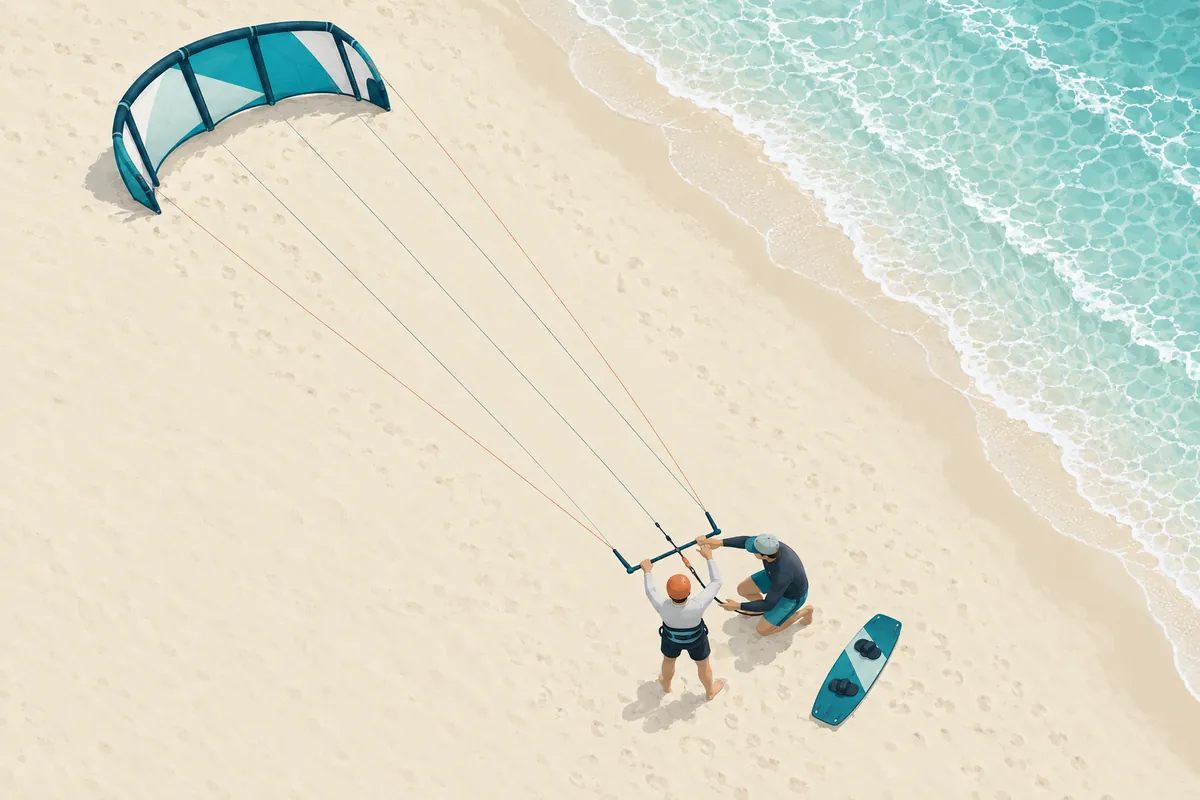
In this chapter
Each of these has its own pageLearning to kitesurf takes most people 12 to 20 hours of lessons, spread over three to seven days. That is what it costs to reach the level the cards call IKO Level 3 or VDWS Level 5: riding upwind, launching yourself, getting out of trouble in deep water alone. This chapter is the path from a trainer kite in a park to the day you rig without an instructor, with what lessons cost, how to pick a school, and where the water makes it quicker.
The stages come in a fixed order and nobody skips one. What varies is how many hours each takes, and that depends on the wind, the water depth and how many students share your instructor.
Do you need kitesurfing lessons?
Yes, and not because the riding is hard. A 10 to 12 m kite in 20 knots pulls hard enough to lift an adult off the ground and drag them across a beach, a car park, or into other people.
The launch and the landing are where the serious accidents happen, and those are the two phases a self-taught beginner improvises. Lines tangled round a swimmer, a kite looping down a crowded beach: these are classic self-teaching outcomes, and in several countries they arrive with a liability claim attached.
The tempting alternative is cheap second-hand gear and YouTube. Don't.
Three things an instructor gives you that a video cannot:
- Safety-system reflexes. Firing the quick release, flagging the kite onto its safety line, running a full self-rescue and pack-down in deep water: all of it has to be drilled until it is automatic, with someone watching. Self-taught riders rarely practise self-rescue until their first serious incident.
- Judgment. Reading wind direction and strength, spotting gusty or offshore conditions, choosing a kite size, reading a launch area: that is the real curriculum, and it transfers only through supervised repetition.
- Speed. Lessons are the cheap option. A school hands you the right kite for the day's wind, replaces the gear you crash, and compresses into 10 to 15 hours what self-teachers stretch over a season.
The one honest piece of self-teaching in this sport is the trainer kite, a small foil you can fly safely on land before your first lesson. It gets its own section at the end of this chapter.
Watch · 3


IKO vs VDWS: which kitesurfing certification?
Two systems dominate. Of the 1,606 schools in the atlas, 790 list a teaching qualification: 549 of them IKO, 136 VDWS, 59 both. The rest hold national federation badges that count locally, such as FIV in Italy and FFVL in France.
No card is legally required to kitesurf in most countries. What it buys is access to gear: rental shops read your level before handing you a kite, some insurers and destinations ask for it, and any instructor sees in one line what you can do.
IKO (International Kiteboarding Organization)
The IKO was founded in 2001 and is run from the Dominican Republic. It is the card you meet most often outside German-speaking Europe: its schools in the atlas cluster in Italy (70), Spain (60) and Brazil (26), and it is the default across the Americas and Asia. The pathway runs through five levels, each broken into lettered sub-skills:
- Level 1, Discovery Beginner (roughly the first 2 to 4 hours). Everything on land: the SEA check (Spot, Environment, Activity), kite setup, safety systems and pre-flight checks, assisted launching and landing, piloting through the wind window, one-handed flying, firing the quick release. Finishing Level 1 means you can handle a kite on land safely. Nothing more.
- Level 2, Intermediate Beginner (typically 4 to 10 further hours). Into the water without the board: water relaunch, body-dragging downwind and, the one that matters, upwind body-dragging, which is how you retrieve a lost board ever after. Then power strokes, self-rescue basics, right-of-way rules, and the first waterstarts. It ends with you standing up and riding a few metres.
- Level 3, Independent Intermediate (typically 6 to 20 further hours). The milestone: controlling speed by edging, riding consistently, staying upwind, basic transitions, toeside, self-launching, deep-water self-rescue. An IKO Level 3 card is the working passport to renting equipment and riding unsupervised.
- Level 4, Advanced Advanced (10 to 50 hours of riding). First jumps, carving jibes, grabs, recovery techniques, and deeper theory on weather and aerodynamics.
- Level 5, Evolution Advanced. Specialisation tracks: freeride (kiteloops, downloops, rolls), wave riding, unhooked freestyle, hydrofoil or wing foil. Each foil track is budgeted at roughly 10 to 40 hours.
Most students complete Levels 1 to 3 in 12 to 20 hours of instruction spread over 3 to 7 days. Progress is logged on an IKO member card, physical or in the app, so you can start Level 2 in Greece and finish Level 3 in Brazil without repeating anything.
VDWS (Verband Deutscher Wassersport Schulen)
The German water-sports school association is concentrated where you would expect: of its 136 schools in the atlas, 35 are in Germany, 18 in Italy and 15 in the Netherlands. Much of the ION CLUB and large European centre network is VDWS-affiliated. Its kite curriculum has five practical levels plus a theory exam:
- Level 1: safety basics, setup, first kite flying, launch.
- Level 2: confident kite flying, relaunch, body-dragging.
- Level 3: waterstart and first short rides downwind. After Level 3 you sit a multiple-choice theory test on wind theory, right of way, safety.
- Level 4: riding in both directions, holding your position relative to the wind, first basic jibe.
- Level 5: fully independent riding, including consistent upwind ability.
Level 5 plus the theory exam earns the VDWS International Kiteboarding Basic Licence, the card rental stations in German-speaking Europe ask to see. VDWS Level 5 does the same job as IKO Level 3, and schools translate between the two without fuss.
How long does it take to learn kitesurfing?
Most people ride independently after 12 to 20 hours of tuition, which is three to seven days at a school. Staying upwind, the skill that ends the long walk back up the beach, usually lands between 15 and 20 hours of tuition and 20 to 30 hours of total time on the water. Honest averages, assuming decent conditions and a competent school:
| Milestone | Typical hours of instruction/practice |
|---|---|
| Safe kite control on land (IKO 1) | 2–4 hours |
| Body-drag, relaunch, first waterstarts (IKO 2) | 6–12 hours cumulative |
| First rides of 50–100 m in both directions | 8–15 hours cumulative |
| Riding independently in light-wind conditions | 10–15 hours cumulative |
| Staying upwind / true independence (IKO 3) | 15–20 hours of tuition, 20–30 hours total time on water |
| First small jumps | ~50 hours total riding |
| Confident jumping, transitions, first tricks | 50–100 hours total riding |
Three or four lessons of 2 to 3 hours get most people standing and riding. The package sold worldwide, 9 to 12 hours over 3 or 4 days, takes an average student to the edge of independence. Budget another 5 to 10 hours of supervised practice, rental with rescue cover, to lock in upwind riding.
Progress is not linear and not entirely yours to control. The wind cooperates or it doesn't. Wakeboarders and snowboarders often stand up in half the average time because the board feel transfers; windsurfers and sailors grasp the wind theory instantly and still need the full kite-control hours. With no board or wind background you need the top of the ranges, and there is no shame in 25 hours.
Watch · 3


How much do kitesurfing lessons cost?
A private hour costs $50 to $150 (2026), a group hour with two students sharing an instructor $25 to $60 (2026). The 9 to 12 hour beginner course that takes you to the edge of independence costs €300 to €550 (2026) across Europe and North Africa. Schools' own 2025 and 2026 quotes, per person:
| Where | Private hour | Group hour | Beginner course, 9–12 h |
|---|---|---|---|
| Western Europe (Tarifa, Netherlands, UK, Italy) | €60–90 (2026) | €25–50 (2026) | €350–550 (2026) |
| Egypt (El Gouna, Hurghada, Safaga) | €38–70 (2026) | €25–40 (2026) | €300–500 (2026) |
| Morocco and Cape Verde | €75–85 (2026) | €25–35 (2026) | €250–500 (2026) |
| Brazil (Cumbuco, Jericoacoara, Ilha do Guajiru) | R$125–340 (2026) | from R$180 (2026) | R$2,200–2,700 (2026) |
| USA (Hood River, the Outer Banks, Florida) | $100–150 (2026, reported) | $200+ per block (2026, reported) | no dated figure on record |
No US school in the atlas carries a dated price note, so read that row as unverified. A zero-to-hero package, lessons plus gear and accommodation over 7 to 14 days, runs €800 to €1,800 (2026).
How to choose a kitesurfing school
Certification, IKO or VDWS, is the baseline filter: insured instructors, trained to a syllabus. After that, these markers decide how many hours you need.
- Student-to-instructor ratio. 1:1 or 1:2 for beginners; walk away from anything above 1:4. With two students there should still be one kite per student in the water phases, or clearly alternating turns.
- Radio helmets. A one-way waterproof radio in your helmet is the biggest teaching accelerator of the last decade. Without one, your instructor mimes from 100 m away while you repeat the same mistake for ten minutes. 224 of the 1,606 schools in the atlas mention radios in their teaching setup. Schools quote 20 to 30 per cent faster progression; treat that as a sales figure, and ask anyway.
- Rescue and boat support. 269 schools list a boat or a jet ski. At open-water and lagoon spots the driver is both a safety net and a time machine: instead of a 25-minute walk of shame back upwind, you get dropped at the top of the teaching area. Ask who watches the water, how they reach a student in trouble, and how they would get you to a hospital.
- Current gear with working safety systems. Kites should be recent generation, with a wide depower range and a quick release you can fire under load, plus helmets and impact vests as standard. A school teaching on 10-year-old kites probably has a safety culture of the same vintage.
- Teaching conditions. Waist-deep flat water and side-onshore wind forgive everything. 869 of the 1,504 spots in the atlas are marked beginner-friendly and 268 of those are lagoon or flat water, among them El Gouna, Dakhla, Kalpitiya, Le Morne and Lo Stagnone. A shallow lagoon can halve your hours against learning in shorebreak.
- Structure and honesty. A good school logs your level, tells you what comes next, and will cancel when the wind is wrong rather than bill a useless session. Read recent reviews specifically for how it handles no-wind days and refunds.
- Insurance. Confirm the liability cover includes students, and ask whether you need your own: in some countries third-party liability insurance for kitesurfers is effectively mandatory.
The atlas is built for this stage: each spot page lists the schools that teach there with the local rules and flag system, and each school entry carries its certifications, its languages, and the date prices were checked.
Kite camp abroad or lessons at your local spot?
A dedicated trip stacks the deck: consecutive days, warm shallow water, wind that turns up, a lower hourly rate. Five days in a row teach more than ten scattered weekends.
Dakhla is the flattest of the classics: wind on something like 300 days a year, 15 to 25 knots on an ordinary day, 30 knots or more on July and August afternoons, and shallow lagoon edges where the schools teach. Its 19 schools make it a buyer's market.
El Gouna runs 15 to 25 knots from March to November over standing-depth lagoon water with marked school zones. Kalpitiya's lagoon is one of Asia's main beginner venues, though the May to October monsoon blows 20 to 30 knots; December to February, at 14 to 22 knots, is gentler.
Brazil's trade-wind season runs July to January. Cumbuco holds 16 to 26 knots from August to December and teaches in the Cauipe lagoon rather than on the ocean beach; Jericoacoara and Prea blow 20 to 35 knots in high season, a lot of wind for a first week; the beginner water is the river-mouth lagoon at Guriu.
Europe needs less flying: Lo Stagnone in Sicily is knee-deep and enclosed, with schools all along it and a thermal that settles at 15 to 20 knots from April to October.
Tarifa has 28 schools and the widest choice in Europe, but learn there on a Poniente day at 12 to 22 knots; the Levante blows 20 to 40 knots and leans offshore, and beginners stay on the beach for it.
Cape Town is a famous kite city and a poor place to learn: its November to March southeaster is strong and gusty, the Atlantic is cold, and its spot pages read intermediate and up.
Learning locally has one under-rated advantage: you learn the spot and the conditions you will actually ride afterwards, and every windy evening becomes cheap supervised practice. The failure mode is stretching a course over months of sporadic wind, relearning the same skills each time.
The honest recommendation, and the one most instructors give: do an intensive beginner week somewhere windy and shallow, then consolidate at your local spot with supervised rental or refresher hours. Time it for the shoulder months: April to June and September to October in Europe, August to December for the Brazilian northeast, March to November for the Red Sea.
What good learning conditions look like
- Wind: 12 to 20 knots, enough to relaunch and ride, not enough to frighten. 10 to 25 knots is the outer spectrum.
- Direction: side-onshore, about 45° to the beach, blows you back to the sand rather than into it.
- Water: flat, ideally standing depth. Waves over about a metre are a tax on a beginner.
- Steadiness beats strength: a sea breeze or trade wind beats a gustier inland thermal.
Kitesurfing for kids, and how fit you need to be
Children
There is no universal legal minimum age. The IKO guideline is age 12 and a minimum weight of about 35 kg (77 lb). Many schools take confident, water-happy kids from 8 to 10 on small kites of 1.5 to 4 m in shallow water, and 85 of the schools in the atlas advertise a course for children.
The real gates are weight (enough mass not to be lifted by a gust, so most schools want 30 to 35 kg or more), swimming ability, attention span and genuine desire. Ratios for kids should be strictly 1:1, sessions shorter at 60 to 90 minutes, conditions conservative.
Do you need to be fit to kitesurf?
No, and you do not need to be strong. The kite's pull, which in a gust reaches several hundred kilos, goes through your harness into your hips and core, not through your arms; your hands only steer a bar balanced to need fingertip pressure.
That is why 60 kg teenagers, 70-year-olds and riders who cannot do five pull-ups all cruise happily in 25 knots. What you do need is to swim confidently and stay lightly active for a 2 to 3 hour session: walking in waist-deep water, climbing back onto the board again and again. Core endurance and flexibility reduce fatigue, but they are not an entry requirement.
Common beginner mistakes and how to fix them
- Stopping lessons early. Fix: finish the IKO 3 or VDWS 5 syllabus, self-rescue included, before you buy gear and go solo.
- Staring at the kite. Your kite stays where you last sent it; your body follows your eyes. Fix: feel the kite through the bar and look where you want to go, exactly like driving.
- Death-gripping and pulling the bar in. Instinct says hold on tight; physics says sheeting in powers the kite up more. Fix: learn early that pushing the bar away is the brake. Light hands, let the harness work.
- Wrong kite size for the wind. Overpowered is dangerous, underpowered is merely frustrating. Fix: as a beginner, let the school or an experienced local call your kite size every single session.
- Ignoring wind direction and forecast. Offshore wind, dying wind or an approaching front turns a small error into a rescue. Fix: make the SEA check a habit. Establish the wind direction relative to the shore, check the forecast and the tide, identify the hazards downwind.
- Bad body position: stiff legs, weight on the front foot, bum out, shoulders hunched. Fix: knees bent, weight through the back leg and the harness, hips forward, chest open. Sit against the harness rather than fight it.
- Skipping upwind body-dragging practice. The first time you lose your board in deep water is not the moment to learn how to get it back. Fix: drill it until it bores you.
- Riding too far downwind. Beginners drift, and the walk back is the sport's traditional hazing. Fix: stay within your depth and start each run from the upwind end of your area.
- Neglecting gear checks. Worn lines and sticky quick releases fail at the worst possible moment. Fix: a two-minute inspection of the lines, the bridles, the leash and the quick release before every session, and test-fire the release regularly.
- Comparing your progress to other people's. Ten hours or thirty, everyone converges on the same skills. Fix: count wind hours, and mark the milestones (first body-drag, first waterstart, first upwind run) instead of the calendar.
Trainer kite practice before your first lesson
Beginner The best thing you can do before your first lesson costs about €100–170 (2026): a 2 to 3 m foil trainer kite on two or three lines.
Flown in a park or on an empty beach, it teaches the wind window, steering inputs, flying one-handed and by feel, figure-eight power strokes and crash-relaunching: the exact skills that otherwise eat the first hours of much more expensive tuition. Ten hours on a trainer saves several paid hours on the big kite; instructors spot a trainer-kite student within minutes.
- Size: 2 m is a safe minimum; 2.5 to 3 m gives an adult more realistic power.
- Lines: three-line versions add relaunch capability and a safety flag-out that is worth having.
- Conditions: fly it in steady 8 to 15 knots, in a space with no people, power lines or roads downwind.
- Respect: treat even a 3 m kite seriously. In 25 knots it can yank you off your feet.
And the caveat that keeps this chapter honest: a trainer kite is a preparation tool, not a substitute. It makes lessons cheaper and faster; it does not make them optional.
Watch · 2

Questions riders ask
How long does it take to learn kitesurfing?
12 to 20 hours of tuition over three to seven days takes most people to IKO Level 3 or VDWS Level 5. Reliable upwind riding usually needs 20 to 30 hours on the water.
How much does a beginner kitesurfing course cost?
A 9 to 12 hour course cost €300 to €550 (2026) across Europe and North Africa. Private hours ran $50 to $150 (2026), group hours $25 to $60 (2026).
Do I need an IKO or VDWS licence to rent kitesurfing gear?
Not by law in most countries, but rental shops use the card to decide. IKO is the one you meet most often: 549 of the 790 certified schools in the atlas carry it, against 136 with VDWS, which is concentrated in German-speaking Europe.
What wind is best for learning to kitesurf?
12 to 20 knots, side-onshore at about 45° to the beach, over flat standing-depth water. Steady beats strong, and you never learn in offshore wind without boat support.
Can I teach myself to kitesurf from YouTube?
You can teach yourself the trainer kite, and you should. The big kite is different: launching and landing are where the serious accidents happen, and nobody rehearses those alone.
What age and weight can children start kitesurfing?
The IKO guideline is age 12 and about 35 kg. Schools take 8- to 10-year-olds on 1.5 to 4 m kites in shallow water, one instructor per child.
Chapter 03 · Part II · The Machine