Map › Guides › Learning the Sport › Kite camp abroad or lessons at your local spot?
The Kitesurfing Compendium · Learning the Sport
Kite camp abroad or lessons at your local spot?
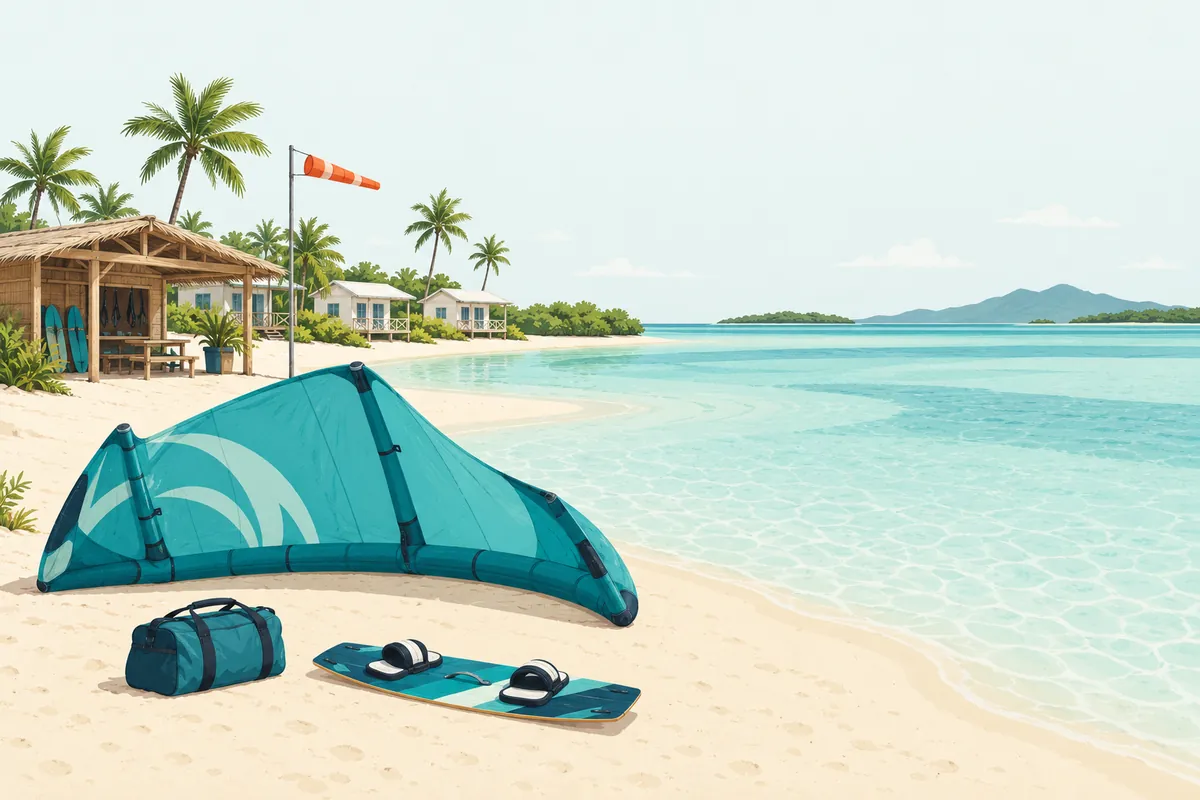
A dedicated trip stacks the deck: consecutive days, warm shallow water, wind that turns up, a lower hourly rate. Five days in a row teach more than ten scattered weekends.
Dakhla is the flattest of the classics: wind on something like 300 days a year, 15 to 25 knots on an ordinary day, 30 knots or more on July and August afternoons, and shallow lagoon edges where the schools teach. Its 19 schools make it a buyer's market.
El Gouna runs 15 to 25 knots from March to November over standing-depth lagoon water with marked school zones. Kalpitiya's lagoon is one of Asia's main beginner venues, though the May to October monsoon blows 20 to 30 knots; December to February, at 14 to 22 knots, is gentler.
Brazil's trade-wind season runs July to January. Cumbuco holds 16 to 26 knots from August to December and teaches in the Cauipe lagoon rather than on the ocean beach; Jericoacoara and Prea blow 20 to 35 knots in high season, a lot of wind for a first week; the beginner water is the river-mouth lagoon at Guriu.
Europe needs less flying: Lo Stagnone in Sicily is knee-deep and enclosed, with schools all along it and a thermal that settles at 15 to 20 knots from April to October.
Tarifa has 28 schools and the widest choice in Europe, but learn there on a Poniente day at 12 to 22 knots; the Levante blows 20 to 40 knots and leans offshore, and beginners stay on the beach for it.
Cape Town is a famous kite city and a poor place to learn: its November to March southeaster is strong and gusty, the Atlantic is cold, and its spot pages read intermediate and up.
Learning locally has one under-rated advantage: you learn the spot and the conditions you will actually ride afterwards, and every windy evening becomes cheap supervised practice. The failure mode is stretching a course over months of sporadic wind, relearning the same skills each time.
The honest recommendation, and the one most instructors give: do an intensive beginner week somewhere windy and shallow, then consolidate at your local spot with supervised rental or refresher hours. Time it for the shoulder months: April to June and September to October in Europe, August to December for the Brazilian northeast, March to November for the Red Sea.
What good learning conditions look like
- Wind: 12 to 20 knots, enough to relaunch and ride, not enough to frighten. 10 to 25 knots is the outer spectrum.
- Direction: side-onshore, about 45° to the beach, blows you back to the sand rather than into it.
- Water: flat, ideally standing depth. Waves over about a metre are a tax on a beginner.
- Steadiness beats strength: a sea breeze or trade wind beats a gustier inland thermal.
More from Learning the Sport
The other articles in this chapter- IKO vs VDWS: which kitesurfing certification?
- How to choose a kitesurfing school
- Kite camp abroad or lessons at your local spot?
The Fundamentals · Learning the Sport · The Gear · Buying Gear & Keeping It Alive · Tech & Innovation · Wind, Weather & Water · Safety & Risk · When Things Go Wrong · Rules & Etiquette · Advanced Riding · Spots of the World · Practical Tricks & Life Hacks · The Video Library · Field Notes & Extras