Map › Guides › Spots of the World › Best kitesurfing spots in Europe
The Kitesurfing Compendium · Spots of the World
Best kitesurfing spots in Europe
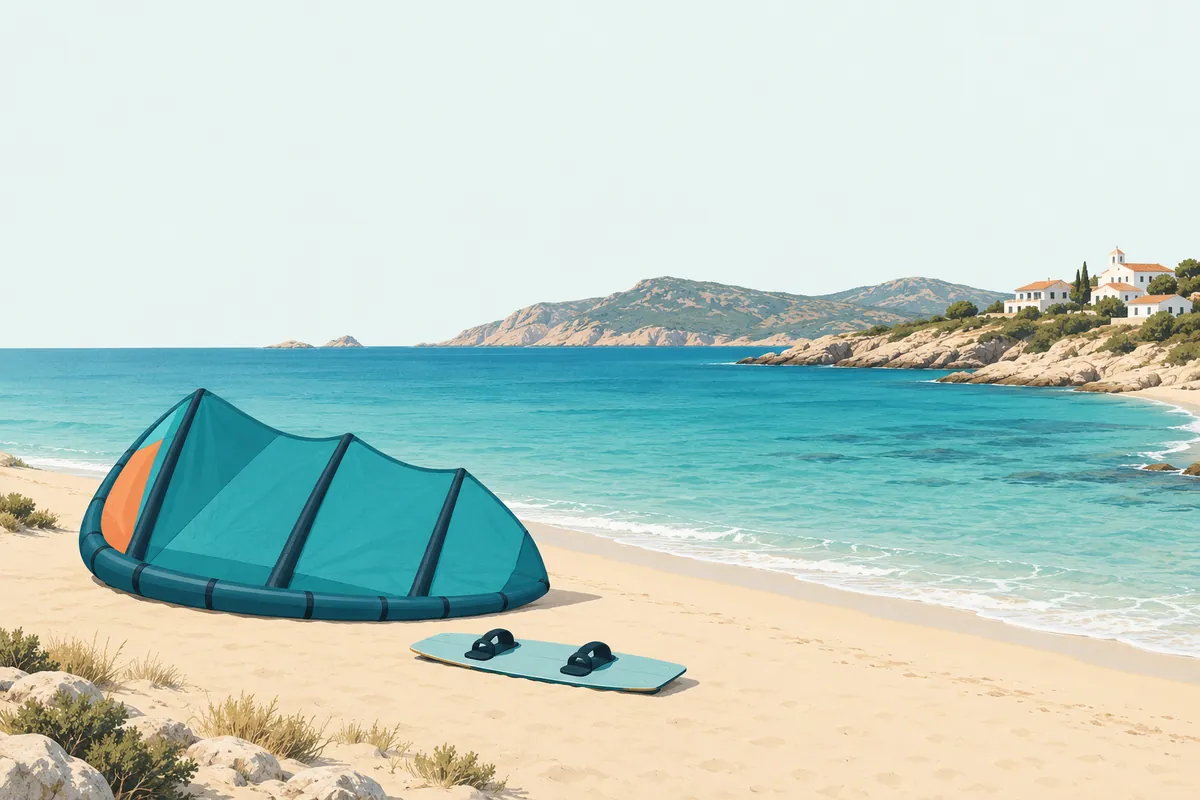
Europe rides spring to autumn. Dakhla closes the section because it is where Europe goes in winter.
Tarifa, Spain
The southern tip of Spain, where the Atlantic squeezes into the Mediterranean through the Strait of Gibraltar: more than 300 days a year blow above 15 knots across its beaches. The Levante is a warm, dry easterly accelerated by the strait, about 60% of the windy days at 20–40 knots and more.
It is gusty and side-offshore at the main beaches, it irons the water flat, and it puts you on a 5–9 m kite. The Poniente is the Atlantic westerly and the gentler half: 12–22 knots, often thermally reinforced to 15–25, side-on to onshore, the wind you want if you are learning.
Go mid-March to June or September to November. July and August are windy and packed, and the sand is divided: from 15 June to 15 September 2026 the main beaches are split into marked bathing, kite-school and free-riding zones, and Los Lances Sur is bathing-only inside that window, so check the spot pages before you drive to a beach.
Watch · 1

Fuerteventura and the Canaries, Spain
The Canaries sit in the north-east trade belt and Fuerteventura's Jandia coast squeezes it between the ridges. Sotavento is the flagship: a tidal lagoon behind a sandbar, flat and shallow when it fills.
It does not fill every day. It works on the spring tides around the full and new moon and gives roughly four hours of usable water when it does, which is why the camps publish a season timetable.
May to September is the window, 20–30 knots on a normal afternoon and over 30 in July and August. The ocean side is cross-offshore to offshore, so if you are not solid upwind and the centre boat has gone home there is nothing behind you. Intermediate
Greece and the Meltemi islands
From May to October the Meltemi funnels down the Aegean, 15–25 knots on a normal day and 18–32 on a strong July one.
Pounta on Paros faces the channel toward Antiparos at 18–24 knots most days; Mikri Vigla on Naxos gets a local acceleration worth 5–10 knots over the forecast; Prasonisi on Rhodes is a sand isthmus with flat water on one side and waves on the other; Keros beach on Limnos is a shallow bay at 17–25 knots, quieter than the Cyclades. Best once you can ride upwind. Intermediate
Portugal
Portugal's wind is the Nortada, the summer northerly. Óbidos Lagoon, an hour north of Lisbon, is the flat-water arena: 12–20 knots on an ordinary day, 15–25 once the Nortada is in.
The catch is the calendar: the estuary and the top of the lagoon close during the bathing season; May, early June, late September and October are the clean weeks up there, while the inside lagoon rides all year.
Guincho, near Cascais, is the opposite: 20–30 knot summer afternoons, gusty, rips along the cliffs and rocks at both ends. Advanced In the Algarve the schools teach in the Alvor lagoon and send independent riders to Meia Praia, where the same Nortada blows cross-offshore.
Netherlands
The Dutch coast is proof you do not need palm trees, only wind.
Sessions are frontal rather than thermal, so you watch the forecast instead of the clock: the useful band starts around 16 knots and most riders wait for 18–22. At Brouwersdam the direction decides which spot you get: a south-westerly gives 15–25 knots on the shallow lake side and rides for everyone, a westerly runs 18–28 on the North Sea side and is an advanced day.
April to June and September to October balance wind against crowd; July and August can go windless under high pressure.
Dakhla, Morocco (Western Sahara)
Technically Africa, functionally Europe's winter escape at three to five hours' flying. Dakhla is a lagoon roughly 40 km long on a desert peninsula, with wind on something like 300 to 320 days a year and a long-run mean of 16 knots at the airport, gusting 32. The trade blows cross-shore over flat, shallow water.
March to October is the season: 15–22 knots on a steady day, 15–25 through the winter, 30 and up on July and August afternoons. Beginners get the shallow edges and the lighter mornings.
Beginner Tide changes the spot more than the forecast does: low water leaves small very flat basins, high water opens the whole lagoon but adds chop. The ocean side holds the waves, at Oum Labouir and Pointe de l'Or, and both are intermediate and up.
Watch · 1

More from Spots of the World
The other articles in this chapter- Best kitesurfing spots in Europe
- Best kitesurfing spots in Italy
- Best kitesurfing spots in Africa and the Indian Ocean
- Best kitesurfing spots in the Americas
The Fundamentals · Learning the Sport · The Gear · Buying Gear & Keeping It Alive · Tech & Innovation · Wind, Weather & Water · Safety & Risk · When Things Go Wrong · Rules & Etiquette · Advanced Riding · Spots of the World · Practical Tricks & Life Hacks · The Video Library · Field Notes & Extras