All 14 chapters
In this chapter
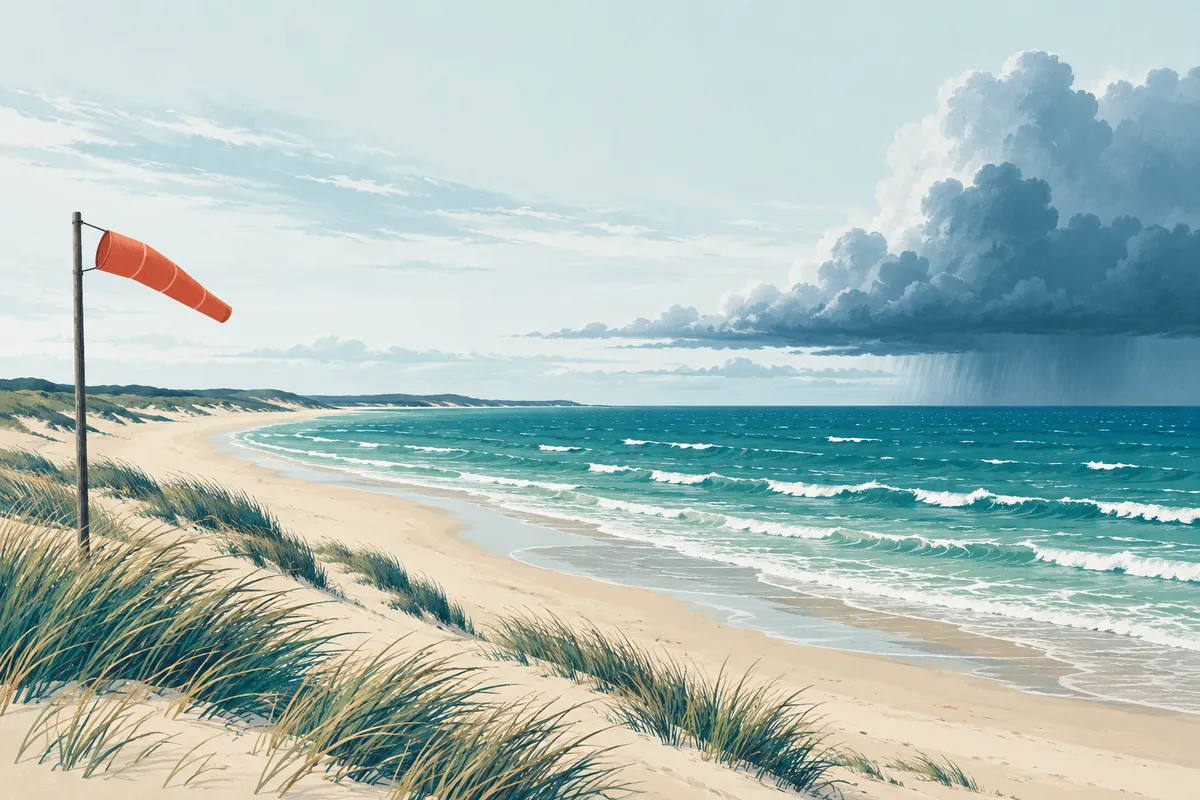
Each of these has its own pageYou need roughly 12 knots of steady wind to ride a twin-tip and hold upwind, and 12–20 knots is the band schools teach in. Wind direction matters more than wind strength: cross-onshore is the safest direction at any beach, and offshore is the one that sends you out to sea. This chapter covers wind direction, kite size for your weight, gusty wind, turbulence behind obstacles, forecast models, tides and the clouds that mean land now.
Six questions, always in this order. Direction relative to the shore, strength, gust spread, what stands behind the beach, the tide, the sky. None of it needs a meteorology degree. It needs you to ask all six on the days that look obvious as well as the days that look marginal.
Which wind direction is safe for kitesurfing?
Before strength, before kite size, ask which way the wind blows relative to the shoreline. There are five orientations and they run on a clean spectrum from safe to lethal. Every spot page in the atlas gives its direction to shore in these terms.
Cross-shore (side-shore)
Wind parallel to the beach. A kitesurfer rides at roughly right angles to the wind, so cross-shore lets you ride straight out and straight back in, which is the ideal geometry.
If the kite goes down or a line snaps you drift along the beach rather than out to sea, and a body drag brings you back to land eventually. One caveat: on peninsulas, points and small islands a cross-shore wind can carry you past the end of the land. Stay close to shore and know what lies downwind.
Cross-onshore
Wind hitting the beach at roughly 45 degrees, and the direction the teaching spots have in common. At El Argoub in Dakhla and along the bay at La Ventana the wind arrives side-onshore, so a rider who stops gets pushed back toward the sand instead of away from it; both spot pages give that as the reason beginners are sent there.
You keep the ride-away-from-the-beach geometry of cross-shore and gain a margin for broken lines, a dropped kite or plain exhaustion. The air has crossed water, so it is smooth. If you are choosing a spot to learn, choose this one. Beginner
Onshore
Wind straight at the beach, at 90 degrees. It sounds safe, since you cannot be blown out to sea, and beginners handle it worst. Every mistake pushes you toward the sand: a mistimed launch or a looping kite drags you up the beach into whatever is hard, and once riding you have to work upwind immediately just to hold position off the shore.
Getting out through a shore break is hardest in dead onshore wind. Riders who hold upwind reliably are fine in it. A beginner's failure mode is sliding downwind, and downwind here is the beach, the swimmers and whatever stands behind them. Intermediate
Cross-offshore and offshore
Wind off the land, either at an angle (cross-offshore) or straight out to sea (offshore). These are the dangerous directions, and offshore is the worst of them. Two problems compound each other:
- You drift away from rescue. If equipment, wind or your own energy fails, you are blown out to sea. Self-rescue body dragging works downwind, which in offshore conditions means further from land. Strong riders do not reliably get back either.
- The wind itself is bad. Air that has just crossed land arrives gusty and turbulent, and often lighter at the shoreline than it is further out, because buildings, trees, dunes and hills chop it up. You launch in weak, dirty wind and get pulled out into stronger wind you cannot escape.
| Direction | Angle to beach | Verdict |
|---|---|---|
| Cross-onshore | ~45° toward land | Best. The one to learn in |
| Cross-shore | Parallel | Very good; watch downwind land ends |
| Onshore | 90° toward land | Rideable by intermediates and above; hard launches, shore-break exit |
| Cross-offshore | ~45° off land | Avoid; boat backup only |
| Offshore | 90° off land | Most dangerous. Do not kite without rescue cover |
How much wind do you need to kitesurf?
Wind for kitesurfing is measured in knots (1 knot ≈ 1.85 km/h ≈ 0.51 m/s). The working envelope of the sport:
- Below ~8 knots: not kiteable on normal gear. A hydrofoiler on a big kite starts at about 8 knots.
- 10–12 knots: the practical floor for a twin-tip rider of average weight. Most riders want at least 12 knots of steady wind to ride and stay upwind.
- 12–20 knots: the teaching band, roughly force 4 to 5 on the Beaufort scale. Enough power to fly and relaunch the kite easily, not enough to punish a mistake hard. Schools keep teaching to about 22 knots on a small kite.
- 16–25 knots: the day most intermediate and advanced riders are waiting for. Powered, and big enough to jump.
- 25–35 knots: strong-wind territory. Small kites, experienced riders, and mistakes that cost something. Advanced
- ~40 knots (force 8): most kitesurfers are off the water. 50 knots is effectively unkiteable.
The destinations riders fly to sit in the middle of that band. Le Morne runs 15–26 knots through the April to October winter, Cumbuco 16–26 knots on a normal day from August to December, and the Dakhla lagoon holds a steady 15–22 knots most days, with July and August afternoons past 30. Each spot page carries its own typical range and the months behind it.
What kite size for my weight and the wind?
Kite power scales with the square of wind speed: 20 knots carries four times the punch of 10 knots, not twice. That square is why riders own a quiver of two or three kites instead of one, and why a gust matters far more than its raw number suggests.
The back-of-the-envelope estimator is the Douglass formula: kite size (m²) ≈ rider weight (kg) × 2.2 ÷ wind speed (knots). For the full table broken out by rider weight, see the gear chapter. A 75 kg rider in 18 knots: 75 × 2.2 ÷ 18 ≈ 9 m², comfortable anywhere between about 8 and 10.5 m². The real-world mapping for a 75–80 kg rider on a twin-tip:
| Wind (knots) | Kite size |
|---|---|
| 8–14 | 13–17 m² (light-wind kite) |
| 12–20 | 10–12 m² (the all-rounder; ~10–12 m is the most-used size worldwide) |
| 18–25 | 8–10 m² |
| 25–35+ | 5–8 m² |
Adjust roughly one square metre per 10 kg of rider weight in either direction. Board size counts too: a 145–150 cm twin-tip buys you a couple of knots at the bottom end, and a hydrofoil roughly halves the wind you need.
How gusty is too gusty?
Two 20-knot days can be completely different animals. What separates them is the gust spread: the gap between the average wind and the peak gusts on the forecast or the anemometer.
- Spread of 3–5 knots (18 gusting 22): smooth, laminar, easy. Typical of sea breezes and trade winds that have travelled over water.
- Spread of 8–10 knots: demanding. Constant sheeting and active kite movement.
- Spread of 10–15+ knots (20 gusting 32): unstable to dangerous, capable riders included. The square law again: 20 to 30 knots is a 2.25× jump in power, arriving in seconds.
Gusty wind comes from air that has crossed land, from frontal or unstable systems, or from mountains and cliffs upwind. Steady wind usually means a long open-water fetch, which is why beginners get sent to trade-wind and sea-breeze destinations in the first place.
Thermal winds and sea breezes
On a sunny coast the land heats faster than the sea. Warm air over the land rises, pressure drops locally, and cooler maritime air flows in to replace it: the sea breeze. It switches on in late morning, peaks mid-afternoon and dies near sunset, which is why so many famous spots are afternoon spots.
La Ventana is the textbook case: mornings are calm, the wind fills between about 11:00 and 12:30, and it fades between 16:00 and 18:00. A thermal commonly adds 5–15 knots on top of the gradient forecast in hot weather.
At Lo Stagnone in Sicily the summer thermal is worth about 5–8 knots over a plain forecast and holds strongest from 12:00 to 18:00. Because the air arrives over water it is smooth, and it is reliably cross-shore or cross-onshore.
Geography amplifies a thermal. Where wind funnels through a gap, a strait or a valley, the Venturi effect accelerates it: the same air squeezed through a smaller space has to speed up, so a 12-knot breeze on the open coast can arrive at a pinch-point spot at 20–25 knots.
Tarifa sits in the Strait of Gibraltar and gets more than 300 days a year above 15 knots, with the Levante accounting for roughly 60% of the windy days and the Poniente most of the rest. The Columbia Gorge does the same trick with a river canyon cut between two mountain ranges.
The reverse runs at night. The land cools and a weak, gusty, offshore land breeze flows out to sea, one more reason dawn sessions on thermal coasts rarely pay.
How far downwind does an obstacle ruin the wind?
Wind does not stop at an obstacle. It splits, tumbles over and around it, and re-forms downstream as a chaotic, swirling wake: the wind shadow. Inside it the speed drops sharply and the direction changes second to second, which is the worst air there is for launching or flying a kite.
Buildings, dunes, cliffs, moored boats, camper vans and a dense crowd of beach umbrellas all count. What follows:
- Launch and land with at least 50–100 m of clear space, and set up downwind of nothing tall.
- Keep a hazard-free zone of roughly 300 m downwind of where you are riding. That is where you and your kite go when something fails.
- Be suspicious of any wind that has just crossed land. It reads lower at the shoreline than it is out to sea, which tempts you into rigging too big.
- Cliffs and steep hills upwind create rotors, and in strong wind updrafts near their faces, called ridge lift, that can loft a kiter. Give vertical terrain a wide berth.
How to read a kitesurfing wind forecast
Three kinds of tool, and most riders end up with all three open:
- A table forecast, which prints raw model output per three-hour block: wind speed, gusts, direction arrows, temperature, cloud in three layers, rain and a star rating. Its value is depth: stack GFS, ICON and AROME for one spot and you see whether they agree.
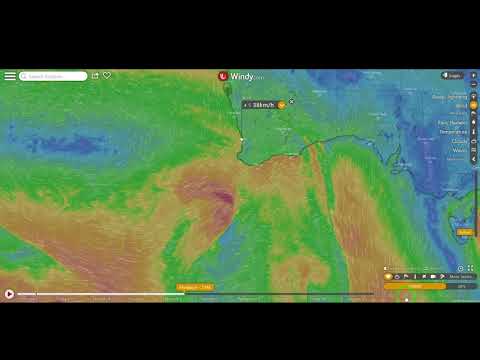
- A map forecast, which animates the same models over a chart. Best for the pattern: where a front is, how a thermal cell builds through the day, what the next 72 hours look like.
- A live station feed. Cross-check the forecast against observed wind at a station near the spot before you drive. Every spot page here links the forecast for its own coordinates, so you are not guessing which grid point to read.
What the numbers and models actually mean
A forecast is the output of a numerical weather model, a physics simulation run on a grid. On a coastline the grid size decides almost everything:
- GFS (American, global, ~13 km grid): available everywhere, good for the multi-day trend and for open-ocean trade-wind regions like Brazil, Cape Verde and Dakhla. Too coarse to see a sea breeze, a venturi or a bay 5 km wide, so it misses local effects outright.
- ECMWF (European, global, ~9 km): generally the most accurate global model. A 2026 comparison against live coastal stations reportedly put it within ±3 knots about 70% of the time.
- ICON (German) and AROME (French, ~1–2 km grid): high-resolution regional models, strong in and around Europe. AROME in particular resolves the thermal and coastal effects the global models smear out.
- NAM and HRRR: the North American high-resolution equivalents.
Using them:
- Compare at least two models. If a global and a local high-resolution model agree on strength and direction, confidence is high. If they diverge wildly the situation is unstable, so plan loosely.
- Trust the 24–48 hour window. Beyond three days you are reading trends, not sessions.
- Read the gust line, not just the average. Average 20 gusting 30 is a rougher day than average 24 gusting 27.
- Check direction against the beach, not the compass. A beautiful 20-knot arrow is worthless, or lethal, if it points offshore at your spot.
- Learn your spot's bias. Thermal spots blow over forecast; shadowed or urban spots blow under. Keep a log, mental or literal.
Watch · 3


How tides change a kite spot
At many spots the tide quietly decides whether a good wind is usable at all. Four mechanisms matter:
- Depth. A shallow lagoon that is waist-deep at mid-tide can be dry sand at low water, or head-deep with a shore break at high water, and the character of the spot flips inside two hours. Ilha do Guajiru in Brazil is the clean example: mid and high tide give the biggest sheet of rideable lagoon and are the window the schools work to, while a spring low drains the water in front of Praia da Barra and pushes everyone to the far end, to the ocean side, or to another spot. Elsewhere the opposite holds and low tide uncovers vast standable flats.
- Current. Estuaries, river mouths, channels and headlands can run several knots of tidal stream on a spring tide, strongest around mid-tide. At Brouwersdam the lake side behind the sluice is effectively still, while the flow past the outlet on the North Sea side reaches 2–3 knots at springs. Current against you steals apparent board speed and upwind ability, and wind against tide stacks up short, steep chop. A 2-knot stream under a marginal 12-knot day is the difference between riding and swimming.
- Exposed hazards. A falling tide uncovers rocks, reef, sandbars and wrecks that were safely underwater an hour before. Plenty of spots are known locally as high-tide only or low-tide only for this reason, and the spot page says which.
- Shore break. Many beaches develop a dumping shore break at particular stages of the tide, which turns entry and exit into the sketchiest part of the session. The standard answer is to body-drag out past it before you start.
Flat water or waves for learning to kitesurf
Flat water, meaning lagoons, sandbar-protected bays and estuaries at the right tide, is the fastest and safest place to learn. Without swell knocking the board around, a beginner can concentrate on kite control, body dragging and the water start, and board skills arrive in half the time. Standable depth is what schools want, which is why the beginner lagoons keep the same names on every list.
You can touch the bottom across roughly 80% of Lo Stagnone in Sicily, in 15 cm to 1.5 m of water. Le Morne has a learning flat of 60–80 cm with the reef 600 m out. The Cauípe lagoon behind Cumbuco teaches in about 120 cm, and the Dakhla lagoon holds standing water up to 300 m out at high tide. Beginner
Small chop, wind-generated ripple under about 0.5 m, rides almost like flat water and is what most open-coast riders live on. It adds ramps to pop off and little difficulty.
Waves are a discipline of their own. Riding real swell asks for wave-reading, timing, and comfort with the kite parked in one part of the window while the board does something else, enough that a competent flat-water rider feels like a beginner again in head-high surf.
For learners, waves add hazards on top of the difficulty: the board is hard to recover in white water, a shore break complicates every entry and exit, and a downed kite in the impact zone gets destroyed. Advanced
When to get off the water in a storm
The forecast gets you to the beach; the sky keeps you alive once you are there. The one cloud every kitesurfer has to recognise is the cumulonimbus, the towering, anvil-topped storm cloud. It is the only cloud that makes its own wind: violent convective updrafts and cold downdrafts mean the wind near a storm cell is unpredictable in strength and in direction, independent of the prevailing breeze.
A squall or microburst ahead of a cell can take the wind from 20 knots to 60–80 knots in seconds, enough to loft a rider clean off the water, or kill it dead, or spin it 180 degrees. Add lightning, which goes very badly with a wet 25 m set of lines, and the rule writes itself.
- A sudden wind drop, a sudden temperature drop, or wind backing rapidly toward the cell are all pre-squall signatures. Any one of them means head in.
- Puffy fair-weather cumulus mostly bring five-minute lulls and puffs as they pass, and a grey sheet of stratus usually means stable, if dull, wind. It is the vertical development that kills.
- Frontal systems, the classic mid-latitude windy day, deliver strong but shifty, gusty wind, often with a sharp direction change as the front goes through. Read the synoptic chart, not only the numbers.
What are ideal wind conditions for a beginner?
Put the whole chapter together and the perfect learning day looks like this: Beginner
- Wind: 12–20 knots, steady, with a gust spread under about 5 knots. A thermal sea breeze or a trade wind that has crossed open water is what you want.
- Direction: cross-onshore, or cross-shore. Never offshore or cross-offshore. Onshore only once you can reliably stay upwind.
- Water: flat and waist-deep if you can get it, small chop otherwise. No meaningful shore break, no waves.
- Space: 100+ m of clean launch area, nothing tall within about 7× its height upwind, no hazards for 300 m downwind, few other beach users.
- Tide: checked. You know the depth, the stream, and what gets exposed over the next three hours.
- Sky: no vertical cloud development upwind, and no front due inside your session window.
- Forecast: two models in agreement, confirmed on arrival by a live wind station, or by the flags and the kite sizes other people are rigging.
Watch · 5


Questions riders ask
How much wind do you need to kitesurf?
About 12 knots of steady wind for a twin-tip rider of average weight, and 12–20 knots to learn in. Below 8 knots only a hydrofoil on a big kite gets going, and above about 40 knots almost everyone is off the water.
What kite size do I need for my weight?
Start from weight in kg × 2.2 ÷ wind in knots. A 75 kg rider in 18 knots lands on a 9 m², and one square metre per 10 kg of body weight moves it up or down. Two kites, roughly 12 m² and 9 m², cover 12–25 knots for that rider.
Why is offshore wind dangerous for kitesurfing?
Because body dragging only works downwind, and downwind is the open sea. The air also reads lighter at the shore than it is further out, so you rig too big and get pulled into wind you cannot escape. Ride it only where a rescue boat is on the water, or on an enclosed lagoon.
How far from buildings and trees should I launch?
An obstacle dirties the air about 3× its height upwind and 7× its height downwind, so a 10 m treeline throws a wake at least 70 m downwind. Launch with 50–100 m of clear space and keep 300 m downwind of you free of hazards.
Does the tide matter if the wind is good?
At tidal spots it decides the session. A spring low can drain a lagoon, uncover reef, or leave you a long walk; a channel or river mouth can run 2–3 knots of stream against you. Read the spot page for the tide notes, then check a tide table next to the forecast.
Chapter 07 · Part III · Wind, Water & Risk