Map › Guides › Wind, Weather & Water › Which wind direction is safe for kitesurfing?
The Kitesurfing Compendium · Wind, Weather & Water
Which wind direction is safe for kitesurfing?
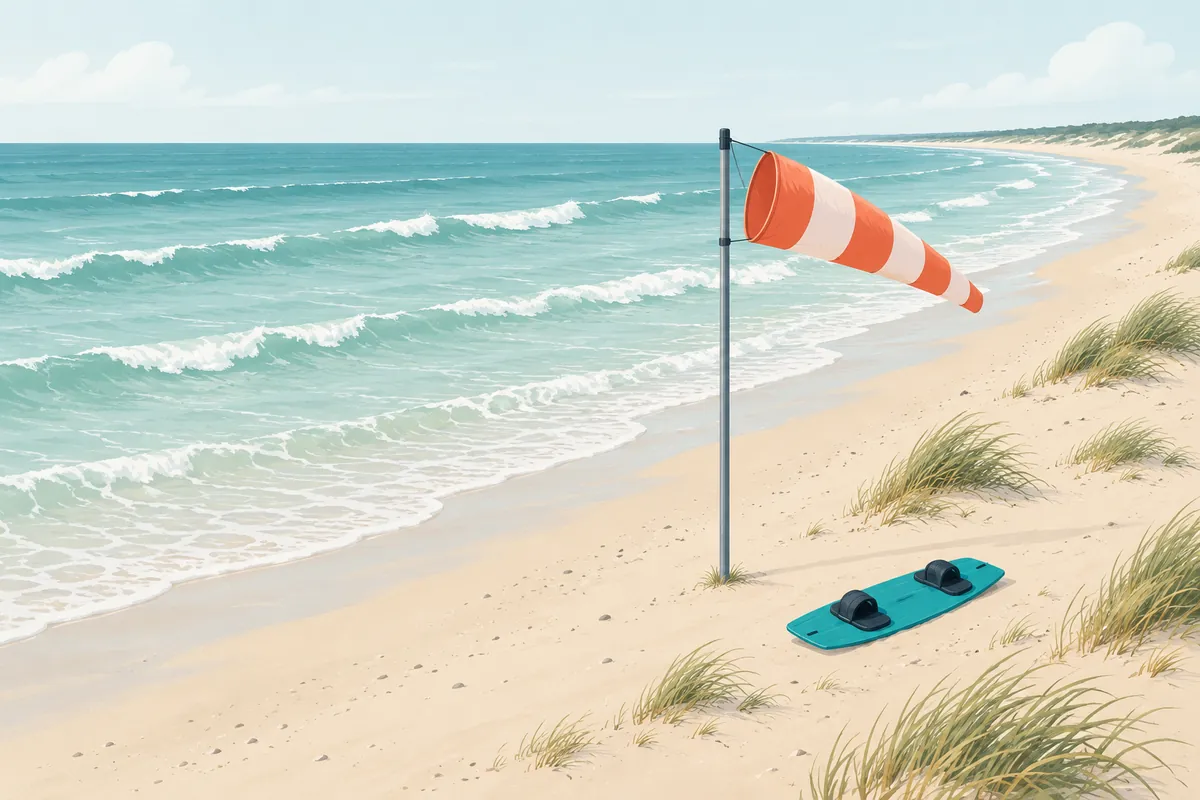
Before strength, before kite size, ask which way the wind blows relative to the shoreline. There are five orientations and they run on a clean spectrum from safe to lethal. Every spot page in the atlas gives its direction to shore in these terms.
Cross-shore (side-shore)
Wind parallel to the beach. A kitesurfer rides at roughly right angles to the wind, so cross-shore lets you ride straight out and straight back in, which is the ideal geometry.
If the kite goes down or a line snaps you drift along the beach rather than out to sea, and a body drag brings you back to land eventually. One caveat: on peninsulas, points and small islands a cross-shore wind can carry you past the end of the land. Stay close to shore and know what lies downwind.
Cross-onshore
Wind hitting the beach at roughly 45 degrees, and the direction the teaching spots have in common. At El Argoub in Dakhla and along the bay at La Ventana the wind arrives side-onshore, so a rider who stops gets pushed back toward the sand instead of away from it; both spot pages give that as the reason beginners are sent there.
You keep the ride-away-from-the-beach geometry of cross-shore and gain a margin for broken lines, a dropped kite or plain exhaustion. The air has crossed water, so it is smooth. If you are choosing a spot to learn, choose this one. Beginner
Onshore
Wind straight at the beach, at 90 degrees. It sounds safe, since you cannot be blown out to sea, and beginners handle it worst. Every mistake pushes you toward the sand: a mistimed launch or a looping kite drags you up the beach into whatever is hard, and once riding you have to work upwind immediately just to hold position off the shore.
Getting out through a shore break is hardest in dead onshore wind. Riders who hold upwind reliably are fine in it. A beginner's failure mode is sliding downwind, and downwind here is the beach, the swimmers and whatever stands behind them. Intermediate
Cross-offshore and offshore
Wind off the land, either at an angle (cross-offshore) or straight out to sea (offshore). These are the dangerous directions, and offshore is the worst of them. Two problems compound each other:
- You drift away from rescue. If equipment, wind or your own energy fails, you are blown out to sea. Self-rescue body dragging works downwind, which in offshore conditions means further from land. Strong riders do not reliably get back either.
- The wind itself is bad. Air that has just crossed land arrives gusty and turbulent, and often lighter at the shoreline than it is further out, because buildings, trees, dunes and hills chop it up. You launch in weak, dirty wind and get pulled out into stronger wind you cannot escape.
| Direction | Angle to beach | Verdict |
|---|---|---|
| Cross-onshore | ~45° toward land | Best. The one to learn in |
| Cross-shore | Parallel | Very good; watch downwind land ends |
| Onshore | 90° toward land | Rideable by intermediates and above; hard launches, shore-break exit |
| Cross-offshore | ~45° off land | Avoid; boat backup only |
| Offshore | 90° off land | Most dangerous. Do not kite without rescue cover |
FAQ
Why is offshore wind dangerous for kitesurfing?
Body dragging only works downwind, and downwind is the open sea. The air also reads lighter at the shore than it is further out, so you rig too big and get pulled into wind you cannot escape. Ride it only where a rescue boat is on the water, or on an enclosed lagoon.
How far from buildings and trees should I launch?
An obstacle dirties the air about 3x its height upwind and 7x its height downwind, so a 10 m treeline throws a wake at least 70 m downwind. Launch with 50-100 m of clear space and keep 300 m downwind of you free of hazards.
Does the tide matter if the wind is good?
At tidal spots it decides the session. A spring low can drain a lagoon, uncover reef, or leave you a long walk, and a channel or river mouth can run 2-3 knots of stream against you. Read the spot page for the tide notes, then check a tide table next to the forecast.
More from Wind, Weather & Water
The other articles in this chapter- Which wind direction is safe for kitesurfing?
- How gusty is too gusty?
- How to read a kitesurfing wind forecast
The Fundamentals · Learning the Sport · The Gear · Buying Gear & Keeping It Alive · Tech & Innovation · Wind, Weather & Water · Safety & Risk · When Things Go Wrong · Rules & Etiquette · Advanced Riding · Spots of the World · Practical Tricks & Life Hacks · The Video Library · Field Notes & Extras