Map › Guides › Safety & Risk › Which wind directions are safe to kitesurf in?
The Kitesurfing Compendium · Safety & Risk
Which wind directions are safe to kitesurf in?
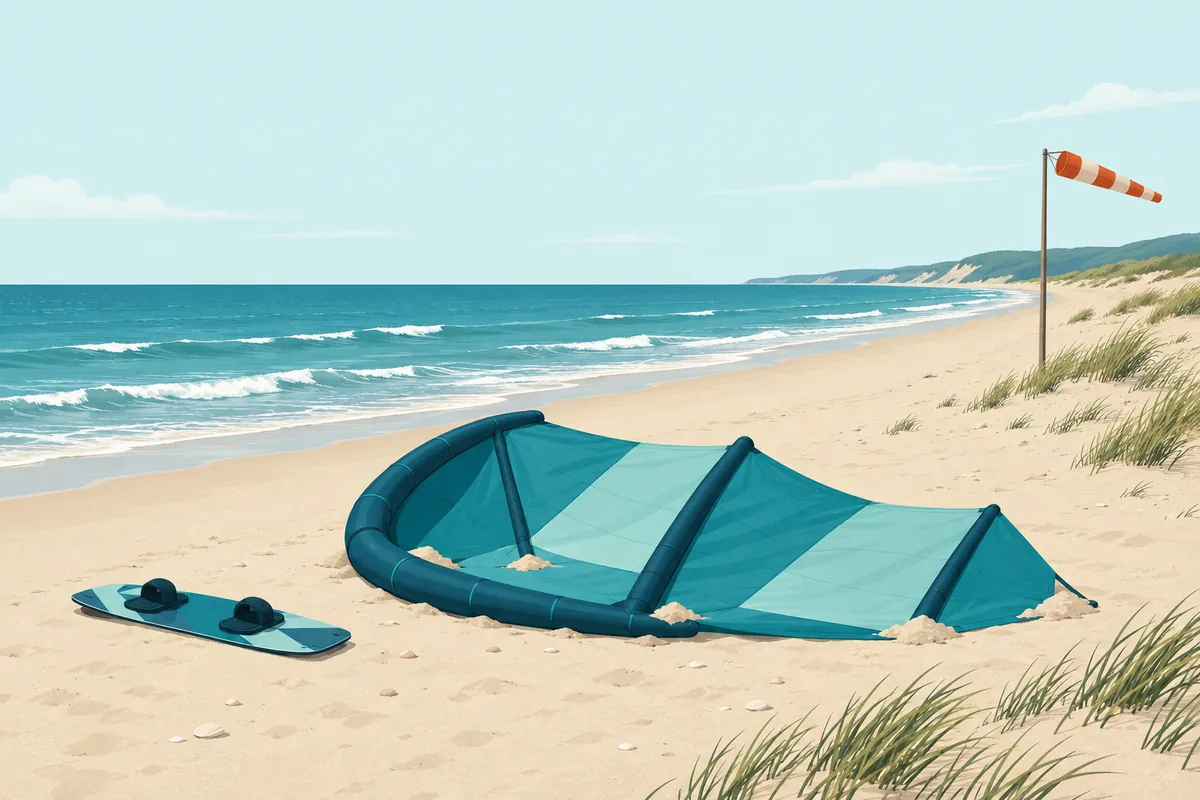
Side-shore and side-onshore are the working directions. Offshore wind kills quietly; dead-onshore pins you against the beach with no run-off room, and the fatality analysis found onshore wind direction was a factor in 58% of deaths.
Can you kitesurf in offshore wind?
Offshore wind blows from the land out to sea. Close in, the water looks flat and inviting because the land is blocking the waves, and every metre you drift is a metre further from help. Kite down and no relaunch, wind dies, a line snaps: you are heading for the horizon. No offshore wind without organised boat rescue on the water.
Two things get mistaken for the exception. The first is the enclosed lagoon. At Ilha do Guajiru the trade comes in side-onshore over the sandstrip, so a drift carries you across flat water instead of out through an opening; at Dakhla the lagoon wind runs cross-shore, N to NE. That is geography doing the work, not offshore riding.
The second is a spot with a real safety operation: at Icaraí de Amontada one bay-tip centre runs a lifeguard team, safety boats, rescue cars and radio, and that cover belongs to its own clients rather than to the beach. Most spot pages carry a rescue line for this reason. At Tatajuba it reads no lifeguard, no rescue boat, no jet-ski, nearest medical care in Camocim.
The related trap is offshore-gusty wind: air that has crossed land arrives turbulent, with lulls that drop a kite out of the sky and gusts that overpower you seconds later.
Storms and squalls
In the same fatality analysis, squalls or violent weather were a factor in 52% of deaths and gusty wind in 67%. Seasonally, autumn (42%) and spring (27%), the seasons of fast-moving fronts and unstable air, took the large majority, against 17% in summer and 14% in winter.
A squall line can double or triple the wind speed in under a minute and swing its direction 90–180°. A rider happy on a 12 m kite in 18 knots is helpless when 40 arrives. The defence is all anticipation:
- Read the gust figures, not the average. A forecast of 18 knots gusting 30 is a red flag: a spread wider than about 8–10 knots means turbulent air.
- Read the sky. A dark line of cloud upwind, a sudden drop in temperature or an odd calm means land now, not in ten minutes.
- Never launch with cumulonimbus or thunderstorms in the area. Lightning and 22–24 m of wet line is a hazard of its own.
- If it catches you out, ride in early and land; in the worst case, quick-release on the water and self-rescue.
Some places put a number on the judgement call, and the spot page carries it. At De Panne the 2026 regulation lets you go to sea only between sunrise and sunset, only with no red flag flying, and only below 7 Beaufort, 13.9 m/s, about 27 knots.
Along the same coast at Nieuwpoort - Oostduinkerke that ceiling was dropped for 2026 and the call is yours again. The Greek national rules allow riding above Beaufort 6 only with a lifeguard and a motor boat present.
More from Safety & Risk
The other articles in this chapter- Which wind directions are safe to kitesurf in?
- Kitesurfing injuries: impact, collisions, lines, cold and marine life
- Should you use a board leash when kitesurfing?
The Fundamentals · Learning the Sport · The Gear · Buying Gear & Keeping It Alive · Tech & Innovation · Wind, Weather & Water · Safety & Risk · When Things Go Wrong · Rules & Etiquette · Advanced Riding · Spots of the World · Practical Tricks & Life Hacks · The Video Library · Field Notes & Extras