Map › Guides › Safety & Risk › Kitesurfing injuries: impact, collisions, lines, cold and marine life
The Kitesurfing Compendium · Safety & Risk
Kitesurfing injuries: impact, collisions, lines, cold and marine life
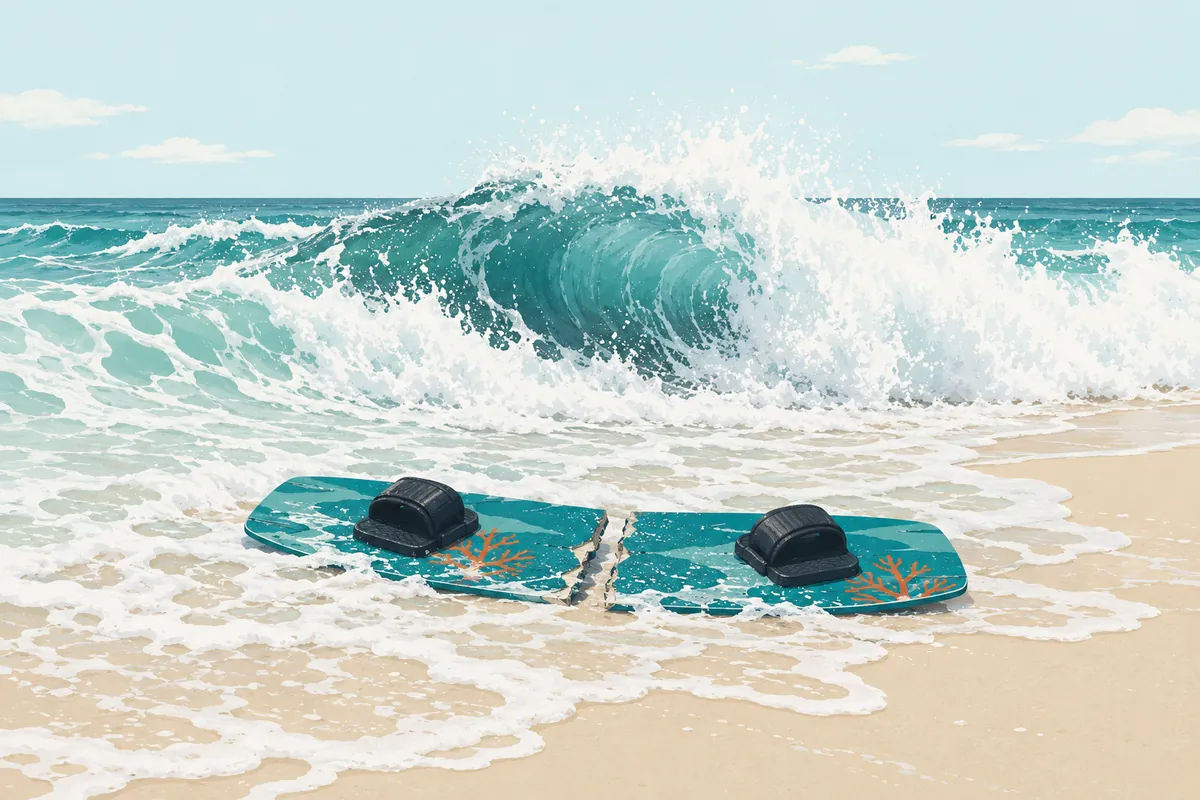
Shore break and shallow-water impact
Waves dumping onto a steep beach break boards, dislocate shoulders and drive riders head-first into the sand. Most impact injuries come from something duller: crashing at speed in waist-deep water. The commonest kitesurfing injuries in clinical studies are cuts and abrasions (23%), rib injuries (12%), knee ligament injuries (6%), foot and ankle fractures and ligament injuries (about 5% each) and concussion (5%).
Other water users, and other kiters
Collisions are a real share of injuries, and kite lines make them worse: two kites tangling can loop both into power that nobody controls. Give at least 50 m of clear space downwind before you jump, 30 m upwind.
Keep well clear of swimmers, because kiters give way to every other water user, and never assume the rider on the other tack knows the right-of-way rules or will honour them.
Stay out of marked bathing zones, which in many countries is law rather than etiquette. The awkward part is that the number moves: on the Gold Coast three versions of the exclusion circulate and disagree, from 60 m either side of the flags to 200 m offshore before you cross flagged water (2026). Take the widest and read the spot page before you rig.
Lines under tension
Kite lines are Dyneema 1–2 mm thick with a breaking strain of 200–300 kg or more. Under load they behave like a cheese wire, and the medical literature documents deep lacerations, tendon damage and finger amputations.
Four rules cover it: never grab a line under tension; never step over or stand inside your lines or anyone else's; control a kite in wind by the leading edge, never the bridles; and when you help someone launch or land, hold the kite, not the lines.
Cold water and hypothermia
Cold is a slow emergency that takes your judgement first and your hands second, the two things a crisis needs. Below about 35 °C core temperature come confusion, fumbling fingers and lost coordination. A self-rescue that takes 45 minutes in 12 °C water is a survival situation in board shorts and a routine chore in proper neoprene. By water temperature (see the full wetsuit-thickness chart for the finer bands):
| Water temperature | Recommended exposure protection |
|---|---|
| Above ~22 °C | Boardshorts or a shorty |
| 17–21 °C | 3/2 mm fullsuit |
| 12–16 °C | 4/3 or 5/4 mm fullsuit with boots |
| Below 12 °C | 5/4–6 mm suit (or drysuit) plus 5 mm boots, gloves and a hood |
In winter, shorten the session, stay closer to shore, and never ride alone.
Marine life
Statistically the least of your worries, and still worth a paragraph. Jellyfish stings and standing on a weever fish or a sea urchin cause more incidents than anything with teeth.
The stingray shuffle, sliding your feet along the bottom instead of stepping down, prevents most ray strikes in warm shallow water; the Gold Coast spot notes ask for exactly that on the flats beside the sandbanks. Shark incidents involving kitesurfers are vanishingly rare, and the moving board and kite appear to deter rather than attract. Ask the school what lives at the spot.
More from Safety & Risk
The other articles in this chapter- Which wind directions are safe to kitesurf in?
- Kitesurfing injuries: impact, collisions, lines, cold and marine life
- Should you use a board leash when kitesurfing?
The Fundamentals · Learning the Sport · The Gear · Buying Gear & Keeping It Alive · Tech & Innovation · Wind, Weather & Water · Safety & Risk · When Things Go Wrong · Rules & Etiquette · Advanced Riding · Spots of the World · Practical Tricks & Life Hacks · The Video Library · Field Notes & Extras