Map › Guides › Practical Tricks & Life Hacks › What wetsuit thickness for the water temperature?
The Kitesurfing Compendium · Practical Tricks & Life Hacks
What wetsuit thickness for the water temperature?
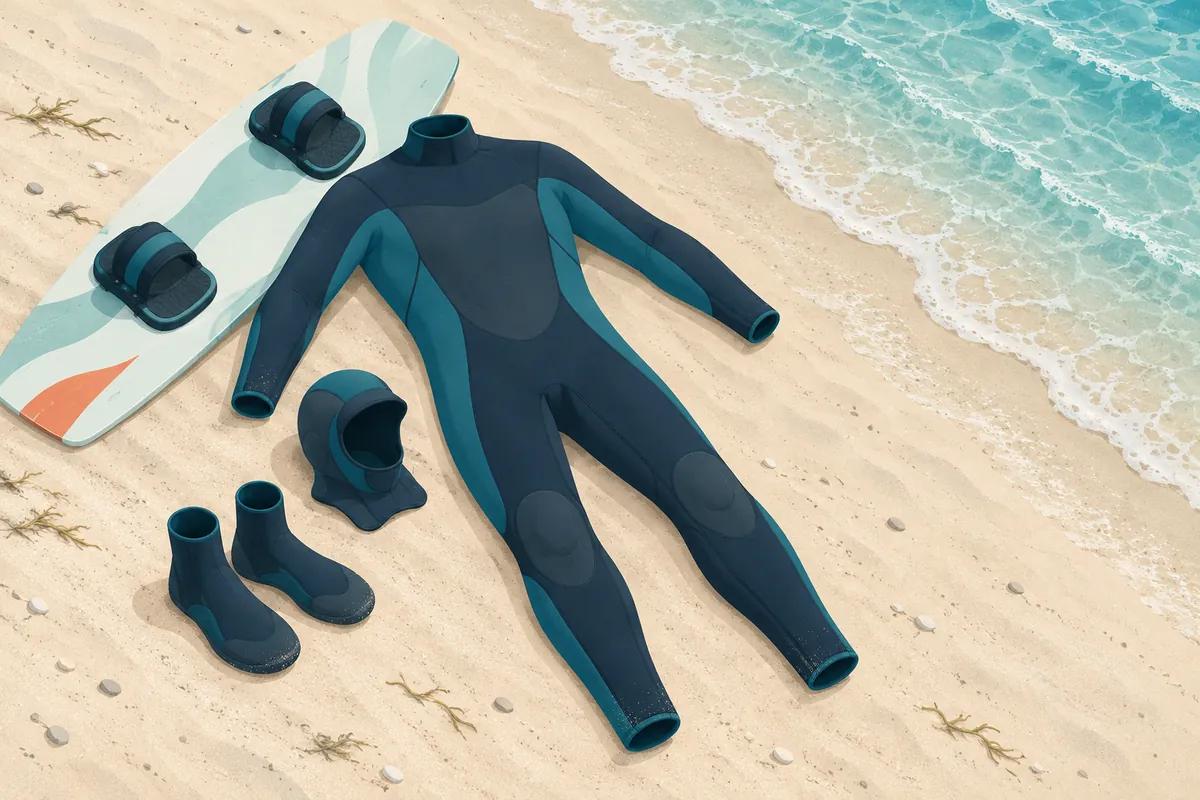
Dress for the water temperature, then go one step warmer for the wind. A kitesurfer is not immersed like a diver: you stand above the water, in the wind powering your kite, so evaporative cooling does more work on you than on a surfer in the same sea.
Thickness is written as two or three numbers in millimetres, 4/3 or 5/4/3. The first number is the torso panel, thickest for core warmth; the later numbers cover arms and legs. The bands below overlap, because session length, wind strength and tolerance each move you a step.
| Water temp | What to wear | Accessories | Seams |
|---|---|---|---|
| Above 24 °C / 75 °F | Boardshorts + rash guard or lycra | Nothing (sun protection instead) | n/a |
| 18–24 °C / 65–75 °F | Neoprene top (0.5–2 mm) or shorty (2/1) | None | n/a |
| 17–20 °C / 62–68 °F | 3/2 springsuit or full suit | None | Flatlock |
| 14–17 °C / 58–63 °F | 3/2 to 4/3 full suit | Booties | Glued & blind-stitched (sealed) |
| 11–14 °C / 52–58 °F | 4/3 to 5/4/3 full suit | Boots + gloves + hood | Sealed and taped |
| 6–11 °C / 43–52 °F | 5/4 to 5/4/3 | 5 mm boots, gloves, hood | Sealed and taped |
| Below 6 °C / 42 °F | 6/5/4 semi-dry or a drysuit | Everything, no exposed skin | Sealed and taped |
- Seams matter as much as thickness. Flatlock seams let water through and belong only in warm water. From roughly 17 °C down you want glued and blind-stitched seams; below 14 °C, taped or liquid-sealed seams are what actually keep you warm.
- Fit beats thickness. A loose 5/4 that flushes cold water on every crash is colder than a snug 4/3.
- Drysuits earn their keep when the air and the water are both against you: the usual trigger is wind chill plus water putting you around or below 15 °C / 60 °F effective. You can wear warm layers underneath and change in seconds. They are also baggier and pricier, typically €500–900 in 2026.
- Extremities. Booties, gloves and a hood in 2–3 mm make a startling difference; in properly cold conditions go 5 mm, even 7 mm for boots if you run cold. If you are cold while setting up on the beach, you will never warm up on the water.
- Neoprene tops and hoodies (0.5–2 mm) are the most underrated item in the quiver. Over a shorty or under a summer suit they add a month at each end of the season, and on the beach they kill wind chill while you rig.
- Rash guards and lycra are the number-one item for warm-water riders and beginners: harness rash, board scrapes and sunburn all stop, and a UPF 50 long-sleeve protects more reliably than any cream.
One destination can span most of the chart on its own. The spot page for Zandvoort puts the water at 18 °C in summer and 6 °C in winter: a sealed 3/2 in mid-August, a 6/5/4 or a 5/4 with gloves, 5 mm boots and a hood in late February.
Warm air is no guide either; Essaouira is 20–22 °C in summer under a hot sky and still takes a 3/2. Every spot page carries the summer and winter water temperature and the suit riders there wear.
FAQ
What wetsuit thickness do I need for kitesurfing?
In 14-17 C water, a 3/2 to 4/3 with booties. In 11-14 C, a 4/3 to 5/4/3 with boots, gloves and hood. Below 6 C, a 6/5/4 semi-dry or a drysuit. Go one band warmer than a surfer would.
How much water should I drink while kitesurfing?
Roughly 0.5 L per hour of riding on top of your normal daily intake, in small amounts between runs to the beach. Past 90 minutes, use an electrolyte drink.
More from Practical Tricks & Life Hacks
The other articles in this chapterThe Fundamentals · Learning the Sport · The Gear · Buying Gear & Keeping It Alive · Tech & Innovation · Wind, Weather & Water · Safety & Risk · When Things Go Wrong · Rules & Etiquette · Advanced Riding · Spots of the World · Practical Tricks & Life Hacks · The Video Library · Field Notes & Extras