Map › Guides › Practical Tricks & Life Hacks › Flying with kite gear: what airlines charge for a kite bag
The Kitesurfing Compendium · Practical Tricks & Life Hacks
Flying with kite gear: what airlines charge for a kite bag
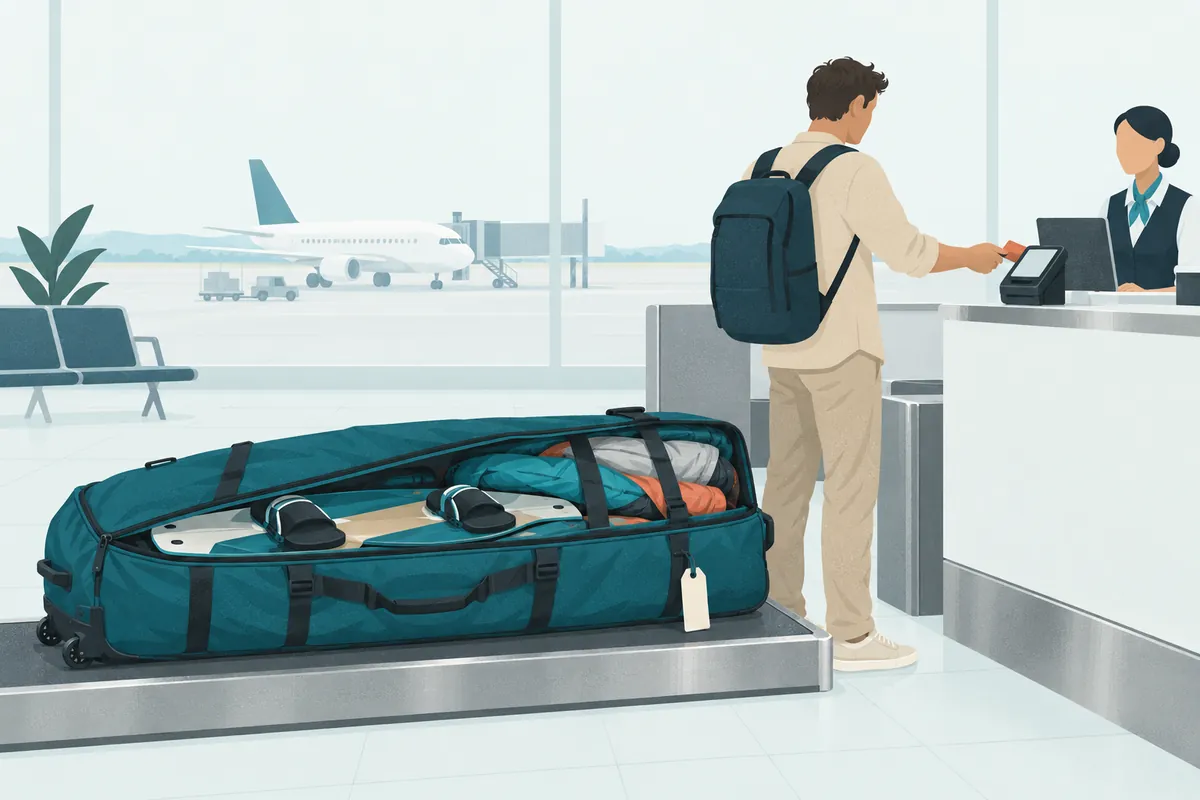
Kite gear travels better than almost any other boardsport equipment: kites compress and twin-tips are short. The fees are the problem, and on a cheap ticket they cost more than the seat.
- Check the specific airline before you book, not after. The spread is enormous. Air France carried a kite bag as an ordinary checked bag in 2026, free under 300 cm and 23 kg if declared 48 hours ahead, except on Light fares; Emirates the same in 2026. Alaska charged $30 (2026) for a first sports bag, $40 for a second (2026). Ryanair wanted EUR/GBP 35–60 online in 2026, more at the airport, per item per flight. Iberia's long-haul rate was EUR 130–187 in 2026. The airline pages carry each policy with the year it was checked.
- Book the bag online, never at the desk. On the low-cost carriers the gap is a third to a half: Wizz Air charged EUR 45 online, EUR 65 at the airport (2026); Norwegian EUR 35 and EUR 60 (2026). Some carriers want notice rather than money. Air France asks for 48 hours, Condor for 8, and turning up undeclared roughly doubled Condor's USD 75–150 per leg in 2025.
- Choose your bag and your words. The old golf bag trick, checking gear as golf equipment because many airlines carry that free or cheap, is fading: agents at kite destinations have seen it all. It still works where kiters are rare, and a golf-style bag at least avoids the reflexive surfboard fee. Never lie if asked. "Sports equipment" is honest and usually enough.
- Pack to 23 kg / 50 lb, and weigh it. That is the standard allowance on most full-service carriers, but check yours: Ryanair capped a sports item at 20 kg in 2026, Norwegian at 25 kg. A €15 luggage scale (2026) pays for itself on the first trip. A standard boardbag swallows a twin-tip with fins and straps off, 2–3 kites, bar, harness and pump. It weighs more coming home: sand and damp gear.
- Shave weight where it counts. Kites out of their individual bags and into compression sacks, harness and wetsuit into hand luggage or worn, pump handle disassembled. The bar is borderline: a large metal object that gets questioned at security, so check it. Some riders carry one kite as cabin baggage.
- Protect the board. Fins off, pipe-insulation foam or bubble wrap on the rails, clothes as padding. Photograph the packed bag before you close it, for the insurance claim you hope not to make.
- Or do not fly with it at all. For a one-week trip to a major destination, renting locally, typically €30–60 a day in 2026 and less by the week, or buying and reselling, can beat two round-trip board fees plus the schlep.
Watch · 4


More from Practical Tricks & Life Hacks
The other articles in this chapter- What wetsuit thickness for the water temperature?
- Best sunscreen for kitesurfing, and how often to reapply
- Booties, ear plugs and the injuries that actually happen
- Flying with kite gear: what airlines charge for a kite bag
- How to make kite gear last longer
The Fundamentals · Learning the Sport · The Gear · Buying Gear & Keeping It Alive · Tech & Innovation · Wind, Weather & Water · Safety & Risk · When Things Go Wrong · Rules & Etiquette · Advanced Riding · Spots of the World · Practical Tricks & Life Hacks · The Video Library · Field Notes & Extras