Map › Guides › Practical Tricks & Life Hacks › Booties, ear plugs and the injuries that actually happen
The Kitesurfing Compendium · Practical Tricks & Life Hacks
Booties, ear plugs and the injuries that actually happen
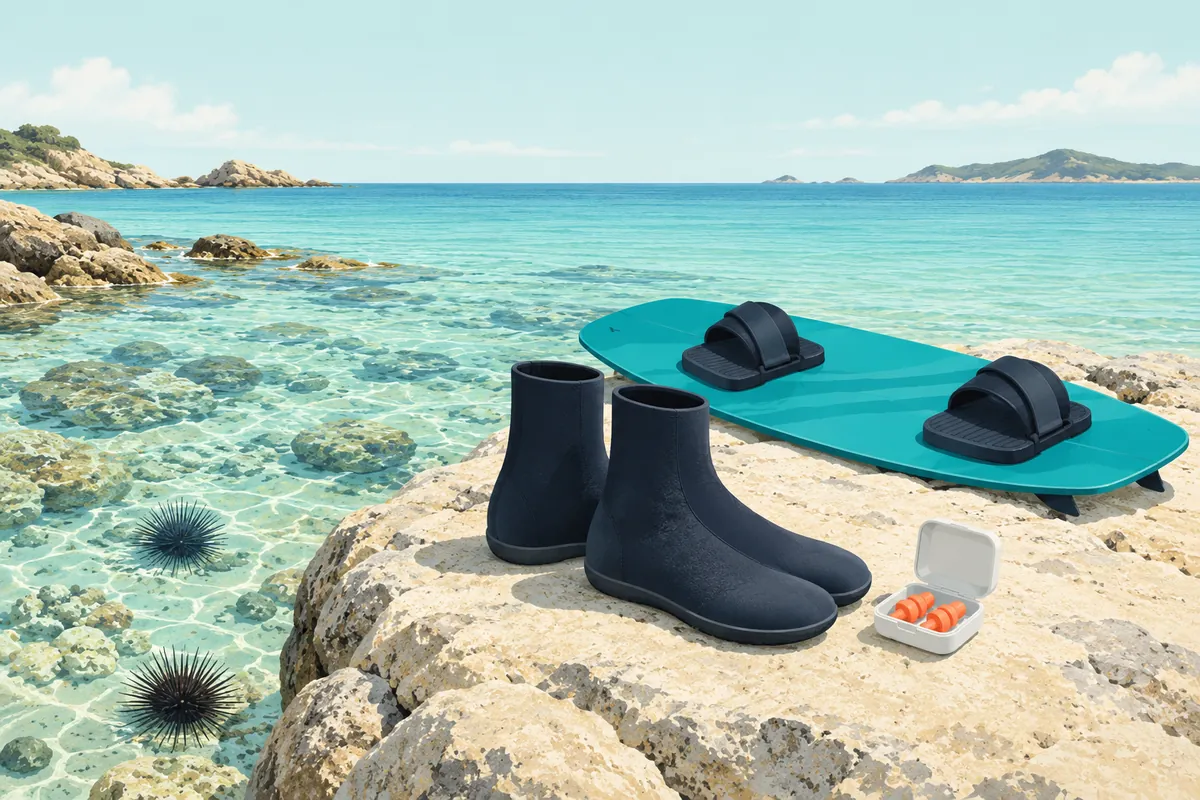
Booties do two jobs: warmth, since they are the first accessory you add below about 15 °C / 60 °F water, and protection from rocks, oyster beds, coral rubble and sea urchins. Urchins are not a tropical footnote: 62 spot pages in the atlas list them among the hazards riders report, Le Morne and Kalpitiya among them, and 333 list reef or coral.
For kiting, choose an internal split-toe design, which stabilizes the boot on the board, and avoid zips, which corrode and jam. A thin 1 mm reef sock will not stop a determined urchin spine, so on shallow rocky launches shuffle your feet anyway.
If you do collect spines, soak the foot in the hottest water you can stand, take out what you can with tweezers, and let deep fragments dissolve. See a doctor if a joint is involved.
Ear plugs and surfer's ear. Exostosis, bony growth that narrows the ear canal, comes from repeated exposure to cold water and wind, which makes kitesurfers a textbook risk group, mainly below roughly 18 °C water.
It is irreversible except by surgery and completely preventable: vented watersports ear plugs, which keep water out while letting sound through, cost €20–50 in 2026 off the shelf, or around €100 and up in 2026 custom-fitted. Add a neoprene hood or headband in winter.
Common minor injuries. The statistics are reassuringly mundane. Cuts and abrasions account for roughly 23–25% of reported kitesurfing injuries, bruises about 20%, and rib complaints about 12%. The countermeasures:
- Fins and board rails cause most cuts, so carry your board fins-out. Treat any tropical coral cut seriously and clean it aggressively, because it infects fast.
- Board-to-shin bruises fade as your body-drag and waterstart technique improve.
- Rib pain from the harness is a fit problem before it is a technique problem. A harness that rides up and levers on your lower ribs is the wrong harness for your torso. Try a different shape, waist against seat, hard-shell against soft, before buying rib protection.
- Persistent one-sided rib pain after a hard crash can be an intercostal strain or a fracture. It heals with weeks of rest, not with riding through it.
- Warm up before sessions. Five minutes of mobility work measurably reduces strains.
More from Practical Tricks & Life Hacks
The other articles in this chapter- What wetsuit thickness for the water temperature?
- Best sunscreen for kitesurfing, and how often to reapply
- Booties, ear plugs and the injuries that actually happen
- Flying with kite gear: what airlines charge for a kite bag
- How to make kite gear last longer
The Fundamentals · Learning the Sport · The Gear · Buying Gear & Keeping It Alive · Tech & Innovation · Wind, Weather & Water · Safety & Risk · When Things Go Wrong · Rules & Etiquette · Advanced Riding · Spots of the World · Practical Tricks & Life Hacks · The Video Library · Field Notes & Extras