Map › Guides › Buying Gear & Keeping It Alive › Kite maintenance and what actually kills kites
The Kitesurfing Compendium · Buying Gear & Keeping It Alive
Kite maintenance and what actually kills kites
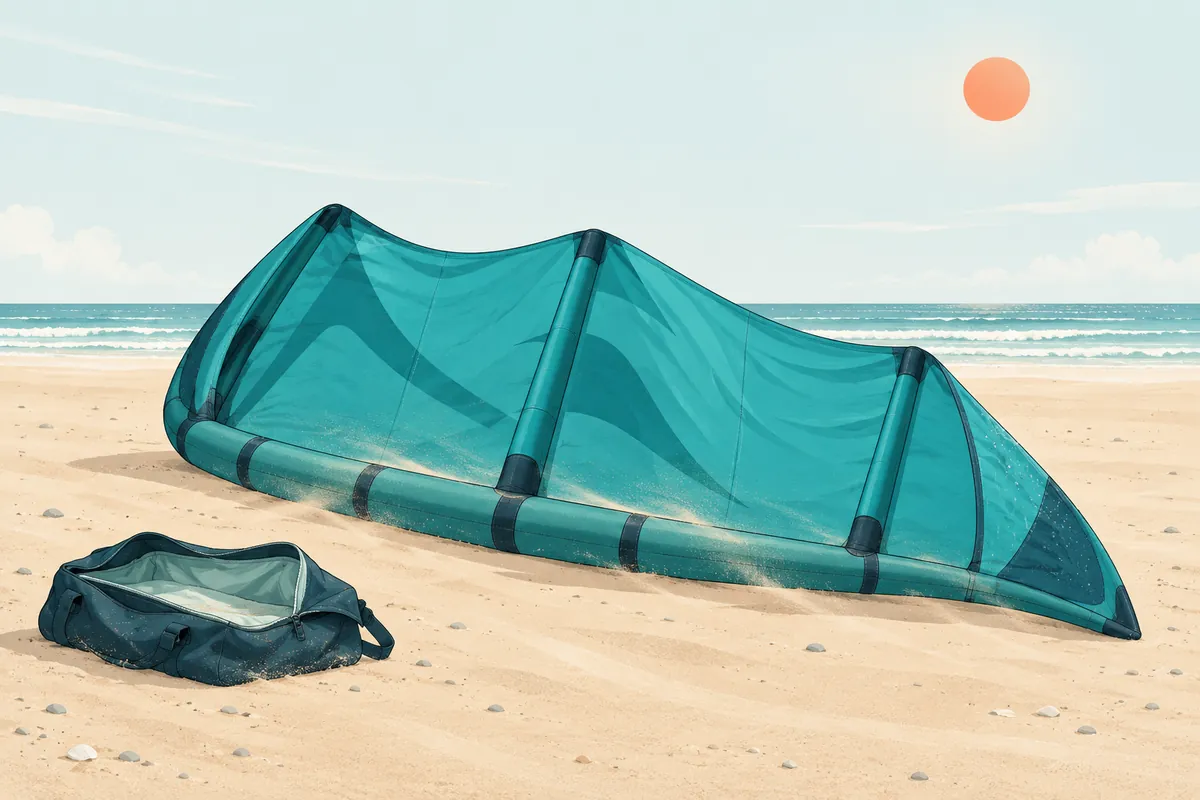
Kites rarely die from crashes, and kite cloth does not wear out from flying. Kites die from four things: UV, heat, blown sand and being packed wet. Salt sits further down the list than almost everyone expects. Get those four right and the rest is detail.
- UV is enemy number one. Sunlight degrades the ripstop coating and the stitching thread, and every minute a kite sits inflated on the beach while you chat is sunlight mileage on the canopy. Pump up right before you ride; pack down or shade the kite right afterwards. Packing up immediately after every session reportedly doubles the life of a kite. A kite left flapping and baking between sessions loses crispness a season faster than one packed promptly, and that, more than hours on the water, is what separates the four-season kite from the eight-season kite. Storage matters the same way: never store gear in sunlight.
- Heat kills valves. A car boot in summer passes 60 °C easily, which is hot enough to soften the heat-welded valve glue and delaminate bladders. Sticky, peeling valves are the signature injury of car-boot storage. Never leave a kite in a hot car or a baking garage.
- Sand is sandpaper. Sand ground into the canopy abrades coating and stitching every time the kite is rolled. Sand inside the leading edge migrates and punctures bladders when you fold. Sand in the pump hose is injected straight into the bladder and destroys the pump seals. Shake the kite out thoroughly before rolling; on coarse-sand beaches, fold wingtip to wingtip and roll toward the centre so the sand falls out rather than in. Keep the pump hose capped and tap it clear before connecting. Clean pump seals with alcohol and lubricate with silicone spray, never WD-40. And never drag a kite across the beach.
- Rinsing, the honest answer. For the kite itself, most experienced riders and school operators do not rinse after saltwater sessions, and there is a reason: salt suppresses mould, while trapped fresh water starts mildew in as little as three days. A kite rolled up damp with salt water survives. A kite rinsed with fresh water and packed wet grows mould that stains and weakens the canopy permanently. So: brush off the sand, dry it, pack it. Rinse briefly with cold fresh water only when the kite got muddy, was dragged through sandy shorebreak, or is going into storage for weeks, and then dry it completely in the shade before rolling. Bars, harness hardware and pumps are the opposite case: rinse them in fresh water after every salt session, and soak the bar in warm water now and then to dissolve salt crystals, or the springs, the swivels and the quick-release internals corrode and seize. Cycle the quick release while you rinse it, because salt and sand in the release mechanism can jam the one component that must never jam.
- Dry before storing. Always. A kite packed wet grows mould and stinks, and the trapped moisture degrades coatings and stitching. Dry in shade, and never leave a kite flapping in the sun "to dry," because flapping itself fatigues the trailing edge.
- Pack loosely, store cool and dark. Compression-stuffing a kite creates hard creases that become micro-tears. Roll along the leading edge without strangling it, use the kite's own roomy bag, keep heavy objects off it, and vary where the folds fall. For long-term storage some riders leave a whisper of air in the bladders with the valves open. At the end of the season: a final rinse of the hardware, a full dry, and indoors.
- Lines and soft parts. Do not step on lines, keep them out of the sand when rigging, and untie any knot you find, since a knot costs up to half the line's strength. Check line evenness about every 20 hours of riding. Expect to replace the depower rope and the chicken-loop line when they go fuzzy: soft parts look shabby after roughly 100 hours, and line sets are due at around 200 hours, or every two to three seasons.
More from Buying Gear & Keeping It Alive
The other articles in this chapterThe Fundamentals · Learning the Sport · The Gear · Buying Gear & Keeping It Alive · Tech & Innovation · Wind, Weather & Water · Safety & Risk · When Things Go Wrong · Rules & Etiquette · Advanced Riding · Spots of the World · Practical Tricks & Life Hacks · The Video Library · Field Notes & Extras