Map › Guides › Buying Gear & Keeping It Alive › Do you need a trainer kite?
The Kitesurfing Compendium · Buying Gear & Keeping It Alive
Do you need a trainer kite?
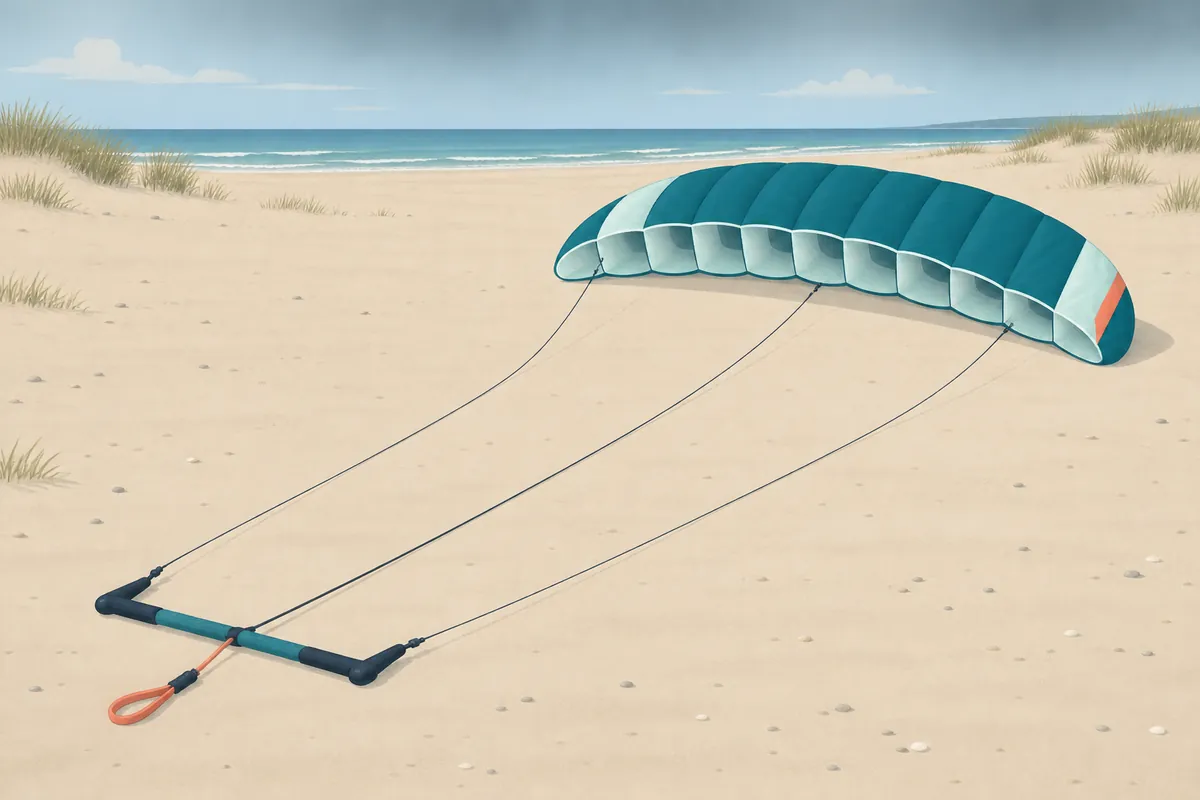
A trainer kite is a small two-line or three-line foil of 1.5–3.5 m² flown on land, with no bladders to pump and near-indestructible construction, and at $100–300 in 2026 it is the cheapest progress per dollar in kitesurfing.
Sizing: a 2.5–3.5 m² suits an average adult of 65–85 kg in 10–17 knots; drop to 2–2.5 m² for kids, lighter fliers, or gusty and windy regions. Choose a three-line model if you can, because the third line adds a kill and relaunch function and teaches you that a kite can be depowered, which is the single most important reflex in the sport.
Kite control is the bottleneck skill of the first lessons. Riders who arrive with 4–10 hours of trainer time reportedly get through those lessons about twice as fast, and at $60–120 per lesson hour in 2026 the trainer pays for itself before you touch the water.
Unlike everything else in this chapter, a trainer barely depreciates: it resells for most of its purchase price, or becomes the gift that recruits your friends into the sport.
What to practise, in fields, on beaches and in parks, never near roads, power lines or people, and not in strong wind:
- Park the kite. Steady hands at the edge of the window, at 10, 12 and 2 o'clock, learning where the power lives (the centre of the window) and where it does not (the edge).
- Fly figure-eights. Slow, controlled figure-eights and sine waves through the power zone on both tacks, to feel where the pull lives and how kite speed makes power.
- Fly by feel, not by sight. Hold position while looking at the horizon, steering with bar pressure rather than arm strength. On the water your eyes will be on the board.
- Launch and land. Repeatedly, both upwind and cross-wind, until it is routine.
- Fly one-handed, and in every posture. You will need the free hand for the board later. Fly while walking, while sitting, and while standing up, which is a preview of the water start.
- Crash it and relaunch it. On purpose, until recovery is boring. Later, let it drag you gently across grass or shallow water, the direct precursor to body-dragging.
Watch · 3


More from Buying Gear & Keeping It Alive
The other articles in this chapterThe Fundamentals · Learning the Sport · The Gear · Buying Gear & Keeping It Alive · Tech & Innovation · Wind, Weather & Water · Safety & Risk · When Things Go Wrong · Rules & Etiquette · Advanced Riding · Spots of the World · Practical Tricks & Life Hacks · The Video Library · Field Notes & Extras