Map › Guides › Tech & Innovation › Kite quick release systems and the ISO 21853 standard
The Kitesurfing Compendium · Tech & Innovation
Kite quick release systems and the ISO 21853 standard
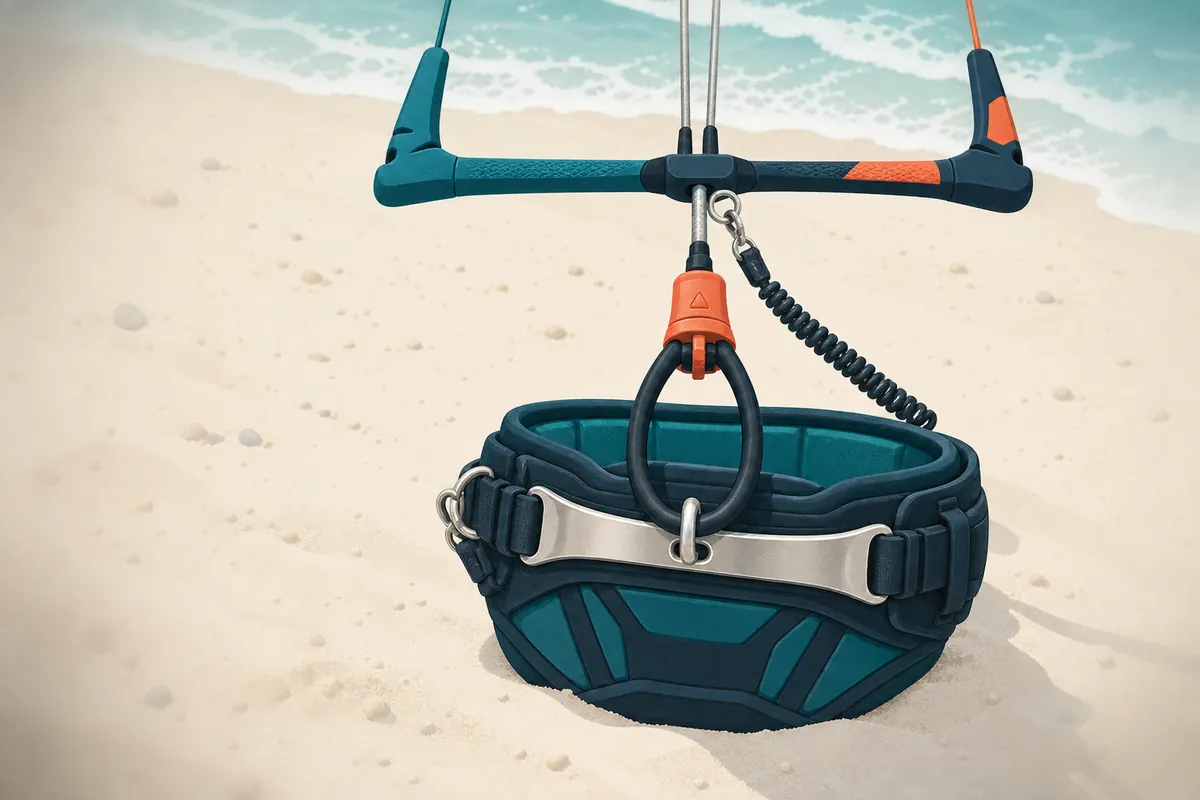
Beginner The safety story is the part of this chapter that matters most to a new rider, because the history is the reason the modern release works the way it does.
- Late 1990s to early 2000s. Two-line bars, no depower, no release. A rider was effectively locked to a powered kite. Accidents were frequent and some were fatal.
- Mid-2000s. Four-line bars with a chicken loop hooked into a waist harness put the load on the body and let you sheet the bar out to depower. The first quick releases arrived, but the designs were proprietary and inconsistent, and they jammed under load or with sand in the mechanism.
- 2010s. The push-away quick release won. Shove the collar away from you, the chicken loop opens, the kite flags out on a single safety leash line, and the pull drops to near zero. By about 2015 every major brand had converged on that logic, and below-the-bar swivels, low-V splits and auto-untwist loops cleaned up the details.
- 14 February 2020. ISO 21853, the international standard for kiteboarding release systems, came into force after six years of work by the GKA with an international engineering team. A release passes if it opens with no more than 170 N of force and in no more than 2 seconds, tested dry, sandy, wet-sandy, in fresh water, and cold and wet. Certification runs at two independent facilities, the Fraunhofer Institute in Rostock and Camosun in Victoria, Canada, and a compliant release carries the ISO number embossed on the hardware.
The hardware standardised and so did the teaching. Learn this sequence as muscle memory, in order, before your first solo session.
- Let go of the bar. It feels wrong and it is right: letting go sheets the kite out and dumps most of the power at once. The large majority of scary moments end here.
- Release the chicken loop. Push the quick-release collar away from you. The loop opens, the kite flags out onto the single safety-leash line, the pull drops to near zero, and the kite stays attached so you can recover it.
- Release the leash. Last resort, for when the flagged kite is still a danger: lines wrapped around you, or the kite dragging you at something hard. This separates you from the kite completely.
For a buyer the guidance is short. Any current bar from a major brand, Duotone Click Bar or Trust Bar, North Navigator, Ozone Contact, Core Sensor, Cabrinha Overdrive, uses a tested push-away release. Buying used or off-brand, the ISO 21853 marking on the hardware is the box to check.
Watch · 2


More from Tech & Innovation
The other articles in this chapter- Aluula vs Dacron kite airframes
- Big air kites and the world jump record
- Kite hydrofoils and light-wind riding
- Kite quick release systems and the ISO 21853 standard
The Fundamentals · Learning the Sport · The Gear · Buying Gear & Keeping It Alive · Tech & Innovation · Wind, Weather & Water · Safety & Risk · When Things Go Wrong · Rules & Etiquette · Advanced Riding · Spots of the World · Practical Tricks & Life Hacks · The Video Library · Field Notes & Extras