Map › Guides › The Fundamentals › The bar, lines and harness explained
The Kitesurfing Compendium · The Fundamentals
The bar, lines and harness explained
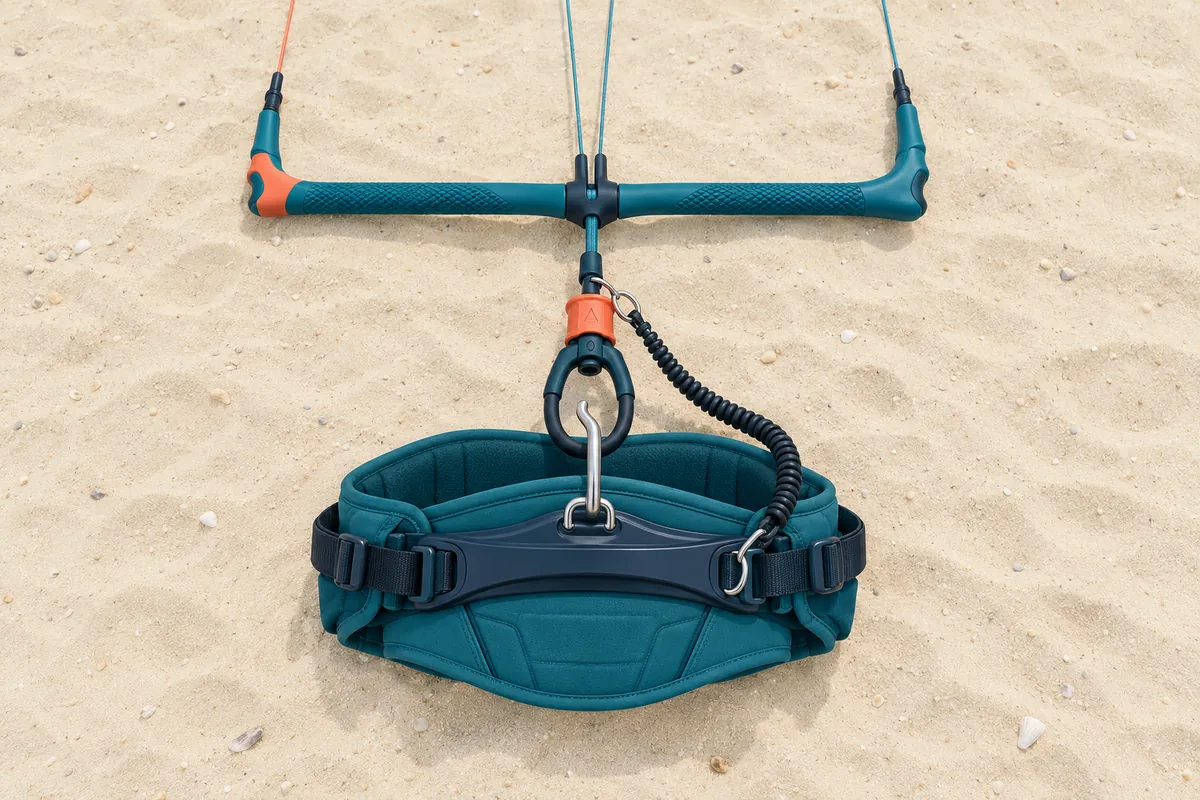
A modern kite system has four lines, sometimes five, and several layered safety releases. The chain from kite to rider runs like this.
- Front lines, also called centre lines. Two lines from the kite's leading edge, through the centre of the bar, to the chicken loop: a rubber-coated loop that hooks onto the metal hook of your harness. These carry roughly 80–90% of the kite's load, which is why the pull ends up in your body and not your arms.
- Back lines, the steering lines. Two lines from the kite's wingtips to the ends of the bar. Pull the right end of the bar down and the right wingtip brakes, so the kite turns right; pull left and it turns left. The kite always turns relative to its own nose, including when the nose is pointing at the water, which is the part that catches people out.
- Depower system. The front lines anchor to your harness and the back lines to the sliding bar, so moving the bar along the centre line changes the front-to-back ratio. That is the sheeting mechanism above. A trim strap or cleat sets the range for the day.
- Quick release. The chicken loop carries a push-away release. Fire it and the loop opens, the bar flies away, and the kite flags out on a single front line through your safety leash, losing nearly all its power at once. That is safety level two; level one is letting go of the bar.
- Leash release. The last level. The safety leash has its own release that separates you from the kite entirely, for when a flagged kite is still dragging you somewhere bad.
- The harness, either a waist harness (most common) or a seat harness, which schools like because it cannot ride up and gives a lower tow point for body dragging. It puts the load on your core and hips and lets you ride for hours without your arms giving out.
The kite itself is a leading edge inflatable, or LEI: an inflatable frame, pumped to roughly 6–9 psi, holds the shape, keeps the kite floating, and lets you relaunch it off the water. That last property is what made the sport learnable. Beginners fly bow, delta or hybrid shapes, which have big depower ranges and relaunch easily.
More from The Fundamentals
The other articles in this chapter- The bar, lines and harness explained
- How to launch and land a kite safely
- What you learn in kitesurfing lessons, stage by stage
- How long does it take to learn to kitesurf?
The Fundamentals · Learning the Sport · The Gear · Buying Gear & Keeping It Alive · Tech & Innovation · Wind, Weather & Water · Safety & Risk · When Things Go Wrong · Rules & Etiquette · Advanced Riding · Spots of the World · Practical Tricks & Life Hacks · The Video Library · Field Notes & Extras