Map › Guides › Practical Tricks & Life Hacks
The Kitesurfing Compendium · chapter 12
Practical Tricks & Life Hacks
All 14 chapters
In this chapter
Each of these has its own pageWhat wetsuit thickness to wear for the water temperature, how to stop the kite bar shredding your hands, what an airline charges for a kite bag, and how to make a kite last six seasons instead of three. This is the practical side of kitesurfing that no lesson covers, and the side that decides how many days a year you ride.
The riders who log the most hours are rarely the ones with the newest quiver. They are the ones who stay warm ten minutes longer, whose hands survive day two of a trip, and whose gear does not need a repair day at the start of every season. All of it is learnable in an afternoon.
What wetsuit thickness for the water temperature?
Dress for the water temperature, then go one step warmer for the wind. A kitesurfer is not immersed like a diver: you stand above the water, in the wind powering your kite, so evaporative cooling does more work on you than on a surfer in the same sea.
Thickness is written as two or three numbers in millimetres, 4/3 or 5/4/3. The first number is the torso panel, thickest for core warmth; the later numbers cover arms and legs. The bands below overlap, because session length, wind strength and tolerance each move you a step.
| Water temp | What to wear | Accessories | Seams |
|---|---|---|---|
| Above 24 °C / 75 °F | Boardshorts + rash guard or lycra | Nothing (sun protection instead) | n/a |
| 18–24 °C / 65–75 °F | Neoprene top (0.5–2 mm) or shorty (2/1) | None | n/a |
| 17–20 °C / 62–68 °F | 3/2 springsuit or full suit | None | Flatlock |
| 14–17 °C / 58–63 °F | 3/2 to 4/3 full suit | Booties | Glued & blind-stitched (sealed) |
| 11–14 °C / 52–58 °F | 4/3 to 5/4/3 full suit | Boots + gloves + hood | Sealed and taped |
| 6–11 °C / 43–52 °F | 5/4 to 5/4/3 | 5 mm boots, gloves, hood | Sealed and taped |
| Below 6 °C / 42 °F | 6/5/4 semi-dry or a drysuit | Everything, no exposed skin | Sealed and taped |
- Seams matter as much as thickness. Flatlock seams let water through and belong only in warm water. From roughly 17 °C down you want glued and blind-stitched seams; below 14 °C, taped or liquid-sealed seams are what actually keep you warm.
- Fit beats thickness. A loose 5/4 that flushes cold water on every crash is colder than a snug 4/3.
- Drysuits earn their keep when the air and the water are both against you: the usual trigger is wind chill plus water putting you around or below 15 °C / 60 °F effective. You can wear warm layers underneath and change in seconds. They are also baggier and pricier, typically €500–900 in 2026.
- Extremities. Booties, gloves and a hood in 2–3 mm make a startling difference; in properly cold conditions go 5 mm, even 7 mm for boots if you run cold. If you are cold while setting up on the beach, you will never warm up on the water.
- Neoprene tops and hoodies (0.5–2 mm) are the most underrated item in the quiver. Over a shorty or under a summer suit they add a month at each end of the season, and on the beach they kill wind chill while you rig.
- Rash guards and lycra are the number-one item for warm-water riders and beginners: harness rash, board scrapes and sunburn all stop, and a UPF 50 long-sleeve protects more reliably than any cream.
One destination can span most of the chart on its own. The spot page for Zandvoort puts the water at 18 °C in summer and 6 °C in winter: a sealed 3/2 in mid-August, a 6/5/4 or a 5/4 with gloves, 5 mm boots and a hood in late February.
Warm air is no guide either; Essaouira is 20–22 °C in summer under a hot sky and still takes a 3/2. Every spot page carries the summer and winter water temperature and the suit riders there wear.
Best sunscreen for kitesurfing, and how often to reapply
Three hours on the water is three hours of direct sun plus reflection off the surface. Chemical sunscreens largely rinse off. Mineral (zinc oxide) sunscreen sits on the skin as a physical barrier, reflects UVA and UVB, resists washing off, is less likely to sting the eyes, and is generally reef-safe. The system that works:
- Face: a zinc stick (SPF 50, often tinted) on nose, cheekbones, ears and forehead before the session. Sticks survive water far better than lotions, and you can reapply one on the beach with sandy hands without turning it into paste.
- Lips: a dedicated SPF 30–50 lip balm, reapplied every time you come in. Burned, cracked lips are one of the most common kite-trip complaints and one of the easiest to prevent.
- Body: cover instead of cream wherever you can. Long-sleeve UPF lycra, boardshorts over it, a suit in cooler water. Cream only the gaps: hands, neck, backs of the knees, and the tops of the feet, a painful omission for strapless riders.
- Reapplication: broad spectrum, SPF 30 minimum, is the dermatologist floor. Reapply every 60–90 minutes of session time, and always after towelling off. Almost any decent product works if reapplied. None works applied once at 10 a.m.
- Head: a cap, a surf hat with a chin strap, or a helmet. A light-coloured cap under strong sun also cuts fatigue noticeably on long sessions. In tropical destinations many instructors refuse to teach without headwear.
In warm water the lycra is the whole defence. Cumbuco runs 26–29 °C and nobody wears rubber there, so a long-sleeve top and a zinc stick is the entire system for a week of six-hour days.
Sunglasses for kitesurfing
Your eyes take a double dose from direct and reflected UV, and long-term exposure contributes to pterygium, "surfer's eye". The options, in ascending order of commitment:
- Cheap polarized plus a retainer. A €20–40 pair (2026) of polarized sports sunglasses on a neoprene floating retainer strap. You will eventually donate a pair to the sea; the retainer postpones that day considerably.
- Watersports-specific eyewear (Ocean, LiP, SeaSpecs and similar, roughly €50–150 in 2026): floating frames with air chambers in the temples, hydrophobic coatings, vents that resist fogging, rubber nose and temple grips that get stickier when wet, plus a leash. Polarized lenses cut glare enough to change how far upwind you can read the water.
- Prescription. Several watersports brands offer inserts or direct Rx lenses. Daily contacts under sport sunglasses work too, but carry spares and rewetting drops, and close your eyes on crashes.
How to stop the kite bar giving you blisters
Nothing ends a kite holiday faster than palms that look like raw steak on day three. Blisters come from friction plus moisture plus grip pressure, and you have to attack all three.
Grip technique comes first. The bar is not a pull-up bar. Sheet out, trim properly, and hold the bar with hooked fingers rather than a white-knuckle fist: when the kite is trimmed correctly, your harness carries the load and your hands only steer.
Death-gripping is also the main cause of blown forearms, the thing riders call arm pump. If your forearms burn after 30 minutes, the fix is trim and relaxation, not stronger arms. Ride with the bar sheeted out a centimetre more than feels natural, and open your hands to a two-finger grip on the flat stretches.
The gloves question. There is no consensus. Against: gloves reduce bar feel, and a thicker grip diameter increases forearm fatigue. For: they prevent holiday-ending blisters, and below about 14 °C water they are not optional.
A workable synthesis is none for everyday riding once your calluses are set, thin 1–2 mm or open-palm for the first days of an intensive trip, 3–5 mm for winter. Open-palm mitts keep bar feel and keep the back of the hand warm.
Tape tricks. At the first hot spot, not after the blister forms, cover it with sports tape or kinesiology tape. Climbers' finger tape wrapped around the base of the fingers works well, and some riders pre-tape known wear points before big-air days.
If a blister has already formed: drain it with a sterilized needle if it is large, leave the roof of skin on, cover with a hydrocolloid plaster and tape over it. You can usually ride the next day.
Callus maintenance. Calluses are your friends until they get thick enough to catch and tear. File them flat with a pumice stone after showers during heavy riding periods. Hands adapt, and after a few months of regular riding the problem mostly stops happening.
Booties, ear plugs and the injuries that actually happen
Booties do two jobs: warmth, since they are the first accessory you add below about 15 °C / 60 °F water, and protection from rocks, oyster beds, coral rubble and sea urchins. Urchins are not a tropical footnote: 62 spot pages in the atlas list them among the hazards riders report, Le Morne and Kalpitiya among them, and 333 list reef or coral.
For kiting, choose an internal split-toe design, which stabilizes the boot on the board, and avoid zips, which corrode and jam. A thin 1 mm reef sock will not stop a determined urchin spine, so on shallow rocky launches shuffle your feet anyway.
If you do collect spines, soak the foot in the hottest water you can stand, take out what you can with tweezers, and let deep fragments dissolve. See a doctor if a joint is involved.
Ear plugs and surfer's ear. Exostosis, bony growth that narrows the ear canal, comes from repeated exposure to cold water and wind, which makes kitesurfers a textbook risk group, mainly below roughly 18 °C water.
It is irreversible except by surgery and completely preventable: vented watersports ear plugs, which keep water out while letting sound through, cost €20–50 in 2026 off the shelf, or around €100 and up in 2026 custom-fitted. Add a neoprene hood or headband in winter.
Common minor injuries. The statistics are reassuringly mundane. Cuts and abrasions account for roughly 23–25% of reported kitesurfing injuries, bruises about 20%, and rib complaints about 12%. The countermeasures:
- Fins and board rails cause most cuts, so carry your board fins-out. Treat any tropical coral cut seriously and clean it aggressively, because it infects fast.
- Board-to-shin bruises fade as your body-drag and waterstart technique improve.
- Rib pain from the harness is a fit problem before it is a technique problem. A harness that rides up and levers on your lower ribs is the wrong harness for your torso. Try a different shape, waist against seat, hard-shell against soft, before buying rib protection.
- Persistent one-sided rib pain after a hard crash can be an intercostal strain or a fracture. It heals with weeks of rest, not with riding through it.
- Warm up before sessions. Five minutes of mobility work measurably reduces strains.
How much water to drink on a long kite session
Kiting hides its sweat. Wind and spray mean you never feel it, and dehydration shows up as fading concentration, then the sloppy crash that ends the day.
- Before: complex carbs plus light protein 1–2 hours ahead, oatmeal and fruit, or a banana with yogurt. Arrive at the beach already topped up.
- During: as a working figure, add roughly 0.5 L of water per hour of riding on top of your normal ~1.5 L a day, drunk in small doses between tacks to the beach rather than a litre chugged at the end. Past 90 minutes, an electrolyte drink beats plain water. Leave the bottle in the shade by your bag or in a cooler in the car; some riders stash a soft flask in the harness.
- Beach snacks that survive a kite bag: bananas, dates, dried fruit, nuts, flapjack or energy bars, beef jerky. Eat something small every 60–90 minutes on all-day sessions.
- After: protein plus carbs within 30–60 minutes. On multi-day trips that is the difference between five good days in a row and three.
How to stay warm kitesurfing in cold water
Cold-water riders get empty spots and glassy winter winds. Brouwersdam goes from 18 °C in summer to about 6 °C in winter and still has people on the water in January. The craft is entirely in the margins:
- Start warm. Heat the car on the drive, change in the warm car. Pour warm water into your wetsuit, or dunk it, just before putting it on. Rig with gloves and a beanie on. The session is won or lost before you launch.
- The hot-water jug is the classic hack: 5–10 L of hot tap water in insulated jugs in the car. Down the suit after a session it is luxury; over frozen hands mid-session it saves one. Add a thermos of tea for before and after.
- Vaseline on cheeks, nose and eyelids blunts wind chill on the face better than anything else you can carry.
- Afterwards: a changing robe turns the car park into a changing room, and a plastic tub to stand in keeps your feet off frozen asphalt and doubles as a wet-gear bin.
Flying with kite gear: what airlines charge for a kite bag
Kite gear travels better than almost any other boardsport equipment: kites compress and twin-tips are short. The fees are the problem, and on a cheap ticket they cost more than the seat.
- Check the specific airline before you book, not after. The spread is enormous. Air France carried a kite bag as an ordinary checked bag in 2026, free under 300 cm and 23 kg if declared 48 hours ahead, except on Light fares; Emirates the same in 2026. Alaska charged $30 (2026) for a first sports bag, $40 for a second (2026). Ryanair wanted EUR/GBP 35–60 online in 2026, more at the airport, per item per flight. Iberia's long-haul rate was EUR 130–187 in 2026. The airline pages carry each policy with the year it was checked.
- Book the bag online, never at the desk. On the low-cost carriers the gap is a third to a half: Wizz Air charged EUR 45 online, EUR 65 at the airport (2026); Norwegian EUR 35 and EUR 60 (2026). Some carriers want notice rather than money. Air France asks for 48 hours, Condor for 8, and turning up undeclared roughly doubled Condor's USD 75–150 per leg in 2025.
- Choose your bag and your words. The old golf bag trick, checking gear as golf equipment because many airlines carry that free or cheap, is fading: agents at kite destinations have seen it all. It still works where kiters are rare, and a golf-style bag at least avoids the reflexive surfboard fee. Never lie if asked. "Sports equipment" is honest and usually enough.
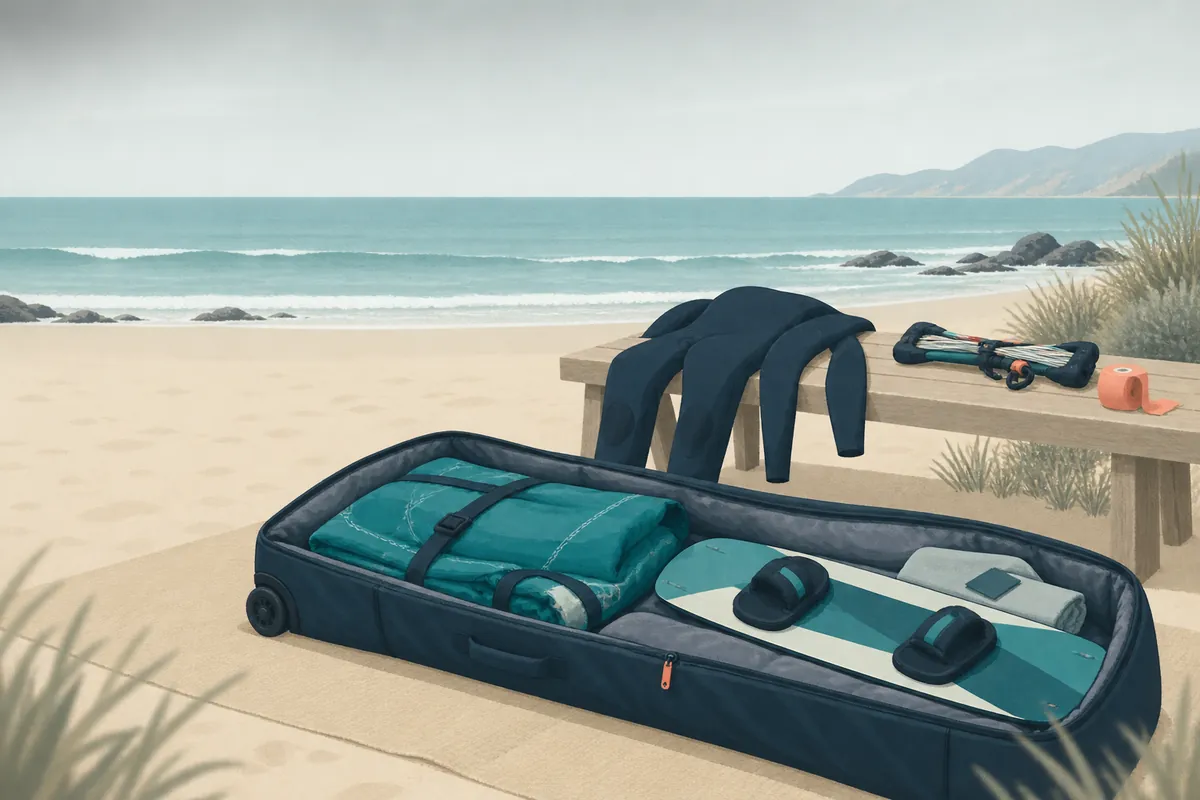
- Pack to 23 kg / 50 lb, and weigh it. That is the standard allowance on most full-service carriers, but check yours: Ryanair capped a sports item at 20 kg in 2026, Norwegian at 25 kg. A €15 luggage scale (2026) pays for itself on the first trip. A standard boardbag swallows a twin-tip with fins and straps off, 2–3 kites, bar, harness and pump. It weighs more coming home: sand and damp gear.
- Shave weight where it counts. Kites out of their individual bags and into compression sacks, harness and wetsuit into hand luggage or worn, pump handle disassembled. The bar is borderline: a large metal object that gets questioned at security, so check it. Some riders carry one kite as cabin baggage.
- Protect the board. Fins off, pipe-insulation foam or bubble wrap on the rails, clothes as padding. Photograph the packed bag before you close it, for the insurance claim you hope not to make.
- Or do not fly with it at all. For a one-week trip to a major destination, renting locally, typically €30–60 a day in 2026 and less by the week, or buying and reselling, can beat two round-trip board fees plus the schlep.
Watch · 4


What to keep in the car for kitesurfing
Half the friction of kitesurfing happens in the car park. A few cheap objects remove most of it:
- Sand management. Sand is the enemy of zippers, valves and bladders. Keep a stiff brush in the car and brush the kite while it is still inflated and dry, especially the trailing edge and the leading-edge seam. Check the pump hose is sand-free before connecting: sand blown into a bladder migrates, and punctures it from the inside when you fold the kite. A doormat or ground sheet by the boot keeps feet and harness clean.
- The plastic tub (60–90 L) is the great kiter's hack. Stand in it to change, throw wet neoprene in it for the drive, and use it to carry water to rinse gear.
- Water jug or garden sprayer (5–10 L) rinses hands, feet, bar and sunglasses after every session.
- Changing robe or poncho towel makes changing in a public car park quick and legal.
- Keys are the eternal problem. A plain metal spare hidden on the car, the key in a small drybag zipped inside the harness pocket, or a lockbox on the towbar. Modern keyless fobs do not survive immersion, so never take one on the water.
How to make kite gear last longer
A kite that lasts six seasons instead of three is the cheapest performance upgrade there is. The habits that get you there:
- Dry before packing, always. Packing a wet kite occasionally is fine. Doing it habitually breeds mould and delaminates coatings. Let the kite dry inflated on the beach after the session, then brush the sand off.
- Rinse strategically. The bar gets fresh water after every session, because salt crystals abrade the depower line and jam the quick release. Wetsuits and harnesses get rinsed and drip-dried in shade after each use. Kites need a rinse mainly before longer storage, and they must dry fully afterward.
- UV is the real killer. Sunlight degrades canopy cloth faster than crashes do. Never leave a kite parked and flapping on the beach for hours ready to go. Deflate it, or at least weight it with sand, and store everything out of the sun.
- Do not drag, do not flap. Dragging a kite across the beach sands down the trailing edge, and a kite left flapping at the edge of the wind window is beating its own stitching apart.
- Small repairs immediately. A 2 cm canopy tear costs a €10 ripstop patch in 2026: clean dry surface, round the corners, patch both sides. One more session and it is an €80 panel replacement in 2026. Carry ripstop tape, bladder patches (TPU tape, held under pressure 30 minutes), a spare line and a valve.
- Storage. Everything bone dry, loosely folded, away from heat and sun. Hang wetsuits on wide hangers or fold them over a rail; a thin wire hanger creases the shoulders permanently. Release board footstrap tension. Before a long break, check the bladders hold pressure, so the first session of the season is not a repair day.
- Lines and safety systems age invisibly. Inspect lines for wear at the knots and sleeves, check they are still equal length by tying them to a fixed point and comparing under tension, and replace a frayed depower line before it replaces itself mid-jump.
Watch · 2

A five-minute routine before and after every session
Before you launch: pump to the pressure printed on the leading edge, walk the lines and check the ends for wear, test-fire the quick release and re-arm it, tape any hot spot you can already feel, and put the bottle in the shade of the bag. After you land: rinse the bar, dry the kite inflated, brush the trailing edge, hang the suit.
The habit most riders skip is the cheapest one. Write down anything that felt wrong before you drive home. A valve that took two goes to seat on Sunday is a flat kite on Saturday if nobody wrote it down.
Watch · 1

Questions riders ask
What wetsuit thickness do I need for kitesurfing?
In 14–17 °C water, a 3/2 to 4/3 with booties. In 11–14 °C, a 4/3 to 5/4/3 with boots, gloves and hood. Below 6 °C, a 6/5/4 semi-dry or a drysuit. Go one band warmer than a surfer would. Each spot page lists its summer and winter water temperature and the suit riders there wear.
Do I need gloves for kitesurfing?
Not for everyday riding once your calluses are established: gloves cut bar feel and a fatter grip increases forearm burn. Use thin 1–2 mm or open-palm gloves for the first days of an intensive trip, and 3–5 mm below about 14 °C water, where they stop being optional.
How much do airlines charge for a kite bag?
Anything from nothing to more than the ticket. Air France and Emirates carried it inside the standard allowance in 2026 under 300 cm; Alaska charged $30 in 2026 for a first sports bag; Ryanair EUR/GBP 35–60 online in 2026. Book online, and check the airline page for the year the policy was verified.
How do you stop the kite bar giving you blisters?
Trim the kite so the harness carries the load, hold the bar with hooked fingers instead of a fist, and tape at the first hot spot rather than after the blister. If your forearms burn after 30 minutes you are gripping, not underpowered.
What is surfer's ear and how do you prevent it?
Bony growth that narrows the ear canal, caused by repeated cold water and wind, mainly below about 18 °C. It is irreversible except by surgery. Vented watersports plugs cost €20–50 in 2026 off the shelf, or about €100 in 2026 custom-fitted, plus a hood in winter.
How much water should I drink while kitesurfing?
Roughly 0.5 L per hour of riding on top of your normal daily intake, in small amounts between runs to the beach. Past 90 minutes, use an electrolyte drink. Dehydration shows up as fading concentration long before it shows up as thirst.
Chapter 13 · Part V · The Kitesurfer's Life