All 14 chapters
In this chapter
Each of these has its own pageKitesurfing gear is five things: a kite, a control bar with its lines, a board, a harness and the safety kit. What each part does, what kite size to buy for your weight and your wind, and what a full setup costs new and second-hand.
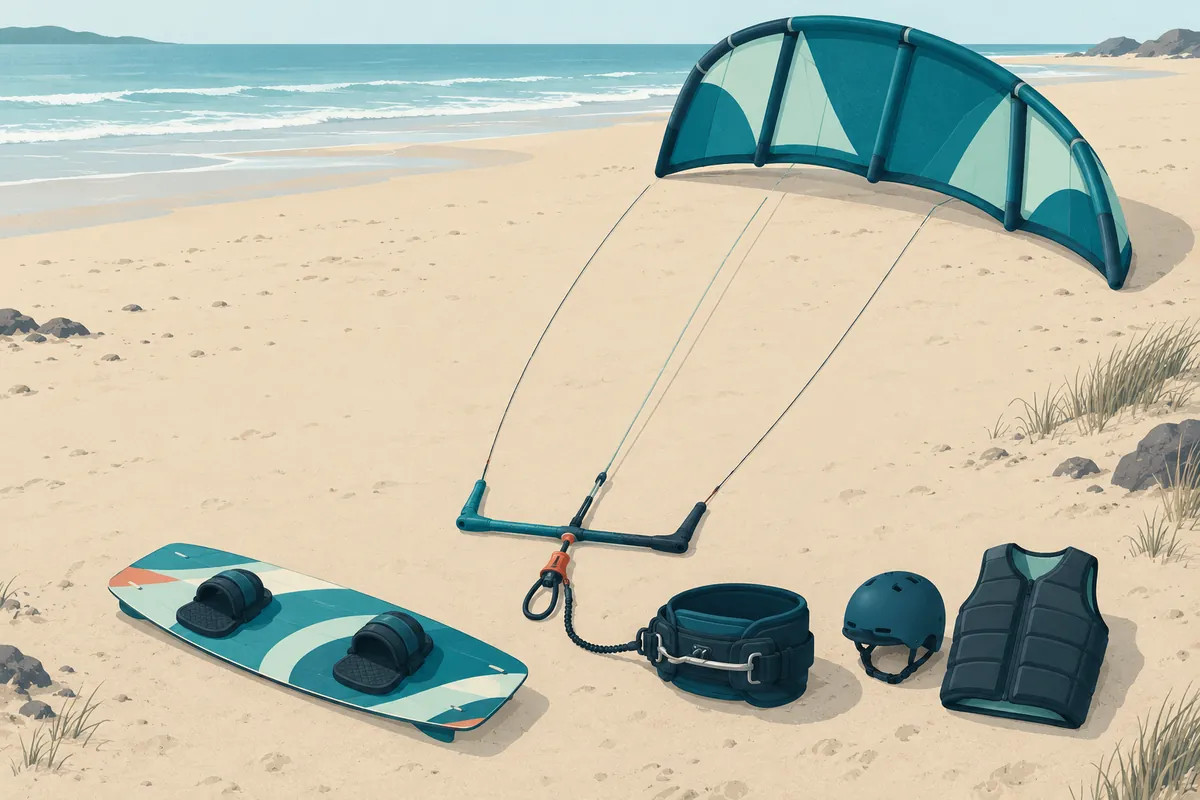
Laid out on the sand it looks like more kit than it is: a 12 m wing of ripstop nylon, 24 m of line thinner than a pencil, a bar covered in adjusters, a board, a harness and a bag of small parts. It is five subsystems.
The kite makes the power, the control bar and lines meter it and switch it off, the board turns it into forward motion, the harness takes the load off your arms, and the safety and accessory kit is what gets you back to the beach. Learn what each one is for and the wall of product in a kite shop turns readable.
What are the different types of kitesurfing kites?
Almost every kite you see on a beach is a leading edge inflatable (LEI): a single-skin canopy held in shape by an inflatable tube along the leading edge plus inflatable cross-tubes called struts. You pump it up before each session, normally to 6–9 PSI. Small kites want more, around 8–10 PSI; big kites hold their shape at 5–6 PSI.
That inflated frame is what lets an LEI float and be relaunched off the water after a crash. Nearly all modern kites are one-pump: one valve feeds the leading edge and every strut through connecting hoses, so rigging takes minutes rather than a quarter of an hour.
Four LEI shapes matter. They differ in arc, sweep, bridling and trailing edge, and those differences decide how the kite feels in your hands, how much power it dumps when you sheet out, and how easily it comes back off the water.
C-kites Advanced
The original shape: a deep C-shaped arc, square wingtips, lines attached straight to the four corners with no bridle at all. A C-kite gives the most direct bar feel of any design, turns on its own axis and loops predictably, which is why wakestyle and unhooked freestyle riders still buy them.
Everyone else pays for that: a narrow wind range, limited depower, since sheeting out does not dump much power, and the hardest water relaunch in the sport. Not a beginner kite.
Bow kites
The bow arrived around 2005–2006, a flat, swept-tip kite with a concave trailing edge and a bridle carrying the leading edge. Flat means the projected area collapses when you sheet out, so a bow depowers by close to 100%, covers the widest wind range of any LEI, relaunches easily and drives upwind well.
Bows transformed safety in the sport. The pure ones feel dead in the turn, which is what produced the next two shapes.
Delta kites Beginner
A triangular planform that packs canopy area into the centre of the kite. Deltas keep the bow's depower and wind range and relaunch almost by themselves: the swept shape rolls the kite to the edge of the window while it lies on the water. They are forgiving and grunty for their size, which is why school racks are full of them.
Hybrid (open-C / SLE) kites
The middle ground, and today the biggest category by a distance: a C-like arc with a bridled leading edge and moderate sweep, usually told apart from a bow by its convex trailing edge. Hybrids borrow C-kite turning and pop and keep bow-level depower and relaunch. Most do-everything freeride and big-air kites, the ones at the top of the best-seller lists, are three-strut hybrids.
Strut count and light-wind LEIs
Strut count is a second axis of design, independent of shape. Five struts give the stiffest frame and the steadiest high-wind and big-air behaviour. Three struts are the all-round standard. One strut, or none, buys lightness, and weight is what decides everything below about 12 knots.
Single-strut kites (the Duotone Mono and Neo lineage, North Mono, Ozone Alpha and Boxer, Airush Ultra) keep flying in wind where a heavier kite falls out of the sky, which makes them the pick for light-wind days, for travel, since they pack small, and above all for foiling. They flutter more, they give up top end when overpowered, and they backstall a little if you park them deep and underpowered.
Foil kites
The other branch of the family has no inflatable parts. A foil, or ram-air, kite is a double-skin wing of closed cells that inflates through intake valves from the airflow itself and holds its shape on a bridle. Foils are far more efficient than LEIs: they fly and are raced in 6–8 knots, sit further forward in the wind window, and make power a same-size LEI cannot.
Every serious hydrofoil racer and most snowkiters use one. The bill is real: often 1.5–2× the price of the equivalent LEI, fiddly launching and landing, bridles that tangle, and a water relaunch that closed-cell designs allow but only for a while, because a foil kite left sitting in the sea takes water in through the cells. Learn on an LEI. A foil kite is a specialist's tool.
How a kitesurfing control bar works
The bar is your steering wheel, throttle and ejector seat in one.
Working outwards from your hands: the bar itself, 45–55 cm wide, with narrow bars of about 45–47 cm for kites under 9 m, wide bars of 50–55 cm for 10 m and up, and adjustable ends on many current models; the depower or trim system, a cleat or clicker that shortens the front lines to take power out for the whole session; the chicken loop you hook into your harness; the quick release above it; and the safety leash connection.
How it works. The two centre (front) lines carry most of the kite's load through the chicken loop into your harness; the two outer (back, or steering) lines run to the bar ends. Pull the bar in and you tension the back lines, raising the canopy's angle of attack, and the power comes on. Push it away and the kite sheets out. Pull one end and it turns.
Let go completely and a modern kite drifts down to low power; fire the quick release and it flags out on a single line at close to zero power.
By about 2015 every major brand had settled on the push-away release, and since 14 February 2020 the international standard for these systems, ISO 21853, has required a release to open under no more than 170 N of load and in under 2 seconds, tested dry, wet, sandy and cold. Certified hardware carries the number embossed on it.
Four lines or five?
Four lines is the modern default: simpler, less to tangle, with the safety routed down one front line, which is called single front line flagging.
A fifth line, a centre line running to the middle of the leading edge, survives mainly on true C-kites, where it does the depower and safety job the missing bridle cannot and helps the kite relaunch. North and Duotone have also sold five-line safety on hybrids in the past. Unless you are buying a C-kite, buy a four-line bar.
Line length
Standard is 22–24 m. Longer lines of 25–27 m sweep a bigger arc through the wind window, so the kite builds more power in each stroke, which is what you want in marginal wind.
Shorter lines of 15–20 m make the kite feel faster and more direct and keep loops low; they are the norm for hydrofoiling and in schools, where less power means smaller consequences. Many bars ship at 24 m with removable 2 m extensions, so one bar covers both 22 m and 24 m.
The lines are pre-stretched Dyneema or Spectra, each rated to several hundred kilograms. They wear. Check for fraying, and re-measure the set once a year: unevenly stretched lines make a kite fly badly, and can be knotted back to equal length. A new bar costs $400–650, or €350–550, in 2026.
Watch · 4


Kiteboard types and what board size for your weight
Twin-tips Beginner
The symmetrical, bidirectional board you ride left or right without ever switching your feet. About 80% of riders are on one, for freeride, freestyle and big air. Size it by weight and wind.
| Rider weight | Typical all-round twin-tip |
|---|---|
| under 60 kg | 128–133 cm × 38–40 cm |
| 60–75 kg | 133–138 cm × 39–41 cm |
| 75–90 kg | 138–142 cm × 40–42.5 cm |
| over 90 kg / light wind | 142–150 cm × 42–46 cm |
More rocker, the banana curve along the length of the board, gives softer landings and better chop handling but needs more power to plane; a flatter rocker is faster and goes upwind better.
Nearly everyone rides foot straps; boots belong to advanced wakestyle. A new twin-tip with straps and fins runs $400–900 in 2026, and a light-wind door of 150 cm or more is a much cheaper route to marginal days than owning a giant kite.
Directionals (surfboards) Intermediate
Surfboard-shaped, with a nose and a tail, ridden in waves or for strapless freestyle. Kite surfboards are built stronger, and therefore heavier, than paddle surfboards because the loads are higher.
Sizes run 5'4"–6'0" depending on your weight and the wave: much shorter relative to the rider than a normal surfboard, because the kite supplies the power. The extra volume also planes earlier than a twin-tip, so a directional plus your biggest kite is the classic light-wind pairing. New: $700–1,200 in 2026.
Hydrofoil boards Advanced
A short board on a 70–100 cm mast carrying an underwater wing that lifts you clear of the surface. Foils need far less power: a competent foiler on a big front wing rides in 8–10 knots with a small kite, often a single-strut 6–9 m or a foil kite, which turns a dead forecast into a session.
Bigger front wings of 1,500–2,000 cm² on a shorter 60–75 cm mast are the learning setup. This is not first-year equipment: ride a twin-tip well first. Board and foil together cost $1,000–2,500 in 2026.
Seat harness or waist harness, and which to buy
The harness moves the kite's pull from your arms to your body; without one you would last a few minutes. Two families, plus one component choice.
- Seat harness Beginner sits low on the hips with leg straps, has a low hook point, and cannot ride up. Best for beginners, because a kite parked at 12 o'clock pulls upward and drags a waist harness into your ribs, and for schools and for riders with back trouble. It restricts hip movement.
- Waist harness is what most riders wear once they are off school kit. Higher hook point, free hips, easier board handling and rotations. Soft-shell versions flex and forgive and suit freeride; hard-shell versions are a moulded composite plate (Mystic Majestic X, Ride Engine and the like) that spreads the load across your back and will not fold or pinch under a heavy load, which is what big-air and strong-wind riders want.
- The spreader bar across the front carries either a fixed hook, the twin-tip standard, or a rope or sliding spreader, favoured in surf and on a foil because it lets the harness pivot as you carve.
Fit beats model: a harness that rides up or pinches ruins every session it touches. Try it on before you buy. Soft-shell $120–250, hard-shell $250–450 (2026).
One point of vocabulary: "harness lines" belong to windsurfing. The kitesurfing equivalent is the chicken loop and hook described above.
What wetsuit thickness for the water temperature
You stand in the wind on top of the water, so a kitesurfer chills faster than a surfer in the same sea. A thickness written as "5/4" means 5 mm on the torso and 4 mm on the arms and legs.
| Water temperature | Suit | Extras |
|---|---|---|
| 24°C+ / 75°F+ | boardshorts or lycra/shorty | sun protection |
| 19–24°C / 66–75°F | 2 mm shorty or 3/2 | none |
| 15–19°C / 59–66°F | 3/2 or 4/3 full suit | optional 2–3 mm booties |
| 10–15°C / 50–59°F | 4/3 or 5/4, sealed seams | 3–5 mm booties, gloves, hood/beanie |
| below 10°C / 50°F | 5/4 or 6/4 hooded, or drysuit | 5–7 mm booties and gloves |
Front-zip suits with glued and taped seams flush far less water when you crash, which is worth the premium below about 19°C. A good full suit is $150–450 (2026); booties, gloves and a hood add $80–150 on top (2026). For layering, gloves and cold-session technique below that, see the cold-water section of the tips chapter.
Kite leash, impact vest and helmet
- Kite leash, mandatory. It joins your harness to the bar's safety line, so when you punch the quick release the kite flags out instead of leaving: a loose kite tumbling downwind at 40 km/h is a hazard to everyone on the beach. Short leashes suit hooked-in riding, long leashes unhooked freestyle. Every leash carries its own mini quick-release as the final abandon-ship option. About $40–70 in 2026.
- Impact vest. 50N-class flotation plus rib and torso padding for hard crashes, standard among big-air riders and a sensible buy for anyone. Many double as a sling around the harness hook. $80–180 (2026).
- Helmet. A water-sport helmet, with drains and foam that does not waterlog, protects you from the board, the bar and a shallow bottom. Most schools make it compulsory during lessons; wear one anyway. $50–120 (2026).
Pump, repair kit and the rest of the kit bag
The pump needs a gauge that reads to at least 10–12 PSI and adapters for every valve type: $30–80 manual or $100–250 electric (2026). A rechargeable 12 V pump that stops at a set pressure is a real luxury. The rest of the bag:
- Repair kit: bladder patches (TearAid Type A), spare bladders, sail repair tape. A kit costs about $20 in 2026 and saves a shop bill roughly ten times that.
- Line-set spares and pigtails, a spare chicken loop, and a harness knife, built into most spreader bars, for cutting a wrapped line.
- Sand anchor or kite weight to hold a landed kite down, plus four or five straps or a compression bag when you fly. Airlines price a kite bag anywhere from nothing to a flat fee: EUR 40 return on KLM within Europe (2025), about GBP 45 each way on easyJet (2026), nothing on Air France or Emirates for a bag under 300 cm (2026). The airline pages in the atlas carry the rule per carrier with the year it was checked.
- Wind meter, $40–150 in 2026, though a forecast app and the nearest live station cover most of what it tells you. Then sunscreen, sunglasses with a retainer, board shorts with a liner and a changing poncho.
- Board fins, straps and screws loosen constantly. Carry a screwdriver and spares.
What kite size for my weight and the wind
Kite size is the canopy area in square metres, and it has to match your weight and the wind speed. The reference table:
| Rider weight | ≤10 kn | 11–13 kn | 14–16 kn | 17–20 kn | 21–25 kn | 26+ kn |
|---|---|---|---|---|---|---|
| up to 65 kg | 14 m | 12 m | 11 m | 10 m | 9 m | 7 m |
| 65–80 kg | 16 m | 14 m | 12 m | 10 m | 9 m | 7 m |
| 80–95 kg | 18 m | 16 m | 14 m | 12 m | 10 m | 8 m |
| over 95 kg | 19 m | 17 m | 15 m | 13 m | 11 m | 9 m |
For this book's reference rider, 75 kg on a twin-tip, that means a 12 m at 14–16 knots, a 10 m at 17–20 knots and a 9 m at 21–25 knots.
Two destinations show what the table means in practice. Cumbuco runs 16–26 knots on a normal day from August to December, so a 75 kg rider spends the trip on a 9 m and carries a 12 m for the soft end.
Dakhla holds 15–22 knots most of the year and passes 30 knots in July and August: a 12 m and a 10 m in spring, a 7 m in August. Every spot page in the atlas lists the typical wind range and the months it blows, and that range, not the destination's reputation, is what you size against.
Quiver recipes for a 75 kg rider:
- One kite: 10 or 12 m, covering roughly 12/14–22 knots, the most common band at most spots, and the classic first purchase.
- Two kites: 9 m + 12 m, covering about 12–28 knots. The best-value quiver in the sport.
- Three kites: 7 m + 9/10 m + 12 m catches nearly every rideable forecast. Heavier riders shift everything up (8/11/14), lighter riders down (6/8/11). Add a 15–17 m light-wind or single-strut kite only if your home spot is chronically light.
A matching detail: pair a 45–47 cm bar with the small kites and a 50–55 cm bar with the big ones. Most three-kite riders own two bars, though one mid-size adjustable bar can serve all three kites.
How much does kitesurfing gear cost, new and used
New, a complete beginner-to-intermediate setup, meaning one kite with its bar plus a twin-tip, harness, pump, leash and helmet, lands at $1,800–2,500 in 2026, wetsuit not included; brand package deals sometimes come down to $1,200–1,500 (2026). Component by component: a kite on its own is $1,000–1,800 (2026), with the bar occasionally bundled and usually not.
Bars run $400–650 and twin-tips $400–900 (2026); harnesses $120–450 and wetsuits $150–450 (2026). A three-kite quiver with two bars and two boards, bought new, is a $5,000–8,500 proposition in 2026, which is why almost nobody starts that way.
Used is where a beginner should shop, with two exceptions: an old or corroded bar and release, and the helmet. Kites one to three seasons old sell for 40–60% of new price, which is $400–700 (2026) for a recent 9–12 m with its bar; boards go for $150–400 and harnesses $50–150 (2026). A complete second-hand starter kit is realistically $800–1,200 (2026).
Depreciation is steepest in year one, so two-year-old gear from a rider who is upgrading is the sweet spot: shapes have plateaued enough that a hybrid from the early 2020s still rides close to a current one. What dates a kite is its safety system. Treat anything designed before about 2012 as a bad kite to learn on, and prefer a bar whose release carries the ISO 21853 mark.
What to buy first as a beginner
- Take lessons first. Gear decisions made before lessons are usually wrong: you do not yet know your spot, your progression rate, or what actually fits you.
- Buy a harness and a wetsuit. Personal fit matters most for these two, and you will often need them for the lessons anyway.
- Buy one used kite with bar, and one large twin-tip. Size the kite for your spot's most common wind, 10–12 m for a rider around 75 kg, and take a forgiving 140–145 cm board.
- Add the safety and support kit. Pump, kite leash, helmet, impact vest and a repair kit.
- Buy a second kite only once you know which days you are missing. Your session log tells you whether the gap is at the light end or the strong end; guessing in advance wastes money.
Watch · 4


Questions riders ask
What kite size do I need for my weight?
Read the table above against the forecast. A 75 kg rider wants a 12 m at 14–16 knots, a 10 m at 17–20 and a 9 m at 21–25; a 90 kg rider goes about one size up at each step, a 60 kg rider one size down.
What is the best first kite?
A three-strut delta or hybrid, 10 or 12 m for a rider around 75 kg. Both depower to almost nothing when you sheet out and relaunch off the water with little skill.
How much does a full kitesurfing setup cost?
New, $1,800–2,500 (2026) for kite, bar, board, harness, pump, leash and helmet, wetsuit on top. Second-hand, $800–1,200 for the same list (2026).
Is it safe to buy used kitesurfing gear?
Yes for kites, boards and harnesses, which lose 40–60% of their value in the first seasons and little of their performance. No for a bar with an old, sticky or corroded release, and no for a second-hand helmet. Releases certified to ISO 21853 date from 2020 onwards.
What board size should a beginner buy?
Around 140–145 cm for an average adult, a size up from what you will eventually ride. A big board planes earlier and gets you upwind sooner, which is the skill that decides whether your first season is fun.
Do I need a helmet, an impact vest and a board leash?
Helmet yes, and most schools insist on one in lessons. Impact vest, worth it, and standard if you jump. Board leash never: it turns the board into a slingshot aimed at your head, and body-dragging upwind is how you get it back.
Chapter 04 · Part II · The Machine