Map › Guides › The Gear › What are the different types of kitesurfing kites?
The Kitesurfing Compendium · The Gear
What are the different types of kitesurfing kites?
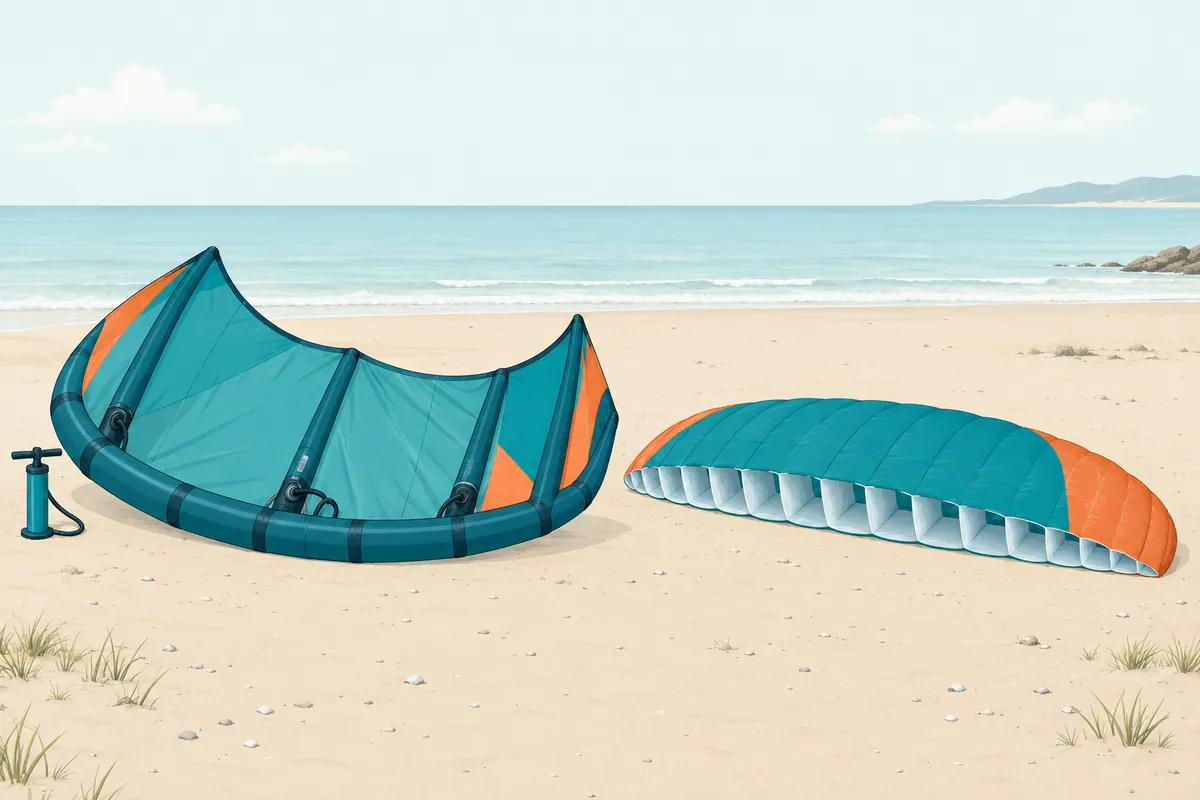
Almost every kite you see on a beach is a leading edge inflatable (LEI): a single-skin canopy held in shape by an inflatable tube along the leading edge plus inflatable cross-tubes called struts. You pump it up before each session, normally to 6–9 PSI. Small kites want more, around 8–10 PSI; big kites hold their shape at 5–6 PSI.
That inflated frame is what lets an LEI float and be relaunched off the water after a crash. Nearly all modern kites are one-pump: one valve feeds the leading edge and every strut through connecting hoses, so rigging takes minutes rather than a quarter of an hour.
Four LEI shapes matter. They differ in arc, sweep, bridling and trailing edge, and those differences decide how the kite feels in your hands, how much power it dumps when you sheet out, and how easily it comes back off the water.
C-kites Advanced
The original shape: a deep C-shaped arc, square wingtips, lines attached straight to the four corners with no bridle at all. A C-kite gives the most direct bar feel of any design, turns on its own axis and loops predictably, which is why wakestyle and unhooked freestyle riders still buy them.
Everyone else pays for that: a narrow wind range, limited depower, since sheeting out does not dump much power, and the hardest water relaunch in the sport. Not a beginner kite.
Bow kites
The bow arrived around 2005–2006, a flat, swept-tip kite with a concave trailing edge and a bridle carrying the leading edge. Flat means the projected area collapses when you sheet out, so a bow depowers by close to 100%, covers the widest wind range of any LEI, relaunches easily and drives upwind well.
Bows transformed safety in the sport. The pure ones feel dead in the turn, which is what produced the next two shapes.
Delta kites Beginner
A triangular planform that packs canopy area into the centre of the kite. Deltas keep the bow's depower and wind range and relaunch almost by themselves: the swept shape rolls the kite to the edge of the window while it lies on the water. They are forgiving and grunty for their size, which is why school racks are full of them.
Hybrid (open-C / SLE) kites
The middle ground, and today the biggest category by a distance: a C-like arc with a bridled leading edge and moderate sweep, usually told apart from a bow by its convex trailing edge. Hybrids borrow C-kite turning and pop and keep bow-level depower and relaunch. Most do-everything freeride and big-air kites, the ones at the top of the best-seller lists, are three-strut hybrids.
Strut count and light-wind LEIs
Strut count is a second axis of design, independent of shape. Five struts give the stiffest frame and the steadiest high-wind and big-air behaviour. Three struts are the all-round standard. One strut, or none, buys lightness, and weight is what decides everything below about 12 knots.
Single-strut kites (the Duotone Mono and Neo lineage, North Mono, Ozone Alpha and Boxer, Airush Ultra) keep flying in wind where a heavier kite falls out of the sky, which makes them the pick for light-wind days, for travel, since they pack small, and above all for foiling. They flutter more, they give up top end when overpowered, and they backstall a little if you park them deep and underpowered.
Foil kites
The other branch of the family has no inflatable parts. A foil, or ram-air, kite is a double-skin wing of closed cells that inflates through intake valves from the airflow itself and holds its shape on a bridle. Foils are far more efficient than LEIs: they fly and are raced in 6–8 knots, sit further forward in the wind window, and make power a same-size LEI cannot.
Every serious hydrofoil racer and most snowkiters use one. The bill is real: often 1.5–2× the price of the equivalent LEI, fiddly launching and landing, bridles that tangle, and a water relaunch that closed-cell designs allow but only for a while, because a foil kite left sitting in the sea takes water in through the cells. Learn on an LEI. A foil kite is a specialist's tool.
FAQ
What kite size do I need for my weight?
A 75 kg rider wants a 12 m at 14-16 knots, a 10 m at 17-20 and a 9 m at 21-25. A 90 kg rider goes about one size up at each step, a 60 kg rider one size down.
What is the best first kite?
A three-strut delta or hybrid, 10 or 12 m for a rider around 75 kg. Both depower to almost nothing when you sheet out and relaunch off the water with little skill.
How much does a full kitesurfing setup cost?
New, $1,800-2,500 (2026) for kite, bar, board, harness, pump, leash and helmet, wetsuit on top. Second-hand, $800-1,200 for the same list (2026).
More from The Gear
The other articles in this chapter- What are the different types of kitesurfing kites?
- How a kitesurfing control bar works
The Fundamentals · Learning the Sport · The Gear · Buying Gear & Keeping It Alive · Tech & Innovation · Wind, Weather & Water · Safety & Risk · When Things Go Wrong · Rules & Etiquette · Advanced Riding · Spots of the World · Practical Tricks & Life Hacks · The Video Library · Field Notes & Extras