Map › Guides › When Things Go Wrong › How to relaunch a kite from the water
The Kitesurfing Compendium · When Things Go Wrong
How to relaunch a kite from the water
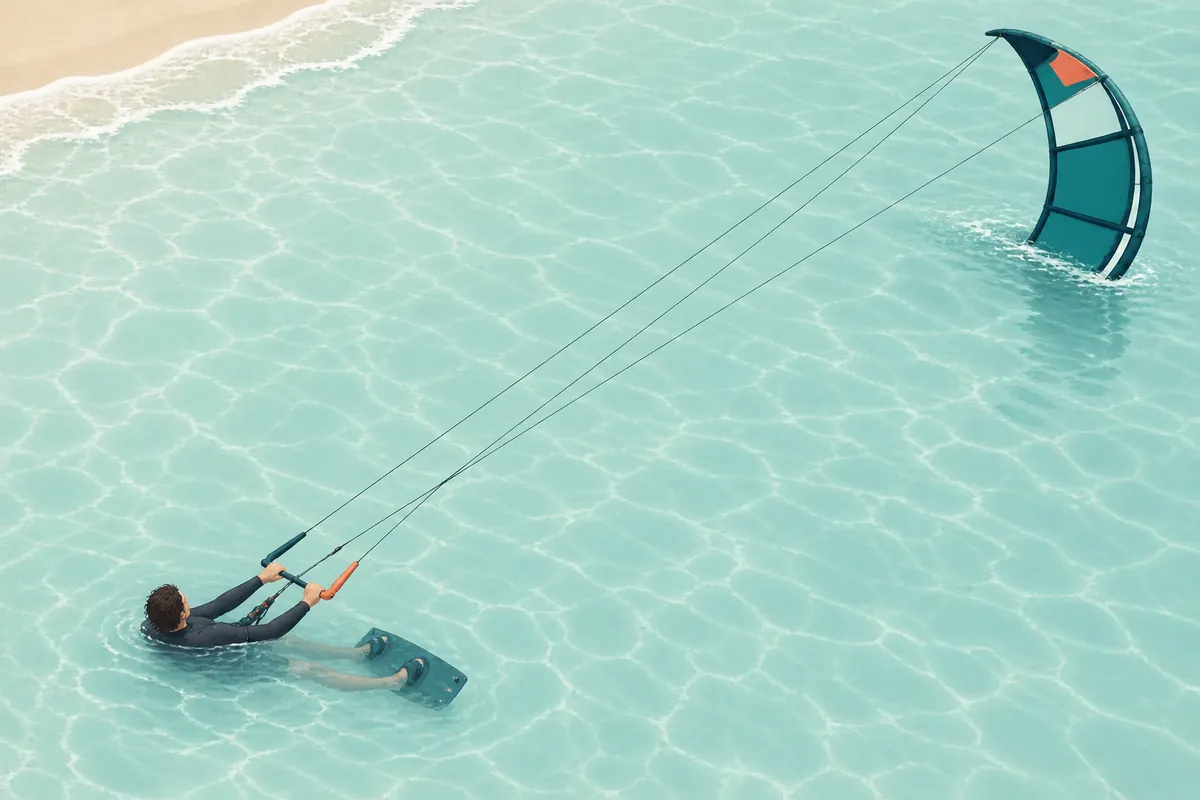
Water relaunch is the recovery skill you use most. Crashing is normal; getting the kite back in the air within a minute is what keeps a crash from turning into a swim. Every relaunch works the same way: kite to the edge of the wind window, up onto one wingtip, then fly it out.
Bow and hybrid kites (the modern standard)
Almost all modern kites are bow or hybrid designs with swept wingtips and depower bridles, and they are built to relaunch easily. The standard sequence:
- Let go of the bar completely. This is the step beginners get wrong most often. Bow and hybrid kites need the bar fully sheeted out (depowered) before they will move to the edge of the wind window. Pulling the bar in pins the kite on its back.
- Let the kite settle leading-edge down. If it crashed trailing-edge down or nose-down, a short steady pull on both centre lines will usually flip it onto its leading edge.
- Grab one steering line, ideally the one running to the wingtip closest to the edge of the wind window, near the floater at the bar end. Pull it in steadily, hand over hand, keeping the bar itself released.
- Wait for the drift. The kite slides toward the edge of the window and one wingtip lifts off the water. Keep gentle, constant tension; the kite will rotate up onto that wingtip.
- Steer up gently. When the kite reaches roughly the 9 or 3 o'clock position on its wingtip, release the steering line, take the bar, and steer up toward 10–11 o'clock (or 1–2 o'clock). Do not yank it straight to 12. In gusty conditions that invites an overflight and a second crash.
In light wind, under about 10–12 knots, the kite needs help: swim a few strokes toward it to create slack, then "pump" the centre lines, or drag yourself upwind so the wind can get under the canopy.
C kites
Advanced Traditional C kites, still ridden by some wakestyle riders, lack the bridle that makes bow kites pivot easily, so the technique differs: increasing rear-line tension cups the trailing edge, which lets the kite pivot up onto a wingtip.
Pull one rear line in far, often several arm-lengths, until the wingtip rises; keep it coming until the kite is on its side at the window edge, then steer up. In light wind, a C kite may need to be pulled into a downwind "taco" and flipped, or may simply not relaunch at all, in which case you move straight to self-rescue.
Inverted kites and wrapped lines
A kite inverts (rolling through its own lines, or wrapping a line around a wingtip) for one of two reasons: it falls out of the sky and the lines go slack, or it hits the water and you keep moving toward it, again killing line tension. Your options, in order of preference:
- Do nothing for 30–60 seconds. Hands off. The wind pushes the kite downwind, tension comes back into the lines, and a surprising number of inversions and half-wraps sort themselves out. Watch the kite; don't wrestle it.
- Relaunch anyway. If the kite comes up and flies acceptably despite a crossed line or a wingtip wrap, do not try to fix it on the water. Fly it conservatively, low in the window, and ride or body-drag straight back to the beach to sort it out on land. A flying kite with a cosmetic tangle beats a perfect line set 500 m from shore.
- Bar juggling Advanced (light wind only). To undo a full inversion, unhook your safety leash, open the chicken loop and, holding both centre lines so the kite stays depowered, pass the bar through the centre lines to reverse the twist. Watch that the outside lines don't wrap the bar as you spin it.
- Self-rescue. If the kite is badly rolled in its own lines and won't fly, don't fight it. Pull your quick release and go to the full self-rescue below. An inverted, unflyable kite is one of the most common triggers for one.
Watch · 2


FAQ
How do you relaunch a kite that has crashed in the water?
Let go of the bar so the kite depowers, then pull one steering line in steadily, hand over hand, until the kite slides to the edge of the wind window and rises onto a wingtip. Take the bar again at 9 or 3 o'clock and steer up to 10-11 (or 1-2). Pulling harder is the mistake, not the fix.
Can you land a kite on your own?
Up to about 15 knots, yes: walk the kite down on the front line to a wingtip, or use a fixed anchor built for it. Above that, flag the kite on the quick release and walk up the single tensioned line.
More from When Things Go Wrong
The other articles in this chapter- How to relaunch a kite from the water
- How to do a kitesurfing self-rescue in deep water
- What to do if a current or offshore wind pulls you out to sea
The Fundamentals · Learning the Sport · The Gear · Buying Gear & Keeping It Alive · Tech & Innovation · Wind, Weather & Water · Safety & Risk · When Things Go Wrong · Rules & Etiquette · Advanced Riding · Spots of the World · Practical Tricks & Life Hacks · The Video Library · Field Notes & Extras