Map › Guides › When Things Go Wrong › How to do a kitesurfing self-rescue in deep water
The Kitesurfing Compendium · When Things Go Wrong
How to do a kitesurfing self-rescue in deep water
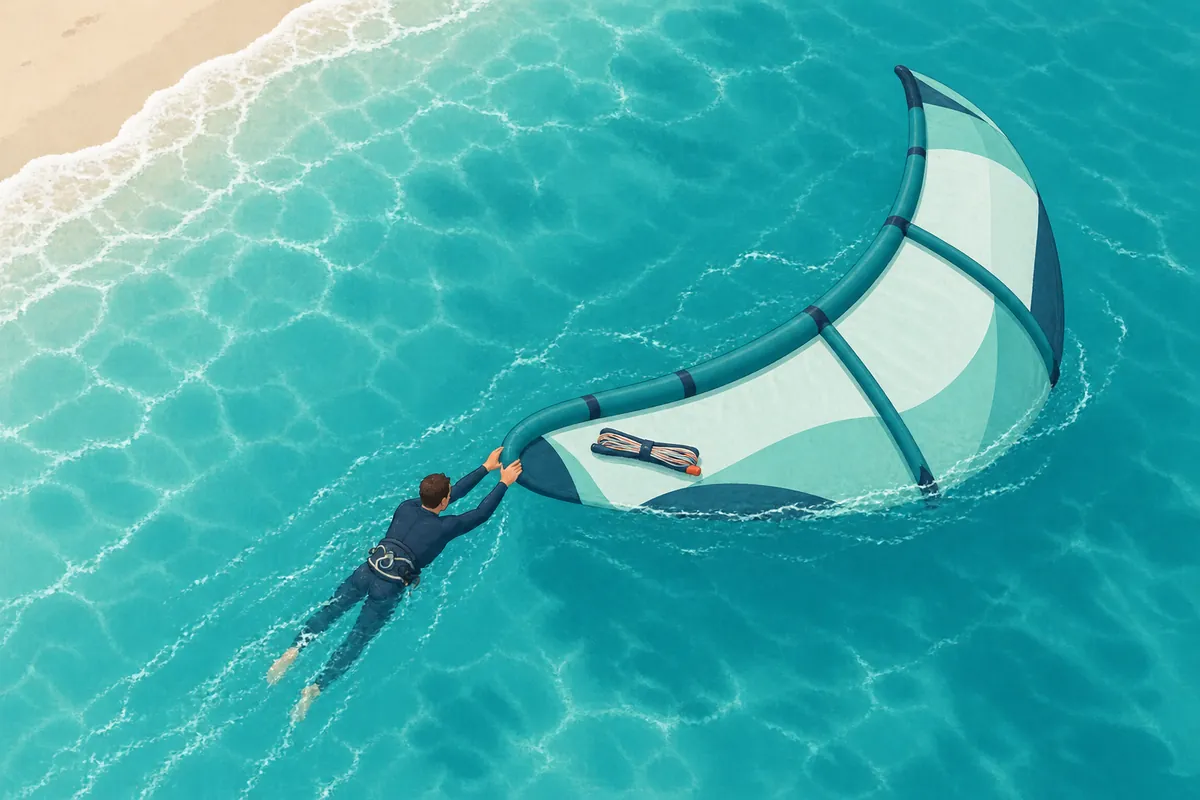
A self-rescue is how you bring yourself and your kite back to land when the kite will not fly. It runs in one fixed order: flag the kite on its safety line, get to the bar, wind the lines on (or swim down the safety line without winding), flip the kite leading-edge up, then use the kite as a sail and go downwind to the nearest safe shore.
It is the most important safety skill in the sport and the one most riders have only ever done standing up in waist-deep water.
That demonstration does not count: with nothing under your feet it feels completely different. Practise it properly once a season, in moderate wind, close to a safe beach. A shallow lagoon like Sicily - Lo Stagnone, ankle to waist deep, is where you learn the hand movements; deep water is where you find out what they cost.
Self-rescue is the right call when:
- The kite is inverted or tangled and won't relaunch.
- The wind has died and the kite won't stay up.
- A line or bridle has broken.
- You are injured, exhausted, or being carried toward danger.
Step 1: flag the kite
Activate your chicken-loop quick release. The kite flags out onto the single safety line, loses all power, and falls to the water downwind of you. Wait until it settles with tension only in the safety line.
Step 2: get to the bar and secure it
Pull yourself hand-over-hand up the safety line to the bar. There are two methods, and you want both.
The classic line-wrapping method (the IKO syllabus version):
- Secure the safety line to the bar. Wrap it on, locking each pass with the bar-end line-winders, and finish with two half-hitches so nothing can unwind.
- Wind all four (or five) lines onto the bar together, keeping steady tension, working your way toward the kite. Keep the winding neat: this bar has to be usable next session.
- Secure the lines at the kite. When you reach it, lock all lines with a final half-hitch or the bar's elastic keepers, and clip or tuck the bar into the back of your harness.
The fast "no-wrap" method: in strong wind or when speed matters, skip winding entirely. Pull yourself hand-over-hand down the safety line only until you reach the kite, and let the bar and lines trail downwind behind the kite as you sail in.
Step 3: sail the kite to shore
With the kite on its back on the water:
- Flip the kite so the leading edge faces up and into the wind. Grab the leading edge at the centre or a wingtip and lever it over.
- Bend the kite into a sail. Take hold of the outside bridle or wingtip and pull it toward you, curving the kite into a C-shape that catches the wind.
- Position yourself at one wingtip. Hook an arm or armpit over the leading edge and let your legs trail in the water as a rudder. Don't park yourself in the middle of the kite; it kills the sail shape.
- Sail on a broad reach. You can hold up to roughly 45 degrees either side of dead downwind. Pick the closest safe landfall downwind: a self-rescue never goes upwind. If you still have your board, tuck it under your chest arm or slide your feet into the straps; it improves your steering noticeably.
Step 4: if shore isn't reachable, raft up
If the wind is dying, the distance is long, or you're waiting for rescue, keep the kite inflated and climb onto it as a raft, staying low across the leading edge and struts.
Stay with the kite: a 9–12 m canopy is visible from the air and from a boat in a way a lone swimmer's head never is. The recognised kitesurfing distress signal is one arm raised straight up, waved slowly side to side.
Deep-water pack-down (only when you must)
Pack down fully only if you have to swim through shorebreak, board a rescue boat, or the flapping kite has become unmanageable:
- Wind and secure all lines first, exactly as in Step 2.
- Deflate the leading edge. Open the deflate valve, keeping it up out of the water so water can't enter the bladder. Leave the struts inflated if your kite allows; they keep it floating.
- Roll from the tips. Fold the kite with the deflate valve on the upper side, grab both wingtips, and roll tightly from the tips toward the valve, squeezing air out as you go. Close the valve.
- Bundle and go. Strap the rolled kite together with the bar, your harness webbing, or the kite's own bridle, lay it across your chest, and backstroke in, or hand the bundle up to the boat.
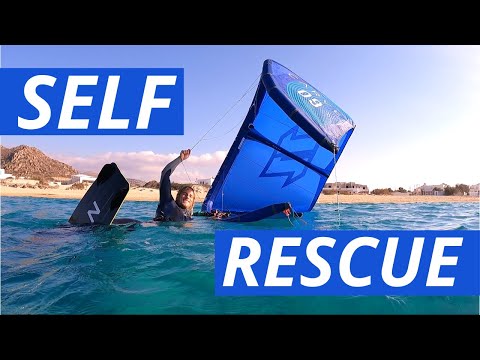
Watch · 3


FAQ
How long does a kitesurfing self-rescue take?
In one timed comparison, winding every line onto the bar took an experienced rider about 4.5 minutes in 15-18 knots; swimming down the safety line without winding put them at the kite in under 30 seconds. Wind the lines when you have time and space.
How do you get your board back without a board leash?
Upwind body drag: park the kite at 10-11 or 1-2 o'clock on the side you're heading, extend your free arm as a keel, roll onto your side and tack 7-8 m at a time up to the board. Board leashes are banned by essentially every school: a leashed board slingshots back at your head.
More from When Things Go Wrong
The other articles in this chapter- How to relaunch a kite from the water
- How to do a kitesurfing self-rescue in deep water
- What to do if a current or offshore wind pulls you out to sea
The Fundamentals · Learning the Sport · The Gear · Buying Gear & Keeping It Alive · Tech & Innovation · Wind, Weather & Water · Safety & Risk · When Things Go Wrong · Rules & Etiquette · Advanced Riding · Spots of the World · Practical Tricks & Life Hacks · The Video Library · Field Notes & Extras