Map › Guides › The Gear › How a kitesurfing control bar works
The Kitesurfing Compendium · The Gear
How a kitesurfing control bar works
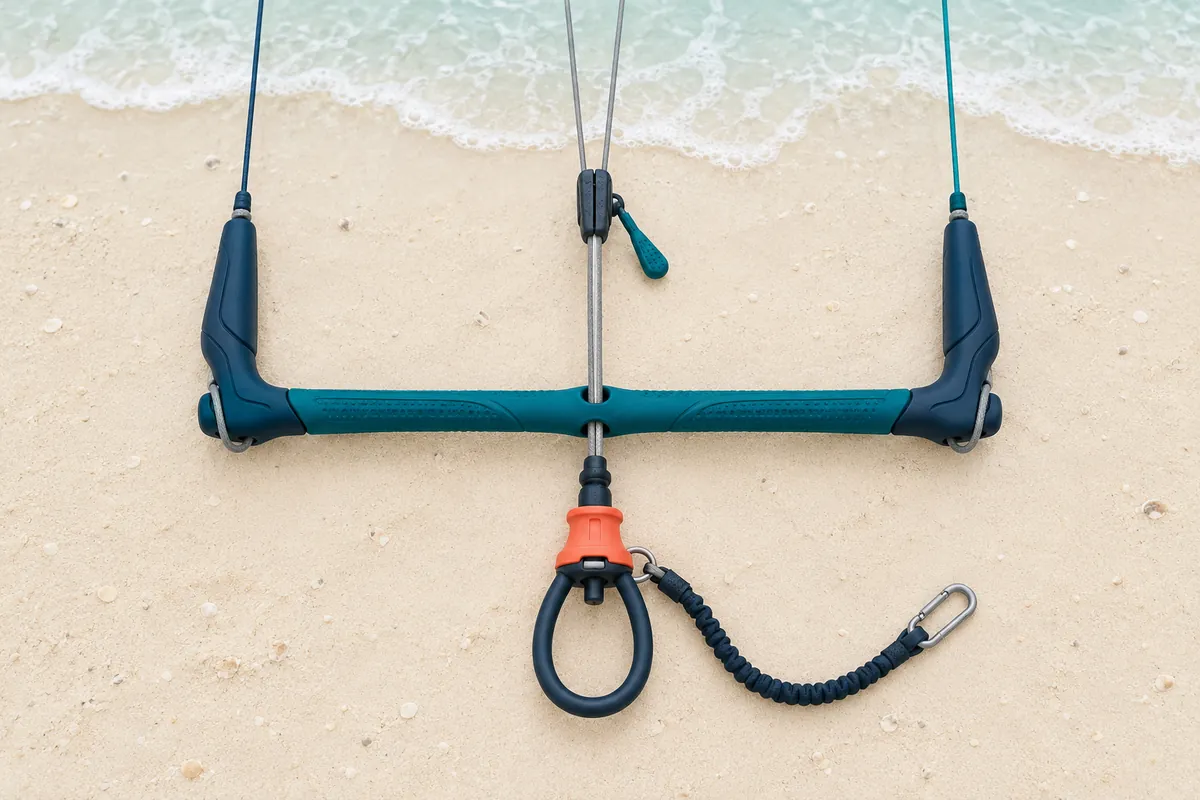
The bar is your steering wheel, throttle and ejector seat in one.
Working outwards from your hands: the bar itself, 45–55 cm wide, with narrow bars of about 45–47 cm for kites under 9 m, wide bars of 50–55 cm for 10 m and up, and adjustable ends on many current models; the depower or trim system, a cleat or clicker that shortens the front lines to take power out for the whole session; the chicken loop you hook into your harness; the quick release above it; and the safety leash connection.
How it works. The two centre (front) lines carry most of the kite's load through the chicken loop into your harness; the two outer (back, or steering) lines run to the bar ends. Pull the bar in and you tension the back lines, raising the canopy's angle of attack, and the power comes on. Push it away and the kite sheets out. Pull one end and it turns.
Let go completely and a modern kite drifts down to low power; fire the quick release and it flags out on a single line at close to zero power.
By about 2015 every major brand had settled on the push-away release, and since 14 February 2020 the international standard for these systems, ISO 21853, has required a release to open under no more than 170 N of load and in under 2 seconds, tested dry, wet, sandy and cold. Certified hardware carries the number embossed on it.
Four lines or five?
Four lines is the modern default: simpler, less to tangle, with the safety routed down one front line, which is called single front line flagging.
A fifth line, a centre line running to the middle of the leading edge, survives mainly on true C-kites, where it does the depower and safety job the missing bridle cannot and helps the kite relaunch. North and Duotone have also sold five-line safety on hybrids in the past. Unless you are buying a C-kite, buy a four-line bar.
Line length
Standard is 22–24 m. Longer lines of 25–27 m sweep a bigger arc through the wind window, so the kite builds more power in each stroke, which is what you want in marginal wind.
Shorter lines of 15–20 m make the kite feel faster and more direct and keep loops low; they are the norm for hydrofoiling and in schools, where less power means smaller consequences. Many bars ship at 24 m with removable 2 m extensions, so one bar covers both 22 m and 24 m.
The lines are pre-stretched Dyneema or Spectra, each rated to several hundred kilograms. They wear. Check for fraying, and re-measure the set once a year: unevenly stretched lines make a kite fly badly, and can be knotted back to equal length. A new bar costs $400–650, or €350–550, in 2026.
Watch · 4


More from The Gear
The other articles in this chapter- What are the different types of kitesurfing kites?
- How a kitesurfing control bar works
The Fundamentals · Learning the Sport · The Gear · Buying Gear & Keeping It Alive · Tech & Innovation · Wind, Weather & Water · Safety & Risk · When Things Go Wrong · Rules & Etiquette · Advanced Riding · Spots of the World · Practical Tricks & Life Hacks · The Video Library · Field Notes & Extras