Map › Guides › The Fundamentals › What you learn in kitesurfing lessons, stage by stage
The Kitesurfing Compendium · The Fundamentals
What you learn in kitesurfing lessons, stage by stage
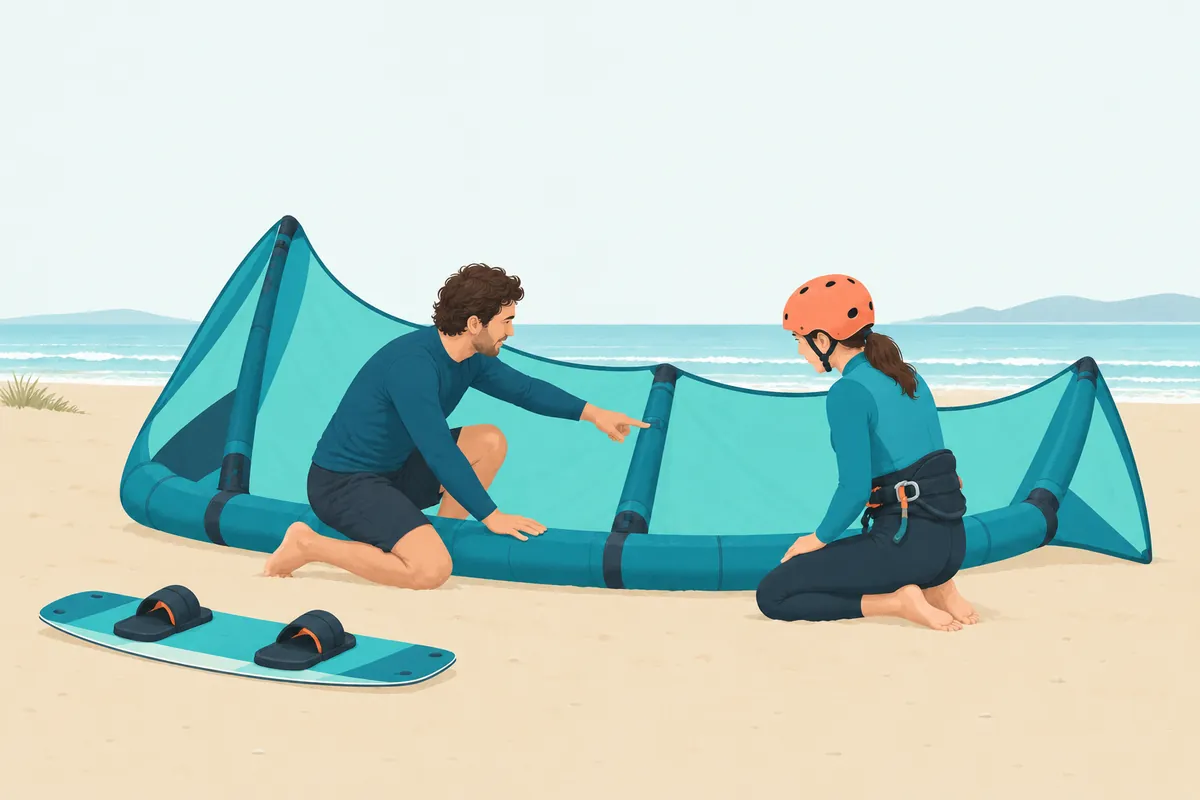
Lessons follow a near-universal sequence. Of the 790 schools in the atlas that state a certification, 549 teach to IKO and 136 to VDWS, which dominates the German-speaking countries; BKSA appears on 9. The school pages say which body each school teaches under. Do not skip stages.
Stage 1: theory and kite control on land, hours 0–4 Beginner
Wind theory, the wind window, reading a spot, setting up the gear, the safety systems. Then flying: parking, figure-8s, power strokes, one-handed control, assisted launch and landing, and firing the quick release until it is reflexive.
Stage 2: body dragging, hours 3–8 Beginner
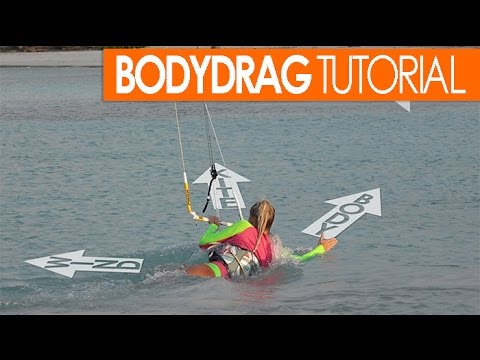
In the water without the board, letting the kite pull you: first downwind, with the kite in gentle figure-8s while you swim-drag, then directional and upwind. Upwind body dragging is the quietly critical one.
Park the kite at about 10:30 or 1:30 with one hand on the bar, extend the other arm and your body as a keel, head slightly ahead of your feet, and knife through the water at up to 45 degrees against the wind.
This is how you get your board back every time you crash away from it, which as a beginner is constantly. Deep-water pack-down and self-rescue, winding the lines in and using the kite as a sail and a raft to reach shore, are taught here too.
Stage 3: the waterstart, hours 6–15 Beginner
The gateway. Sitting in the water, board on your feet, kite parked at 12: point the board about 45 degrees downwind, steer the kite slightly back to one side, then dive it hard through the power zone in the direction you want to go. The surge pulls you up and over the board.
You rise with your weight low and the back foot pressed, ride away for two seconds, then crash. That is normal: the waterstart is a timing skill and almost everyone needs dozens of tries. The faults are diving the kite too timidly, so you flop back, diving it too hard, so you are ripped over the nose, and standing up straight too early.
Stage 4: first runs and controlled riding, hours 10–20 Beginner
Rides stretch from seconds to hundreds of metres. You learn speed control, edging harder to slow and bearing off to accelerate, stopping without a crash, riding both directions, and relaunching the kite off the water. Every session still ends downwind of where it started. That is the walk of shame, and everyone does it.
Stage 5: staying upwind, hours 15–40 Intermediate
This is the skill that makes you independent. The recipe: kite parked and still at about 45 degrees, since working the kite drags you downwind; board carving on its heelside edge; weight back and low; hips open; and the piece every instructor repeats, look where you are going, not at the kite. Looking upwind opens your shoulders and hips and sets your edge for you.
Looking down at the kite locks your body downwind. The classic mistakes: kite too high, which lifts you off your edge; kite too low and sined too much, which drags you downwind; pinching so hard upwind that the board stalls. When you can go out, ride both ways and come back to your towel, you are an independent kitesurfer.
Watch · 5


More from The Fundamentals
The other articles in this chapter- The bar, lines and harness explained
- How to launch and land a kite safely
- What you learn in kitesurfing lessons, stage by stage
- How long does it take to learn to kitesurf?
The Fundamentals · Learning the Sport · The Gear · Buying Gear & Keeping It Alive · Tech & Innovation · Wind, Weather & Water · Safety & Risk · When Things Go Wrong · Rules & Etiquette · Advanced Riding · Spots of the World · Practical Tricks & Life Hacks · The Video Library · Field Notes & Extras