Map › Guides › Learning the Sport › IKO vs VDWS: which kitesurfing certification?
The Kitesurfing Compendium · Learning the Sport
IKO vs VDWS: which kitesurfing certification?
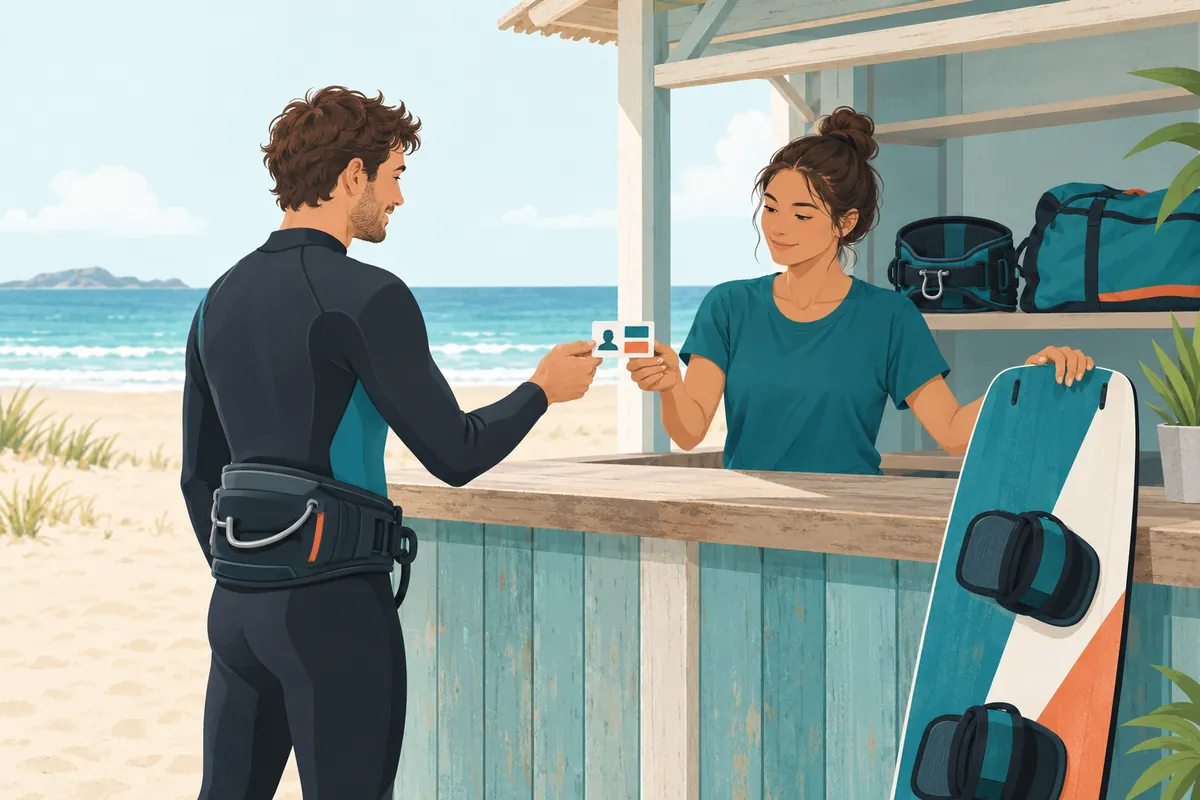
Two systems dominate. Of the 1,606 schools in the atlas, 790 list a teaching qualification: 549 of them IKO, 136 VDWS, 59 both. The rest hold national federation badges that count locally, such as FIV in Italy and FFVL in France.
No card is legally required to kitesurf in most countries. What it buys is access to gear: rental shops read your level before handing you a kite, some insurers and destinations ask for it, and any instructor sees in one line what you can do.
IKO (International Kiteboarding Organization)
The IKO was founded in 2001 and is run from the Dominican Republic. It is the card you meet most often outside German-speaking Europe: its schools in the atlas cluster in Italy (70), Spain (60) and Brazil (26), and it is the default across the Americas and Asia. The pathway runs through five levels, each broken into lettered sub-skills:
- Level 1, Discovery Beginner (roughly the first 2 to 4 hours). Everything on land: the SEA check (Spot, Environment, Activity), kite setup, safety systems and pre-flight checks, assisted launching and landing, piloting through the wind window, one-handed flying, firing the quick release. Finishing Level 1 means you can handle a kite on land safely. Nothing more.
- Level 2, Intermediate Beginner (typically 4 to 10 further hours). Into the water without the board: water relaunch, body-dragging downwind and, the one that matters, upwind body-dragging, which is how you retrieve a lost board ever after. Then power strokes, self-rescue basics, right-of-way rules, and the first waterstarts. It ends with you standing up and riding a few metres.
- Level 3, Independent Intermediate (typically 6 to 20 further hours). The milestone: controlling speed by edging, riding consistently, staying upwind, basic transitions, toeside, self-launching, deep-water self-rescue. An IKO Level 3 card is the working passport to renting equipment and riding unsupervised.
- Level 4, Advanced Advanced (10 to 50 hours of riding). First jumps, carving jibes, grabs, recovery techniques, and deeper theory on weather and aerodynamics.
- Level 5, Evolution Advanced. Specialisation tracks: freeride (kiteloops, downloops, rolls), wave riding, unhooked freestyle, hydrofoil or wing foil. Each foil track is budgeted at roughly 10 to 40 hours.
Most students complete Levels 1 to 3 in 12 to 20 hours of instruction spread over 3 to 7 days. Progress is logged on an IKO member card, physical or in the app, so you can start Level 2 in Greece and finish Level 3 in Brazil without repeating anything.
VDWS (Verband Deutscher Wassersport Schulen)
The German water-sports school association is concentrated where you would expect: of its 136 schools in the atlas, 35 are in Germany, 18 in Italy and 15 in the Netherlands. Much of the ION CLUB and large European centre network is VDWS-affiliated. Its kite curriculum has five practical levels plus a theory exam:
- Level 1: safety basics, setup, first kite flying, launch.
- Level 2: confident kite flying, relaunch, body-dragging.
- Level 3: waterstart and first short rides downwind. After Level 3 you sit a multiple-choice theory test on wind theory, right of way, safety.
- Level 4: riding in both directions, holding your position relative to the wind, first basic jibe.
- Level 5: fully independent riding, including consistent upwind ability.
Level 5 plus the theory exam earns the VDWS International Kiteboarding Basic Licence, the card rental stations in German-speaking Europe ask to see. VDWS Level 5 does the same job as IKO Level 3, and schools translate between the two without fuss.
FAQ
How long does it take to learn kitesurfing?
12 to 20 hours of tuition over three to seven days takes most people to IKO Level 3 or VDWS Level 5. Reliable upwind riding usually needs 20 to 30 hours on the water.
How much does a beginner kitesurfing course cost?
A 9 to 12 hour course cost EUR 300 to EUR 550 (2026) across Europe and North Africa. Private hours ran $50 to $150 (2026), group hours $25 to $60 (2026).
Do I need an IKO or VDWS licence to rent kitesurfing gear?
Not by law in most countries, but rental shops use the card to decide. 549 of the 790 certified schools in the atlas carry IKO, against 136 with VDWS, which is concentrated in German-speaking Europe.
What age and weight can children start kitesurfing?
The IKO guideline is age 12 and about 35 kg. Schools take 8- to 10-year-olds on 1.5 to 4 m kites in shallow water, one instructor per child.
More from Learning the Sport
The other articles in this chapter- IKO vs VDWS: which kitesurfing certification?
- How to choose a kitesurfing school
- Kite camp abroad or lessons at your local spot?
The Fundamentals · Learning the Sport · The Gear · Buying Gear & Keeping It Alive · Tech & Innovation · Wind, Weather & Water · Safety & Risk · When Things Go Wrong · Rules & Etiquette · Advanced Riding · Spots of the World · Practical Tricks & Life Hacks · The Video Library · Field Notes & Extras