Map › Guides › Tech & Innovation › Kite hydrofoils and light-wind riding
The Kitesurfing Compendium · Tech & Innovation
Kite hydrofoils and light-wind riding
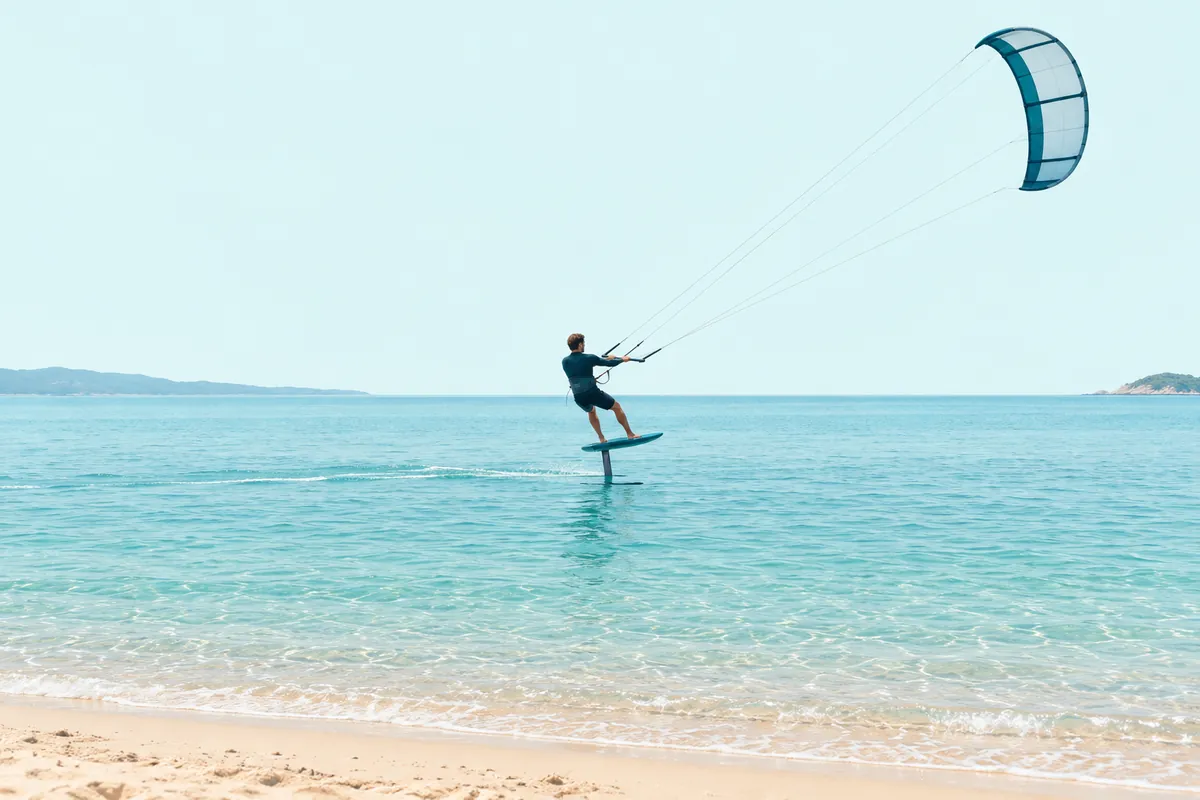
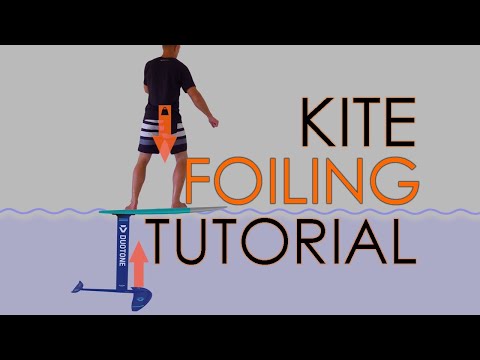
Intermediate A hydrofoil turns light wind from a compromise into a discipline. The foil is a mast of typically 75–100 cm carrying a front wing and a stabiliser; it lifts the board clear of the water and cuts drag so far that a competent foiler rides in 8–10 knots on a kite as small as 6–9 m, at speeds that pass boats and at upwind angles no twin-tip will hold.
Materials and modularity define the market. Full-carbon masts and wings sit at the performance end; aluminium-mast packages keep entry prices sane. The Italian brand Sabfoil (formerly Moses) builds the modular Kraken mast system with a tool-free quick release for moving a foil between boards.
Lift Foils, Levitaz, F-One, Naish, Slingshot, Duotone, North, Cabrinha and Airush all sell modular wing ecosystems: one mast and fuselage, front wings swapped small and fast for racing or big and slow for cruising and waves. The newer work goes into carbon-nanotube-reinforced layups, and into bio-resins and recycled carbon.
The kite end split too. For everyday foiling the light single-strut inflatables above are the easy answer. At the elite end sit ram-air foil kites: twin-skin, bridled, strutless soft kites with glider-like efficiency. Ozone's Chrono, launched in 2014, put water-relaunchable closed-cell foil kites in freeriders' hands; the Flysurfer Soul is the freeride benchmark; the Ozone Hyperlink V3 straddles both worlds.
Racing is foil-kite-only in practice: since about 2012, starting with the Russian brand Elf and its Joker, race courses have belonged to high-aspect ram-air kites, and the Formula Kite class, a hydrofoil board plus a registered ram-air kite such as Ozone's R1, was an Olympic discipline at Paris 2024. An Ozone team rider reportedly held the WOO record briefly on an R1 V4 race kite in nuking wind.
Waist-deep flat water is the place to learn it, not open sea. Langebaan, the lagoon riders pair with a Cape Town trip, is one of the destinations the atlas flags for foiling as well as for beginners; its page also says what the town does not have, which is a nightlife.
Watch · 1
FAQ
How much wind do you need to kite foil?
A competent foiler rides in 8-10 knots on a 6-9 m kite. The mast is usually 75-100 cm, and flat shallow water makes learning far less punishing than open sea.
Single-strut or three-strut kite?
Fewer struts give low end and drift; more struts give top end and easier relaunch. If your home spot is gusty above 20 knots, a single-strut is the wrong kite however light it is.
More from Tech & Innovation
The other articles in this chapter- Aluula vs Dacron kite airframes
- Big air kites and the world jump record
- Kite hydrofoils and light-wind riding
- Kite quick release systems and the ISO 21853 standard
The Fundamentals · Learning the Sport · The Gear · Buying Gear & Keeping It Alive · Tech & Innovation · Wind, Weather & Water · Safety & Risk · When Things Go Wrong · Rules & Etiquette · Advanced Riding · Spots of the World · Practical Tricks & Life Hacks · The Video Library · Field Notes & Extras