Map › Guides › Tech & Innovation › Aluula vs Dacron kite airframes
The Kitesurfing Compendium · Tech & Innovation
Aluula vs Dacron kite airframes
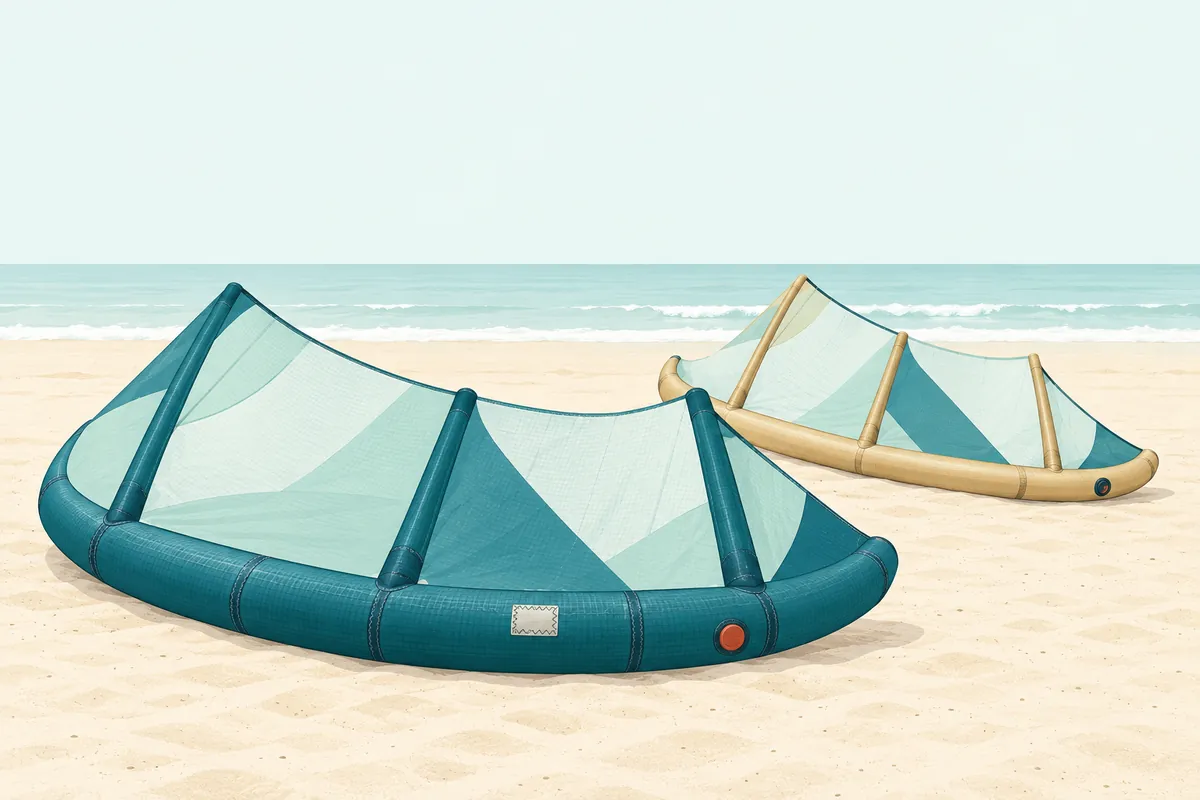
For about twenty years every inflatable kite was built the same way: a leading edge and struts of Dacron, a woven polyester of roughly 155–165 g/m², holding up a ripstop polyester canopy.
Dacron is cheap, it patches with a needle and a scrap of cloth, and it lasts. It is also heavy and it stretches. Under the load of a megaloop or an overpowered gust the airframe flexes, and the profile the designer drew flexes with it.
The change came from Aluula Composites, a Canadian firm whose laminate bonds ultra-high-molecular-weight polyethylene (UHMWPE) to a polymer base film. It weighs about 82 g/m², which takes 40–50% out of the airframe fabric and 25–30% off the weight of the finished kite.
In a published side-by-side load test a Dacron sample failed at 88 lb (40 kg) while the Aluula sample held to 187 lb (85 kg); manufacturer figures put the laminate at roughly six times the tensile strength per unit weight. It also barely stretches, so the airframe takes higher inflation pressure and holds the shape it was designed with.
On the water that shows up as faster turning, better upwind angles, much better drift and low end (a lighter kite flies in less wind and falls out of the sky more slowly), and more control when you are overpowered. In back-to-back testing of the Duotone Evo D/LAB (Aluula) against the Evo SLS (Dacron airframe) in 18–20 knots, testers rated the Aluula version better in essentially every category.
Ocean Rodeo got there first with its A-Series (Flite, Roam, Rise). The material then spread across the premium tier: Duotone's D/LAB line (Evo D/LAB, Rebel SLS D/LAB, Neo D/LAB), Core's XR Pro and Ozone's Edge Ultra-X all fly Aluula airframes.
Other brands built their own high-tension cloth rather than license it: North's N-Max and N-Max2 (used in the Orbit Pro), Duotone's Penta TX in the SLS ("Strong-Light-Superior") range, and Core's ExoTex rigid Dacron alternative. Adoption of UHMWPE-class fabrics reportedly grew about 50% across the 2025 model lineups.
| Property | Dacron (woven polyester) | Aluula (UHMWPE laminate) |
|---|---|---|
| Fabric weight | 155–165 g/m² | ~82 g/m² |
| Load at failure (published sample test) | 88 lb (40 kg) | 187 lb (85 kg) |
| Stretch under load | Significant; the airframe deforms | Minimal; holds its designed profile |
| Effect on complete-kite weight | Baseline | 25–30% lighter |
| Repairability | Easy to patch, well understood | Harder to patch; UV lifespan still unproven |
| Typical retail, complete kite | ~$1,600–2,200 (2026) | ~$3,075–3,700 (2026) |
The catch is money and repair. An Aluula airframe adds roughly 30% to the price of a kite, the laminate is harder to patch than woven Dacron, and its long-term UV life is still being proven in the field. Nobody has published a ten-year field study on a laminate airframe, because nobody has owned one for ten years.
Watch · 2


More from Tech & Innovation
The other articles in this chapterThe Fundamentals · Learning the Sport · The Gear · Buying Gear & Keeping It Alive · Tech & Innovation · Wind, Weather & Water · Safety & Risk · When Things Go Wrong · Rules & Etiquette · Advanced Riding · Spots of the World · Practical Tricks & Life Hacks · The Video Library · Field Notes & Extras