Map › Guides › Buying Gear & Keeping It Alive › How to repair a kite yourself, and when to use a loft
The Kitesurfing Compendium · Buying Gear & Keeping It Alive
How to repair a kite yourself, and when to use a loft
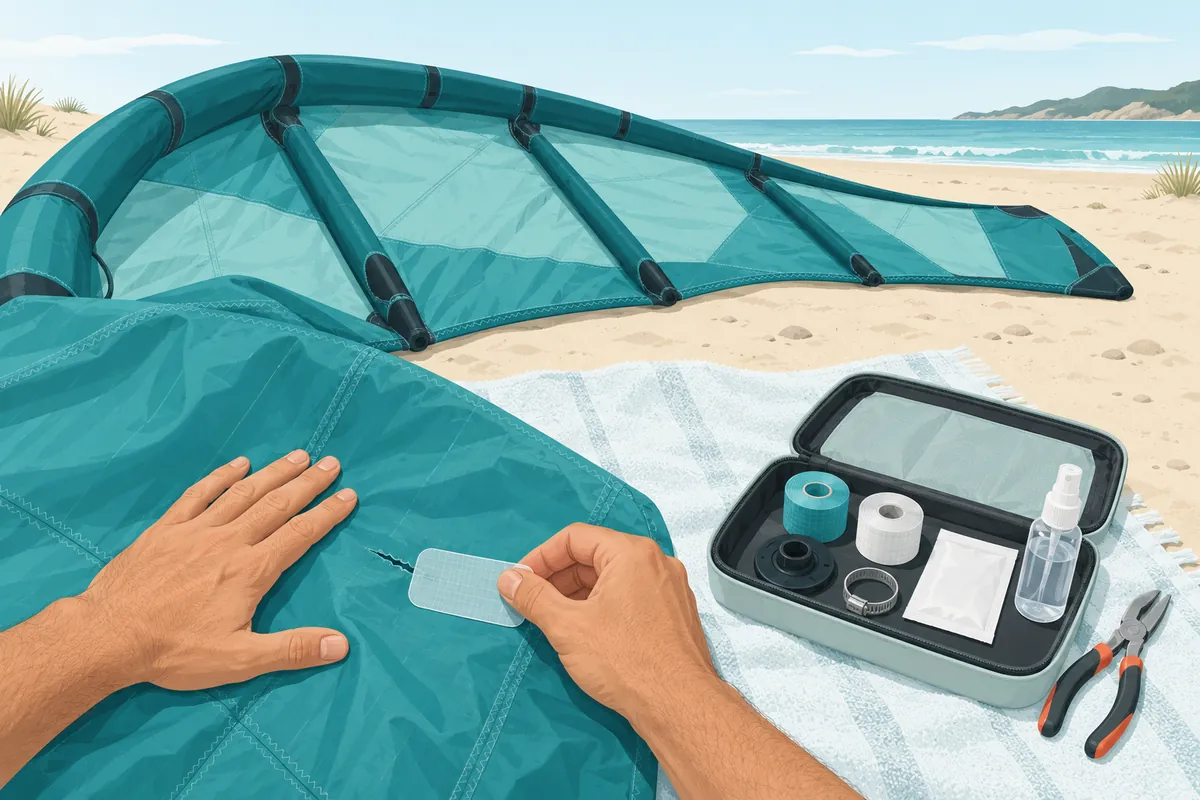
Every kiter eventually does surgery on a beach towel. The standard field kit costs $30–60 in 2026: Tear-Aid Type A and TPU bladder patch tape, self-adhesive ripstop in Dacron and spinnaker weights, a spare valve or two, a spare one-pump hose clamp, alcohol wipes, soapy water in a small spray bottle, pliers.
A bladder patch you do yourself costs about $15 in 2026; the same job at a loft is $85–100 (2026). Four repairs are worth learning.
- Find the slow leak. Inflate firm, spray soapy water along the leading edge and the struts, and watch for bubbles; it usually shows within a minute. For bladder pinholes, pull the bladder out, inflate it outside the kite, and pass it through a bathtub or spray it down.
- Patch the bladder. Clean and dry the area with an alcohol wipe, then apply a Tear-Aid or TPU patch with at least 2 cm of overlap and rounded corners, because square corners peel. Press out every air bubble and leave it 30 minutes or more before re-inflating. Done properly this is a permanent repair.
- Swap a bladder. Attach a leader line, girth-hitched, or use the old bladder to pull a retrieval line through, before you extract the old bladder through the wingtip or the strut opening. Otherwise you are threading a new one blind through a 10-metre tube. Remove the valve fittings through the valve openings, tape the new bladder to the line, feed it in slowly and unwrinkled, and inflate gently at first to check that nothing is twisted. Fiddly, but a 30 to 60 minute living-room job. A strut bladder costs about $25–50 in 2026; a leading-edge bladder $60–120 (2026), sold by the brands' service departments and by specialist bladder makers.
- Reglue or replace a valve. Warm the old valve with a hair dryer to soften the adhesive, peel it off carefully, clean the site, and apply a new self-adhesive valve, pressing out every air bubble. Modern self-stick kits need no glue; a flexible adhesive such as Aquaseal also works. Let it cure as directed before you inflate hard. Cost: $10–25 per valve in 2026.
Two supporting skills round out the kit. Canopy tears: a small tear or pinhole away from a seam, up to roughly 5 cm, takes self-adhesive ripstop applied to both sides with the torn edges aligned precisely, 2 cm of overlap, corners rounded. That is a legitimate permanent fix. Lines: mostly, do not.
A frayed or broken flying line is a replacement, not a repair, and knotting it back together costs up to half its strength. What you can do is re-trim: replace worn pigtails, which are cheap and exist precisely to absorb lark's-head wear, and equalise shrunken lines by moving knots.
Go to a professional loft when a tear is longer than about 10–15 cm, crosses a seam, or involves the leading edge or the strut Dacron, which is structural; when panels need replacing rather than patching; when stitching has failed over a long section; when a bridle attachment point is damaged; when bladder damage sits at the valve neck; or when a home repair keeps failing and the kite is carrying several ageing patches.
Loft repairs are sewn with matched cloth, restore full strength and cost $30–150 in 2026. A canopy tear under about 12 cm is roughly an hour of loft labour; a large leading-edge job is three to four hours. A repair costing $50–150 in 2026 routinely adds seasons to a kite still worth $800 (2026).
Watch · 6


More from Buying Gear & Keeping It Alive
The other articles in this chapter- How much does kitesurfing gear cost, new or used?
- How to inspect a used kite before you buy it
- Which kite sizes to buy for your weight
- Kite maintenance and what actually kills kites
- How to repair a kite yourself, and when to use a loft
- Do you need a trainer kite?
The Fundamentals · Learning the Sport · The Gear · Buying Gear & Keeping It Alive · Tech & Innovation · Wind, Weather & Water · Safety & Risk · When Things Go Wrong · Rules & Etiquette · Advanced Riding · Spots of the World · Practical Tricks & Life Hacks · The Video Library · Field Notes & Extras