Map›Guides›Field Notes & Extras›Planning a kite trip, from airline boardbag rules to camps and downwindersField Notes & Extras
On this page
The Kitesurfing Compendium · Field Notes & Extras
Planning a kite trip, from airline boardbag rules to camps and downwinders
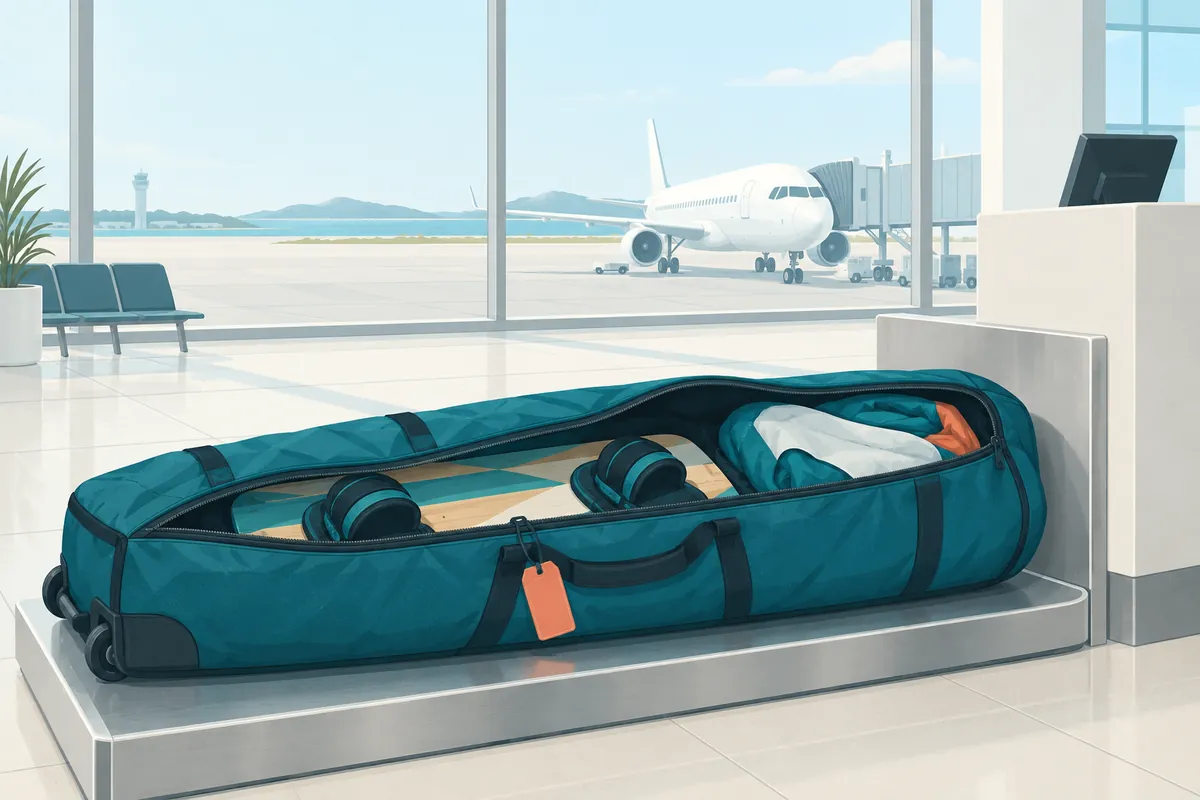
Airline kite-bag rules split three ways: the boardbag rides inside your standard checked allowance, it carries a named sports-equipment fee, or the aircraft is too small to take it at all.
The atlas holds 95 airline policies with the year on each. Of those, 33 take a boardbag inside the standard allowance, 50 charge on top of it, 27 price it cheaper when you pre-book, and 33 carry a small-aircraft caveat.
| Policy tier | What it means | Watch out for |
|---|---|---|
| Inside the standard checked allowance (33 of 95 carriers) | Free within your allowance if under the weight limit, typically 23 kg | Length and linear-dimension caps still apply, and excess weight is charged steeply |
| A named sports-equipment fee (50 of 95) | Air Canada charges $100 flat per kiteboard, Olympic Air €100 for a board over 2 m, Pegasus EUR 65 internationally (kites travel under its special-equipment code), Alaska $35 for the first sports bag (fares bought from 2 January 2024), all 2026 policies | 27 carriers price it lower when pre-booked, so paying at the airport costs more |
| Small-aircraft refusals (33 of 95) | Air Mauritius caps equipment at 180 cm on ATR aircraft against 200–300 cm on jets; Azul drops to 275 cm on ATRs against 320 cm on jets; Air Seychelles carries kite gear on international flights only, not inter-island hops, 2026 policies | Check the operating carrier of every leg, not the one that sold you the ticket |
The airline page in the atlas carries each policy, its year and the official source. Reading yours is how you avoid arguing at a check-in desk about a 190 cm boardbag.
The classic travel hacks, with the honest caveats. Kites and bars have no awkward dimensions, so packing kites in a normal suitcase and renting a board is often cheapest: 1,348 of the 1,680 schools in the atlas rent gear, and mature destinations are thick with them, 23 rental schools in Tarifa, 15 in Dakhla, 11 in Le Morne, 9 in Cabarete.
Splitting weight across two bags beats one overweight bag whenever a second checked bag costs less than the surcharge; do the arithmetic per airline.
Labelling a boardbag as golf equipment exploits some carriers' cheaper golf rates, but misdeclaring can void a damage claim, and where golf and kite gear are priced the same it gains nothing. Whatever you fly with, pack to survive baggage handlers: fins off and wrapped, rails padded with wetsuits and towels, kites as the cushioning layer, harness and bar in the middle of the bag.
Trip planning, camps and downwinders
Plan around the reliable wind windows in the spots chapter and decide rent-versus-bring per destination. Mature spots rent current gear at sane rates; remote trips demand self-sufficiency and a repair kit. Confirm your gear is insured in transit and in storage, because airline liability for sports kit is minimal.
Two formats compress progression like nothing else:
- Coaching camps and clinics Intermediate. A week of video-debriefed, radio-coached sessions is the fastest intermediate-to-advanced route in the sport. 548 of the 1,680 schools in the atlas run camps, and 221 list radio helmets, which is the detail that separates coaching from supervision.
- Downwinders, point-to-point runs with vehicle or boat support. 264 schools list them, 41 of those in Brazil, more than any other country, which is why Brazil's northeast coast is the reference: buggy- and boat-supported multi-day runs across hundreds of kilometres of flat lagoons and waves. Prea was the finishing point of the Sol Sertões downwind rally in October 2025. Never run one unsupported on an unfamiliar coast.
More from Field Notes & Extras
The other articles in this chapter
- 1 Why does kite power increase with the square of wind speed?
- 2 Kitesurfing competitions and the pro tour
- 3 Kitesurfing insurance and liability
- 4 Kitesurfing fitness and injury prevention
- 5 First aid on the beach and in the water
- 6 Beach access, wildlife rules and how spots get banned
- 7 Planning a kite trip, from airline boardbag rules to camps and downwindersYou are here
- 8 What kitesurfing costs in the first year and after
- 9 Kitesurfing history, community and jargon
- Read the full chapter: Field Notes & Extras