Map › Guides › Field Notes & Extras › Kitesurfing insurance and liability
The Kitesurfing Compendium · Field Notes & Extras
Kitesurfing insurance and liability
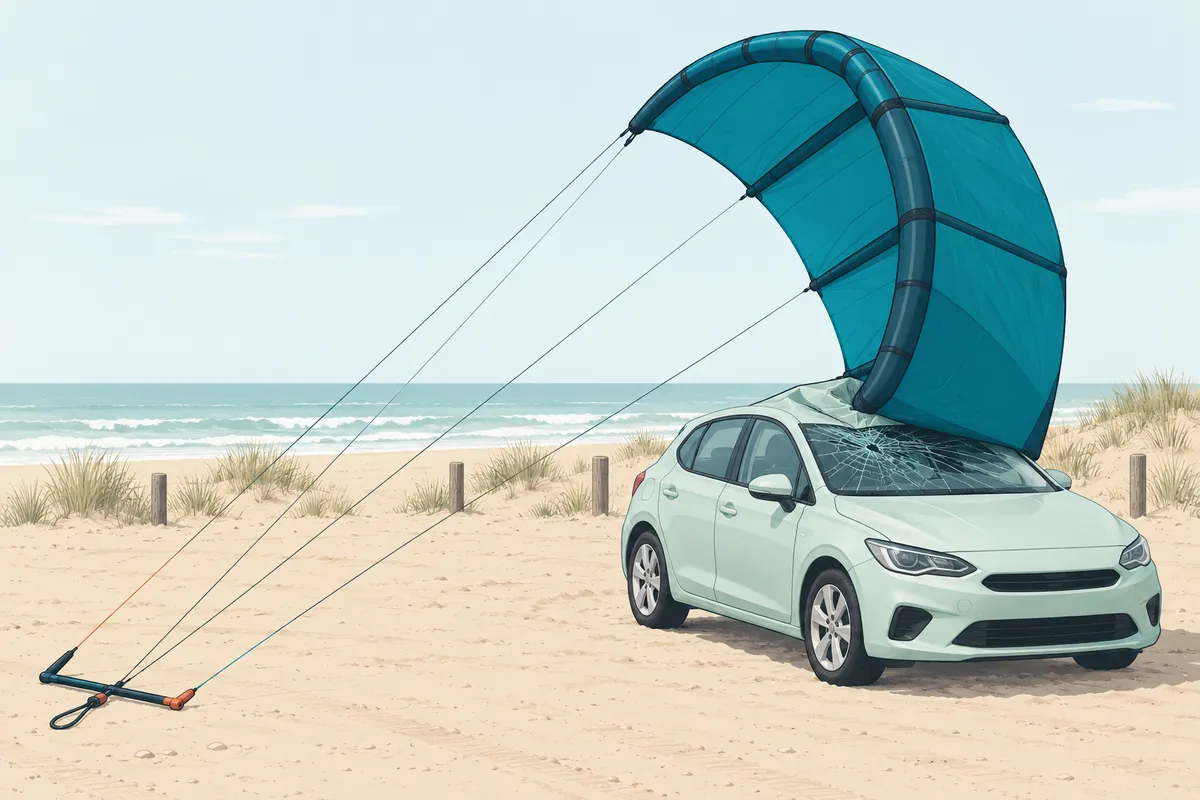
The insurance that matters in kitesurfing is third-party liability, not gear cover and not your own injuries. A looping, riderless 12 m kite can total a parked car or injure a child on the beach, and in most jurisdictions you pay for all of it.
In many countries a kitesurfer counts legally as a sailing vessel, which brings maritime right-of-way rules, harbour bylaws, and, after a collision, the same duty to stop and exchange details as a driver after a car accident. Liability cover is cheap and often already bundled with something you hold:
| Route | What you get | Notes |
|---|---|---|
| IKO insurance programme | Roughly €3 million combined personal-injury and property-damage third-party cover, 2026 | Valid for kitesurfing, snowkiting and windsurfing, worldwide, with IKO membership |
| RYA membership, UK | Third-party cover for kitesurfing, kite foiling, wing surfing and wing foiling included in the membership, 2026 | The membership card doubles as proof of cover at regulated spots |
| National kite association or club | Liability cover bundled into the membership fee in many countries, Germany, the Netherlands and France among them | Many German and Dutch spots want proof of liability insurance before you launch |
| Household or personal liability policy | Some private policies cover non-motorised watersports | Read the exclusions. Many carve out kite sports by name |
Travel and medical insurance is the second layer and the one that catches people out. Standard policies almost always exclude kitesurfing under hazardous activities, and a helicopter evacuation or a foreign hospital stay runs into six figures.
Buy a policy that names kitesurfing, or an active-sports tier that lists it, and check whether it covers competition, offshore riding and foiling. The third layer is gear cover for theft from vehicles and airline damage, sometimes a rider on home contents insurance, sometimes a standalone policy.
If you are in a collision, stop, help, and exchange details exactly as you would in a car. Take photos, note witnesses, and report it to the spot's club or authority.
Fault is usually assessed against the right-of-way rules in the etiquette chapter, which is one more reason to know them cold. Where a spot demands proof of insurance before you launch, the spot page is where that is written: 1,314 of the 1,504 spots in the atlas carry a dated rules-and-access note.
More from Field Notes & Extras
The other articles in this chapter- Why does kite power increase with the square of wind speed?
- Kitesurfing competitions and the pro tour
- Kitesurfing insurance and liability
- Kitesurfing fitness and injury prevention
- First aid on the beach and in the water
- Beach access, wildlife rules and how spots get banned
- Flying with kite gear and planning kite trips
- How much does kitesurfing cost?
- Kitesurfing history, community and jargon
The Fundamentals · Learning the Sport · The Gear · Buying Gear & Keeping It Alive · Tech & Innovation · Wind, Weather & Water · Safety & Risk · When Things Go Wrong · Rules & Etiquette · Advanced Riding · Spots of the World · Practical Tricks & Life Hacks · The Video Library · Field Notes & Extras