Map › Guides › Field Notes & Extras › Kitesurfing history, community and jargon
The Kitesurfing Compendium · Field Notes & Extras
Kitesurfing history, community and jargon
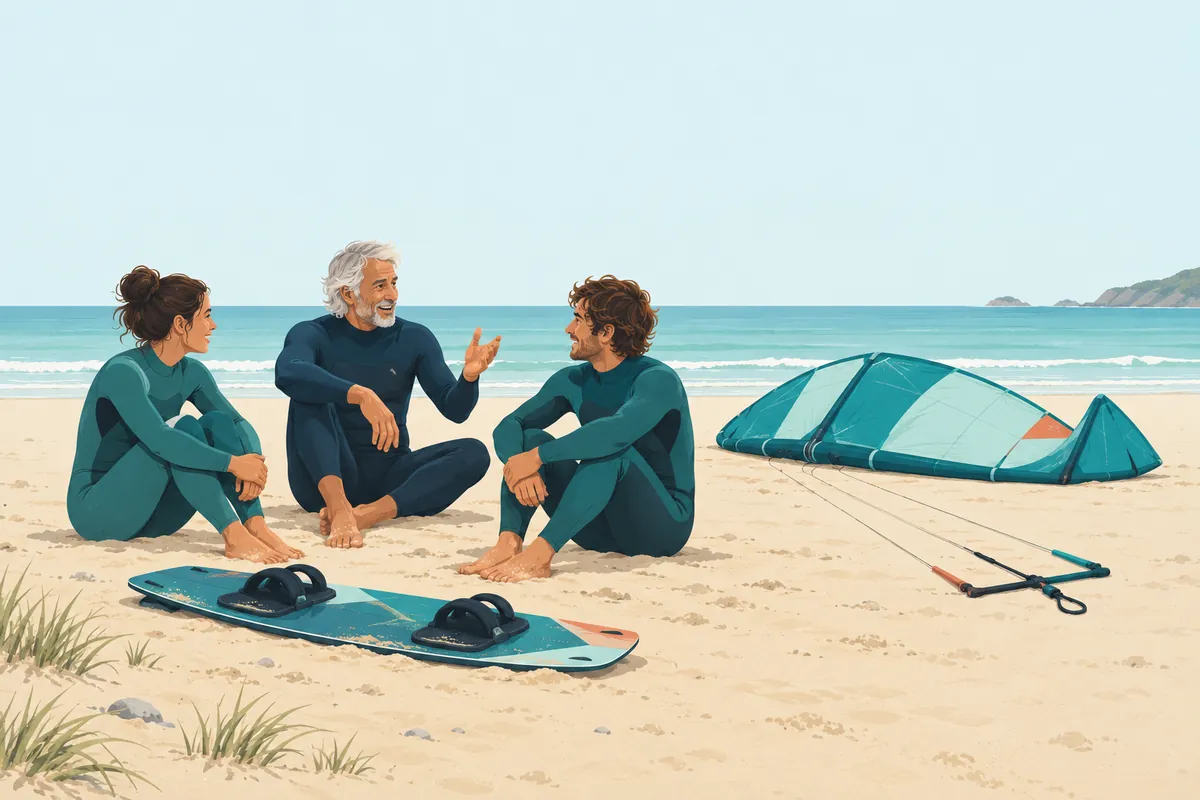
Kitesurfing is young enough that its founders still ride. The working history fits in five beats.
- 1980s, the patent. The Breton brothers Bruno and Dominique Legaignoux develop and patent the inflatable-leading-edge kite, the water-relaunchable design that makes the sport possible, years before anyone can buy one.
- Early 1990s to 1997, proof of concept. Cory Roeseler's KiteSki tows water skis in the Columbia River Gorge, Manu Bertin and Laird Hamilton ride early inflatable prototypes off Maui, and Tarifa becomes the European proving ground. The Legaignoux design reaches shops under the brothers' own Wipika brand in 1997, and the first commercial boom follows.
- Early 2000s, the wild years. Explosive growth on gear with crude depower and no reliable release, a run of serious accidents, and kitemare headlines that threaten beach access worldwide.
- Mid-2000s, the safety revolution. The bow and flat-kite generation, another Legaignoux design, brings near-total depower. Push-away quick releases, flag-out systems and standardised instruction change the risk profile and end the era when kitesurfing deserved its extreme reputation. That standardisation is still visible in the atlas: of 1,606 schools, 549 name IKO certification and 136 name VDWS.
- 2010s to today, diversification. Freestyle, big air, strapless wave riding, hydrofoils and Olympic racing each mature into their own worlds, while the old kite-versus-windsurf culture war dissolves into a shared wind-sports identity, helped along by wing foiling taking riders from both.
Finding your people
The social layer is not decoration. The buddy system is a safety tool, and community is how spots stay open. Entry points:
- Spot groups: nearly every spot has a WhatsApp or Telegram group where locals call sessions and report hazards. Ask any rider on the beach to add you. It is the fastest way in.
- Clubs: membership bundles community, insurance and access advocacy into one fee, the best value in the sport after lessons.
- Online: the long-running general kite forums for gear archaeology, broader Q&A boards for beginner questions and honest gear talk, and manufacturer groups for model-specific tuning.
- Women's kiteboarding: women-only camps and coaching weeks are a growing part of the sport, and riders who use them report a friendlier, faster learning environment. Only four schools in the atlas describe a women's programme by name, so the scene is bigger than the listings. Ask at major spots.
- Kids: 78 schools in the atlas list a kids course, concentrated in France, Spain and Italy. Minimum ages are set school by school and are reportedly around 8 to 12 years, but weight matters more than age, because a light rider gets lofted in a gust. The trainer-kite years before that are where future big-air riders are made.
- Adaptive kiting: sit-ski style boards, adapted harness systems and specialist instructors make the sport reachable for riders with limb loss and spinal injuries. Two schools in the atlas describe an adaptive programme by name, so this is a thin corner of the sport. Ask directly rather than assuming.
Filming your sessions
A little technique separates watchable clips from nausea. A line mount, a camera clamped a few metres up the front lines and pointing back, gives the classic third-person angle; helmet and mouth mounts trade immersion for stability. Follow drones produce the best footage and demand real piloting skill and legal care, because drone rules over crowded beaches are strict almost everywhere.
For numbers, wrist and board sensors and phone apps gamify height and airtime. Accuracy varies by device and conditions, so treat the figures as consistent with themselves rather than as laboratory truth. As a progression tracker they are excellent.
A pocket glossary
| Term | Meaning |
|---|---|
| Sheeting | Pulling the bar in for power or easing it out to depower, changing the kite's angle of attack |
| Sine-ing | Flying the kite in S-curves through the power zone to make apparent-wind power in light air |
| Sending it | Steering the kite hard back past twelve to load a jump, and colloquially, committing hard to anything |
| Lofted | Lifted off the ground involuntarily by a gust with the kite overhead, the accident the safety chapter exists to prevent |
| Tea-bagging | Being repeatedly dunked and lifted in underpowered or gusty conditions |
| Kook | A rider oblivious to etiquette, rules and their own limits. Do not be one |
| Flagging out | Releasing the kite onto one line via the safety system so it loses all power |
| Apparent wind | The wind the kite actually feels: true wind plus the wind of its own motion |
More from Field Notes & Extras
The other articles in this chapter- Why does kite power increase with the square of wind speed?
- Kitesurfing competitions and the pro tour
- Kitesurfing insurance and liability
- Kitesurfing fitness and injury prevention
- First aid on the beach and in the water
- Beach access, wildlife rules and how spots get banned
- Flying with kite gear and planning kite trips
- How much does kitesurfing cost?
- Kitesurfing history, community and jargon
The Fundamentals · Learning the Sport · The Gear · Buying Gear & Keeping It Alive · Tech & Innovation · Wind, Weather & Water · Safety & Risk · When Things Go Wrong · Rules & Etiquette · Advanced Riding · Spots of the World · Practical Tricks & Life Hacks · The Video Library · Field Notes & Extras