Map › Guides › Field Notes & Extras › Kitesurfing fitness and injury prevention
The Kitesurfing Compendium · Field Notes & Extras
Kitesurfing fitness and injury prevention
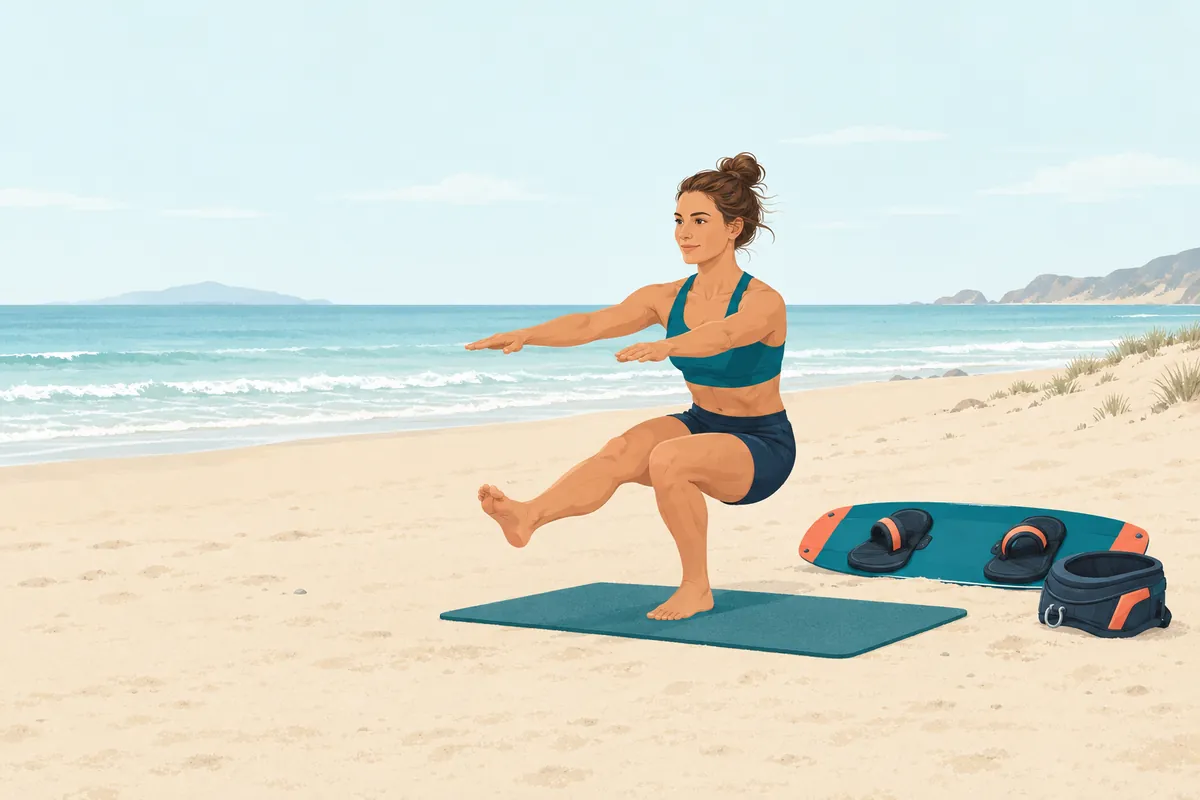
Kitesurfing fitness is balance, core stability, coordination and the eccentric leg strength to absorb landings. It is not raw pulling strength, because the harness takes the kite's pull. Two or three sessions a week of about an hour is the baseline that shows up in your riding.
- Core: planks and side planks, dead bugs, anti-rotation work such as pallof presses. Your core is what holds edge tension against the harness for hours.
- Balance: single-leg work on a balance board or Bosu, single-leg deadlifts. This is the closest dry-land analogue to riding chop.
- Legs for landings: squats and lunges, then, once those are solid Intermediate, box jumps and drop-landings that train the knees to absorb impact the way a hard landing demands.
- Mobility: hips, hamstrings and thoracic spine, which harness posture slowly stiffens.
Around a session, the pattern that keeps riders injury-free is boring and consistent. A dynamic warm-up before riding, meaning leg swings, lunges, arm circles and a brisk walk up the beach, never static stretching on cold muscles. Static stretching and foam rolling after, when the muscles are warm and actually lengthen. Several kite and wetsuit brands publish free conditioning programmes built on exactly this pattern.
The sport's weak points, in order: knees, where the ACL is kiting's signature serious injury on hard flat landings, lower back, from harness posture and being pulled through chop, and shoulders, from bodydrags, crashes and one-armed bar work. Train the muscles around each, and follow the progression chapter on landing mechanics: knees bent, board slightly downwind, absorbing through the legs.
Rider-body realities
- First week of lessons: expect forearm and grip fatigue that feels alarming. It fades within days as you stop strangling the bar, and a kite with lighter bar pressure helps while it does.
- Kiting at 50 and over: entirely realistic, because the harness does the heavy work. Recovery takes longer and warm-ups stop being optional. Bigger kites in moderate wind beat small kites in survival wind.
- Heavier or lighter than average: kite size scales with rider weight, and the gap is bigger than beginners expect. In 14–16 knots the book's reference table puts a rider under 65 kg on an 11 m and an 80–95 kg rider on a 14 m. That is 3 m² of canopy in the same wind. Every size chart in this book assumes a 75 kg reference rider; adjust to your own mass.
- Pregnancy: the harness sits exactly where it should not and crash forces are unpredictable. Most riders and physicians agree on stopping early. Talk to your doctor, and take trainer-kite time on the beach instead.
- Returning from an ACL or ankle injury: finish formal rehab first, then come back through light-wind, big-board cruising with no jumps for several weeks. Re-injury usually comes from jumping too soon, not from riding too soon.
More from Field Notes & Extras
The other articles in this chapter- Why does kite power increase with the square of wind speed?
- Kitesurfing competitions and the pro tour
- Kitesurfing insurance and liability
- Kitesurfing fitness and injury prevention
- First aid on the beach and in the water
- Beach access, wildlife rules and how spots get banned
- Flying with kite gear and planning kite trips
- How much does kitesurfing cost?
- Kitesurfing history, community and jargon
The Fundamentals · Learning the Sport · The Gear · Buying Gear & Keeping It Alive · Tech & Innovation · Wind, Weather & Water · Safety & Risk · When Things Go Wrong · Rules & Etiquette · Advanced Riding · Spots of the World · Practical Tricks & Life Hacks · The Video Library · Field Notes & Extras