Map › Guides › Field Notes & Extras › Why does kite power increase with the square of wind speed?
The Kitesurfing Compendium · Field Notes & Extras
Why does kite power increase with the square of wind speed?
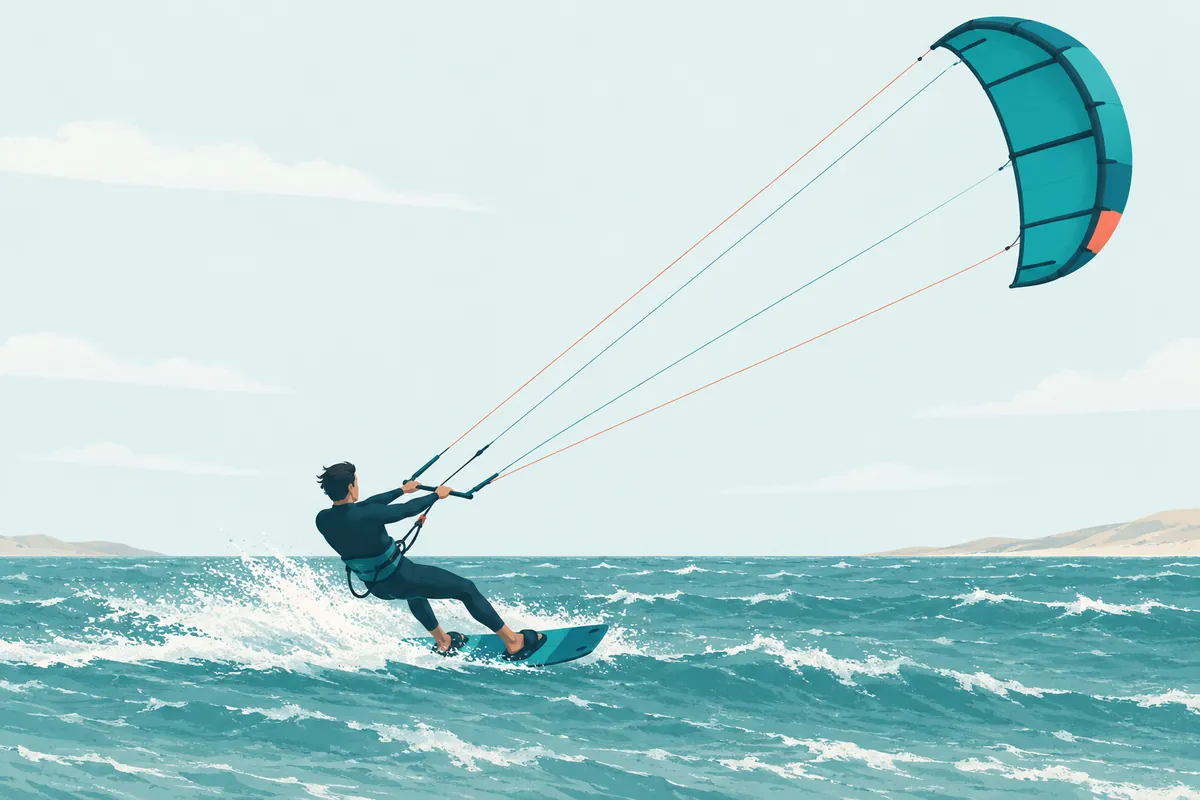
Kitesurfing physics is three ideas: a kite is a wing, its pull grows with the square of the wind speed, and a moving kite makes its own wind. Those three explain gust behaviour, kite sizing, kiteloops and why edging takes you upwind.
A kite is a wing. It meets the air at an angle and deflects it downwards, and the reaction is a large force roughly across the airflow, called lift, plus a smaller one along it, called drag. The bridle and lines hold the canopy at that angle, and sheeting the bar in steepens it, which is why pulling the bar in powers you up and pushing it away depowers you.
Two consequences matter every session:
- Force scales with the square of wind speed. Going from 18 to 25 knots does not add a bit more power. It nearly doubles it, because 25² divided by 18² is about 1.9. That ratio is why a 5-knot gust feels violent, why one kite size covers only a narrow band of wind, and why riders size for the top of the forecast rather than the average.
- A moving kite makes its own wind. The airflow the kite feels, its apparent wind, is the true wind plus the wind created by the kite's own motion. Dive the kite through the power zone and its airspeed reaches two or three times the true wind, and since force goes with the square, the pull multiplies several times over. That is the basis of sine-ing in light air, the violence of a kiteloop, and how Formula Kite racers on foils sail faster than the wind.
The wind window is the quarter-sphere of sky downwind of you in which the kite can fly, and its radius is your line length, usually 22–24 m.
At the edge of the window the kite meets the wind almost side-on and makes little force; in the centre of the power zone it faces the wind squarely and makes the most. Every launch position and every instruction in this book to park the kite at twelve is that geometry applied.
The other half of the system is underwater. Your board edge is a second wing. Held on edge it makes lateral resistance that opposes the kite's pull, and the sum of the two forces lets you travel across the wind and, on a good day, 10–20 degrees upwind of a beam reach, roughly 70 to 80 degrees off the wind direction.
Edge harder and the course points further upwind; flatten the board and it releases, which is why you bear away to build speed before a jump.
More from Field Notes & Extras
The other articles in this chapter- Why does kite power increase with the square of wind speed?
- Kitesurfing competitions and the pro tour
- Kitesurfing insurance and liability
- Kitesurfing fitness and injury prevention
- First aid on the beach and in the water
- Beach access, wildlife rules and how spots get banned
- Flying with kite gear and planning kite trips
- How much does kitesurfing cost?
- Kitesurfing history, community and jargon
The Fundamentals · Learning the Sport · The Gear · Buying Gear & Keeping It Alive · Tech & Innovation · Wind, Weather & Water · Safety & Risk · When Things Go Wrong · Rules & Etiquette · Advanced Riding · Spots of the World · Practical Tricks & Life Hacks · The Video Library · Field Notes & Extras