Map › Guides › Rules & Etiquette › Kitesurfing hand signals for launching and landing
The Kitesurfing Compendium · Rules & Etiquette
Kitesurfing hand signals for launching and landing
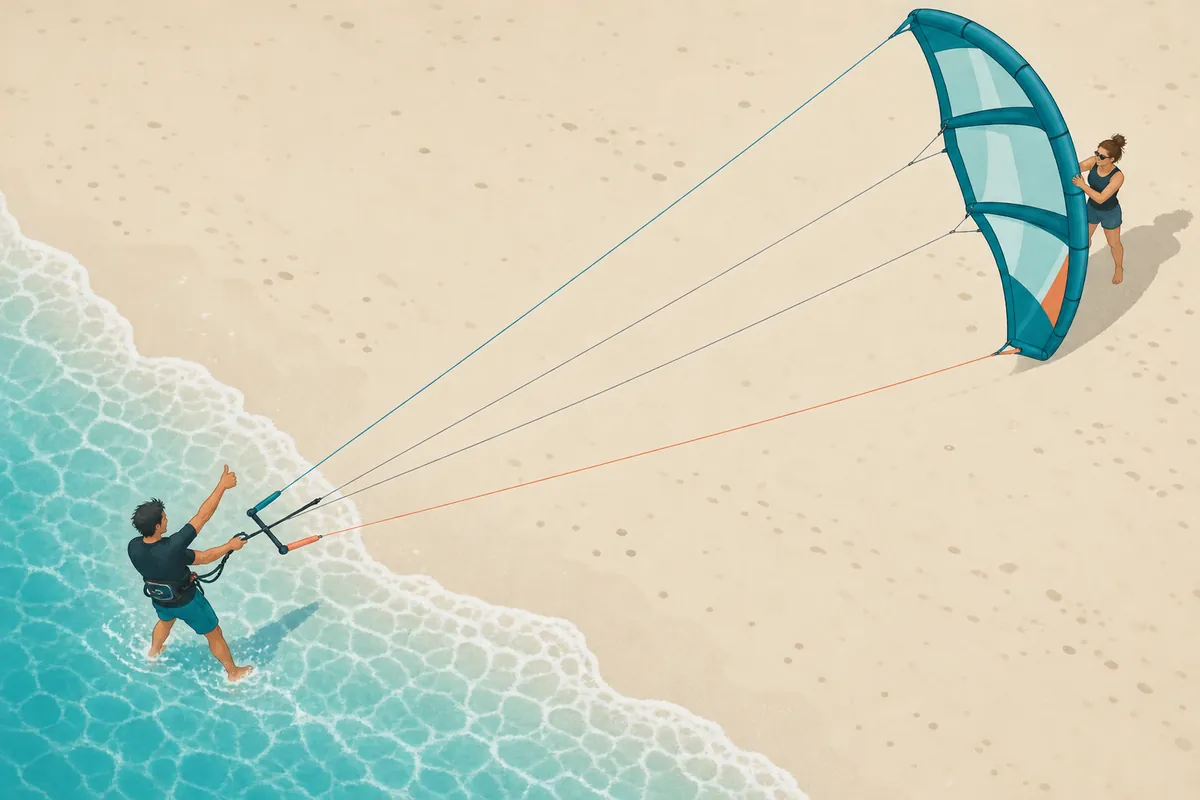
Beginner Assisted launching and landing is the social glue of the sport. If you see a rider walking up the beach with the kite low, or standing at the water's edge looking for eye contact, help them.
It costs 30 seconds, and one day soon it will be you. A non-kiter can be trained as a helper in a minute, but the pilot briefs them and the pilot owns the launch. Agree the plan before the kite comes up; don't scream instructions down the beach.
The signal vocabulary is the same at spots worldwide:
- Launch: thumbs-up from the pilot. The pilot, never the helper, gives a clear thumbs-up when the kite is at the correct angle and the lines are checked (the full assisted launch sequence is in the fundamentals chapter). The assistant then releases the kite smoothly, no throwing it upward. The golden rule: no signal counts until it is acknowledged, and the assistant must never let go before the pilot's thumbs-up.
- Land: tap a flat hand on top of your head. This means "I want to land". The catcher repeats the signal back, positions downwind, and the rider brings the kite slowly down the edge of the window into their hands. Grab the centre strut or a wingtip, never the lines or bridles.
- Not ready or abort: a flat-hand "cut" wave, or crossed arms. Set the kite back down and reset. Either party can abort at any time.
- Distress on the water: both arms waved slowly overhead in a wide arc. This means "I cannot self-rescue, I need help". If you see it, respond or alert someone who can.
When is it fair to self-launch?
Advanced Self-launching (the sand-anchor method and the kite-drag method) and self-landing are legitimate advanced skills, for empty beaches. When other kiters are standing 20 metres away, self-launching reads as either showing off or antisocial, and it is objectively higher-risk: a mistimed self-launch sends an unpiloted kite downwind through whoever is there.
Watch · 3


More from Rules & Etiquette
The other articles in this chapter- Kitesurfing right of way rules
- Where to rig, launch and park your kite
- Kitesurfing hand signals for launching and landing
The Fundamentals · Learning the Sport · The Gear · Buying Gear & Keeping It Alive · Tech & Innovation · Wind, Weather & Water · Safety & Risk · When Things Go Wrong · Rules & Etiquette · Advanced Riding · Spots of the World · Practical Tricks & Life Hacks · The Video Library · Field Notes & Extras