Map › Guides › Advanced Riding › How to jump on a kiteboard
The Kitesurfing Compendium · Advanced Riding
How to jump on a kiteboard
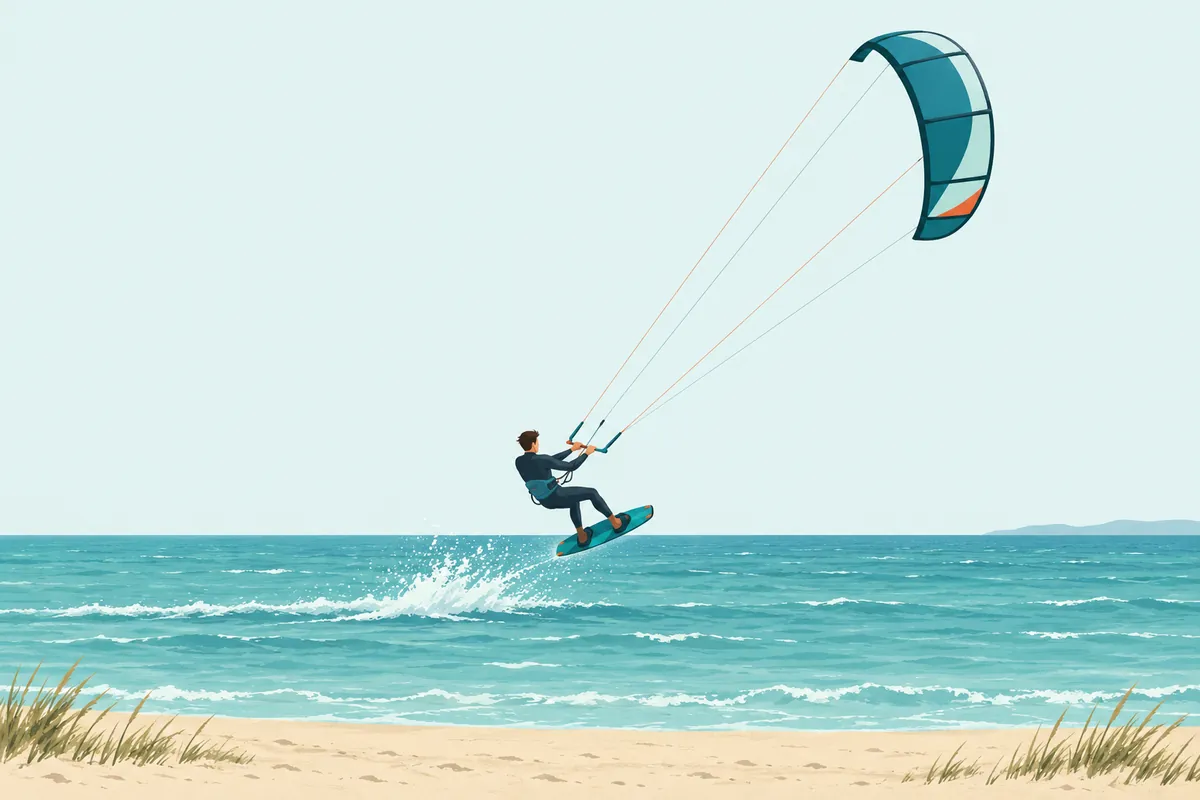
Intermediate A first jump is learnable in one good session if the conditions are right: roughly 15–20 knots of steady side-onshore wind, a kite at the top of its comfortable range (a 12 m in 15–25 knots is the classic learning setup), and flat-ish water with plenty of room downwind. The move has three beats.
- Load. Ride across the wind with good speed, then carve progressively upwind and edge hard: heels dug in, body leaning back and out, lines coming under visible tension. Coaches call it the J-hook, because your wake curves upwind like the tail of a J.
- Send, with the bar out. Steer the kite quickly from its riding position, around 10:30 or 1:30, up toward 12 o'clock, and do it with the bar sheeted out. That lets the kite travel fast to the zenith without ripping you off your edge early.
- Pop and sheet in. As the kite approaches 12, explode off your back leg, pull your front knee up, and sheet the bar all the way in at the same moment. Line tension from your edge, lift from the send and your own pop turn horizontal speed into height.
Timing. You want the kite arriving at 12 exactly as you commit. Late, and you get dragged flat off your edge with no lift. Early, and you get lofted off balance. Almost every failed first jump is one of two errors: pulling the bar in before the edge is loaded, or hucking, which means throwing the body at the trick instead of trusting the sequence.
In the air and landing. Keep the bar sheeted in for the whole flight, because canopy tension is what keeps the kite flying and you underneath it. For the first few, leave the kite near 12 and land.
Once landings feel controlled, add the redirect: as you start to descend, steer the kite forward in your direction of travel, back toward 10:30 or 1:30, so you land moving, board pointing slightly downwind, knees soft, the way a wakeboarder absorbs a wake.
How to jump higher
Height comes from refinement, not violence.
- More speed in, harder edge. Height scales with line tension at the moment of release. Approach faster, carve upwind harder, hold the edge a beat longer.
- Sharper send. A quicker, more decisive pull on the back hand makes the kite generate more lift as it sweeps up through the window.
- Ride powered. At the top of your kite's range the lift is easy. Underpowered, only perfect technique buys you modest height.
- Kite choice matters. Five-strut, high-aspect kites, the modern big air school, boost higher and hang longer than three-strut freeride kites.
- Learn the downloop landing. From moderate height, as you descend, loop the kite down and away in your direction of travel. It traces a tight circle above and in front of you and pulls you forward into a soft, fast, downwind landing. It is a skill in its own right, the second rung of the kiteloop ladder below, and it is what makes bigger jumps survivable.
For reference: recreational riders with good technique boost 5–10 m, and competition big air riders in Cape Town storm winds pass 25–30 m.
Watch · 2


FAQ
How much wind do I need to learn to jump?
Roughly 15 to 20 knots of steady side-onshore wind, with a kite at the top of its comfortable range; a 12 m in 15 to 25 knots is the classic setup. Flat-ish water and plenty of room downwind matter as much as the number does.
Why does my kite not lift me when I send it?
Almost always timing: you are sheeting the bar in before the edge is loaded, or sending while the board is flat. Exaggerate the upwind J-hook carve, send with the bar out, and sheet in only as the kite reaches 12.
More from Advanced Riding
The other articles in this chapter- How to jump on a kiteboard
- How to ride unhooked and land a raley
- How to learn a kiteloop safely
- How to stop plateauing
The Fundamentals · Learning the Sport · The Gear · Buying Gear & Keeping It Alive · Tech & Innovation · Wind, Weather & Water · Safety & Risk · When Things Go Wrong · Rules & Etiquette · Advanced Riding · Spots of the World · Practical Tricks & Life Hacks · The Video Library · Field Notes & Extras